AdvancedQuantitative Aptitude · Lesson 35 of 38 · Updated ·
True Discount and Banker's Discount — Present Worth Made Simple
Suppose a shopkeeper must pay you ₹1,120 two years from now. How much is that promise worth today? If money earns 6% simple interest a year, ₹1,000 today grows into exactly ₹1,120 in two years. So the promise is worth ₹1,000 now.
That idea — the value today of money due later — is the whole topic. It appears in bank exams, older campus papers and commerce/business-maths courses. Everything here uses simple interest (SI), which the earlier interest lesson covered.
1. Present worth and true discount
| Term | Meaning |
|---|---|
| Amount due (A) | the money to be paid on a future date (also called the face value of the bill or the debt) |
| Present worth (PW) | the money which, put at interest now, grows into A by the due date |
| True discount (TD) | A − PW, i.e. the interest earned on PW |
With rate R% per year and time T years:
PW = 100 × A ÷ (100 + R × T) TD = A − PW = A × R × T ÷ (100 + R × T)
Why: PW grows to A, so A = PW + PW × R × T/100 = PW × (100 + RT)/100. Solve for PW.
Example 1
Find the present worth and true discount of ₹1,120 due in 2 years at 6% per annum.
R × T = 12. PW = 100 × 1,120 ÷ 112 = ₹1,000. TD = 1,120 − 1,000 = ₹120. Check: SI on ₹1,000 for 2 years at 6% = ₹120. ✓
Remember: TD is the interest on the present worth, not on the amount.
2. Banker's discount
When a trader holds a bill (a written promise of payment) that is due later, he can sell it to a bank today. The bank does not use the fair present worth. It simply deducts interest on the full amount A for the remaining time. That deduction is the banker's discount.
Banker's discount BD = SI on A = A × R × T ÷ 100 Banker's gain BG = BD − TD
Because BD is interest on A and TD is interest on the smaller PW, BD is always bigger than TD. The bank's extra profit is the banker's gain.
Example 2
A bill for ₹1,090 is due in 9 months. The rate is 12% per annum. Find TD, BD and BG.
T = 9/12 = 3/4 year, so R × T = 9. PW = 100 × 1,090 ÷ 109 = ₹1,000. TD = ₹90. BD = 1,090 × 9 ÷ 100 = ₹98.10. BG = 98.10 − 90 = ₹8.10.
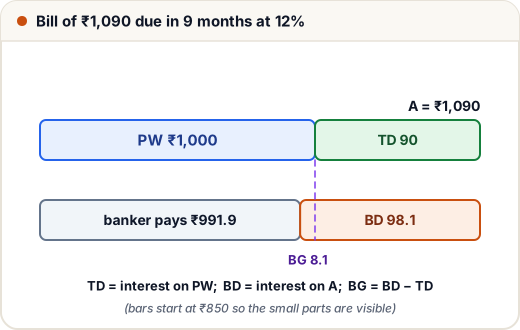
Bills and days of grace: many textbook questions on bills of exchange add 3 days of grace to the stated due date before counting the time. Apply this only when the question mentions bills with a due date, or says so explicitly.
3. The relations that solve most questions
These follow from the definitions above. Learn them; they turn three-line problems into one line.
| Relation | In words |
|---|---|
| BG = SI on TD | the banker's gain is interest on the true discount |
| BG = TD² ÷ PW | so PW = TD² ÷ BG |
| A = BD × TD ÷ (BD − TD) | amount from BD and TD |
| TD = BG × 100 ÷ (R × T) | true discount from banker's gain |
| TD = √(PW × BG) | TD is the geometric mean of PW and BG |
Check with Example 2: TD² ÷ PW = 90² ÷ 1,000 = 8.1 = BG. ✓ And SI on 90 for 9 months at 12% = 90 × 9 ÷ 100 = 8.1. ✓
Example 3
The true discount on a bill is ₹120 and the banker's gain is ₹24. Find the amount of the bill.
PW = TD² ÷ BG = 14,400 ÷ 24 = 600. A = PW + TD = ₹720. Other way: BD = TD + BG = 144, so A = 144 × 120 ÷ 24 = 720. ✓
Example 4
The SI on a sum for some time is ₹88 and the true discount on the same sum for the same time and rate is ₹80. Find the sum.
SI on the sum plays the role of BD. Sum = SI × TD ÷ (SI − TD) = 88 × 80 ÷ 8 = ₹880.
4. Cash now or more money later?
This is the most practical use of present worth. To compare money at different times, bring everything to today and compare the present worths.
Example 5
A scooter is offered for ₹12,000 cash, or ₹12,880 paid after 8 months. Money earns 18% per annum simple interest. Which is better for the buyer?
R × T = 18 × 8/12 = 12. PW of ₹12,880 = 100 × 12,880 ÷ 112 = ₹11,500.
Paying later costs only ₹11,500 in today's money, which is less than ₹12,000. So buying on credit is better for the buyer — he can keep ₹11,500 invested and it will grow to ₹12,880 by the payment date.
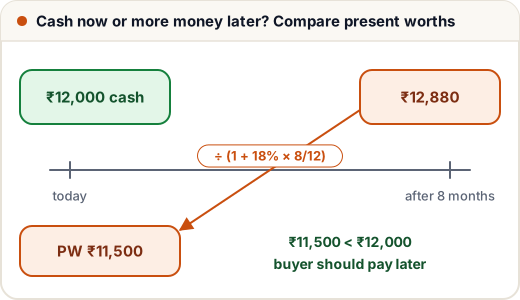
The picture also shows the seller's view: if he needs the money today, the cash offer (₹12,000) is worth more to him.
5. A quick method
- Convert months to years (9 months = 3/4) and find R × T.
- PW = 100A ÷ (100 + RT). TD = A − PW.
- BD = A × RT ÷ 100. BG = BD − TD.
- If only two of TD, BD, BG, PW are given, use the relation table.
Common mistakes
- Taking TD as interest on A. That is the banker's discount. TD is interest on PW.
- Forgetting to convert months into years before multiplying R × T.
- Subtracting in the wrong order: BG = BD − TD, and BD is always the larger.
- Comparing ₹12,000 now with ₹12,880 later directly. Compare present worths.
- Adding 3 days of grace when the question does not mention a bill or a due date.
Quick recap
- PW = 100A/(100 + RT); TD = A − PW = interest on PW.
- BD = interest on A = ART/100; BG = BD − TD.
- BG = interest on TD = TD²/PW; A = BD × TD/(BD − TD).
- To compare payments at different times, compare their present worths.