Quantitative Aptitude · Lesson 14 of 18 · Updated ·
Permutations and Combinations — When to Arrange and When to Choose
This chapter is about counting the ways something can happen — without listing them all.
1. The counting principle
If one thing can be done in m ways and, after it, another in n ways, both can be done in m × n ways (AND → multiply). If you do either one or the other, it is m + n ways (OR → add).
Example 1
A shirt comes in 4 colours and 3 sizes. How many different shirts? 4 × 3 = 12.
Example 2
You can travel Jaipur → Delhi by 3 trains or 2 buses. How many ways? 3 + 2 = 5.
2. Factorial
n! = n × (n − 1) × … × 2 × 1. So 5! = 120, 4! = 24, 3! = 6, 0! = 1.
3. Arrange (permutation) vs choose (combination)
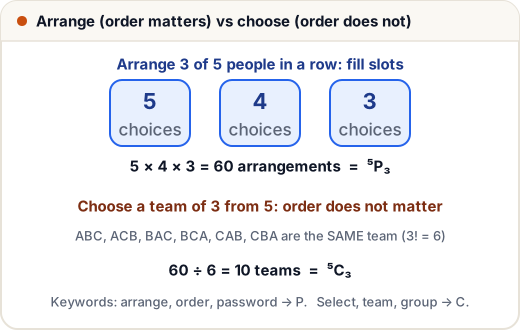
| Order matters? | Formula | Keywords | |
|---|---|---|---|
| Permutation | Yes | ⁿPᵣ = n! ÷ (n − r)! | arrange, order, rank, password, seating, digits of a number |
| Combination | No | ⁿCᵣ = n! ÷ (r! (n − r)!) | select, choose, team, committee, group, handshakes |
ⁿCᵣ = ⁿPᵣ ÷ r! — choosing is arranging, then ignoring the r! orders.
Useful facts: ⁿCᵣ = ⁿCₙ₋ᵣ (choosing 8 of 10 = leaving out 2 of 10), ⁿC₀ = ⁿCₙ = 1.
Example 3
How many 3-digit numbers can be made from 1, 2, 3, 4, 5 without repeating a digit?
Order matters: ⁵P₃ = 5 × 4 × 3 = 60.
Example 4
In how many ways can a committee of 3 be chosen from 8 people?
⁸C₃ = (8 × 7 × 6) ÷ (3 × 2 × 1) = 56.
4. Arranging letters of a word
n letters, all different → n! ways. If some letters repeat, divide by the factorial of each repeat count.
Example 5
How many arrangements of the letters of LEVEL?
5 letters: L twice, E twice → 5! ÷ (2! × 2!) = 120 ÷ 4 = 30.
Example 6 — letters together
In how many arrangements of the word APPLE do the vowels come together?
Vowels A, E → tie them as one block. Items: [AE], P, P, L = 4 items with P twice → 4!/2! = 12. Inside the block, A and E swap: × 2 → 24.
5. Circular arrangements
Around a round table, rotating everyone gives the same seating, so fix one person: (n − 1)! ways.
Example 7
In how many ways can 6 friends sit around a round table? (6 − 1)! = 120.
6. Committees with conditions
Example 8
From 5 men and 4 women, a committee of 3 must have at least 1 woman. How many ways?
Total − (no women) = ⁹C₃ − ⁵C₃ = 84 − 10 = 74.
"At least one" → total minus "none". Much faster than adding cases.
Example 9 — handshakes
10 people each shake hands once with everyone else. How many handshakes? ¹⁰C₂ = 45.
Common mistakes
- Using P when the order doesn't matter (teams, groups) — or C when it does (passwords, rankings).
- Forgetting to divide for repeated letters.
- Forgetting to arrange the people inside a "together" block.
Quick recap
- AND → multiply, OR → add.
- Order matters → ⁿPᵣ; order doesn't → ⁿCᵣ = ⁿPᵣ / r!.
- Repeated letters: n! ÷ (p! q! …).
- Round table: (n − 1)!.
- "At least one" = total − none.