Quantitative Aptitude · Lesson 11 of 18 · Updated ·
Time, Speed and Distance — Formulas, Relative Speed and Tricks
Every question in this chapter comes from one formula.
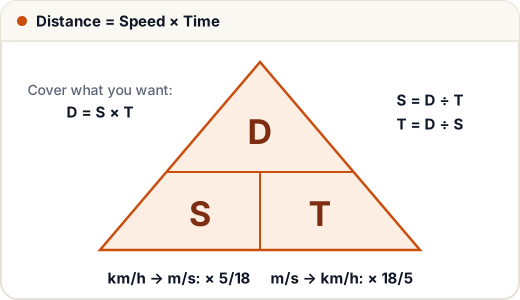
Distance = Speed × Time → Speed = D ÷ T, Time = D ÷ S
1. Units
- km/h → m/s: × 5/18 (72 km/h = 72 × 5/18 = 20 m/s)
- m/s → km/h: × 18/5 (15 m/s = 15 × 18/5 = 54 km/h)
Always check that distance, speed and time are in matching units before calculating.
Example 1
A bus covers 180 km in 3 hours 45 minutes. Find its speed.
3 h 45 min = 3.75 h → speed = 180 ÷ 3.75 = 48 km/h.
2. Speed and time are inverses
For the same distance, if speed is multiplied by k, time is divided by k.
Example 2
Walking at 3/4 of his usual speed, a man is 20 minutes late. What is his usual time?
New speed = ¾ → new time = 4/3 of usual. The extra ⅓ of the usual time = 20 min → usual time = 60 minutes.
Example 3 — late and early
At 40 km/h a student reaches school 6 minutes late. At 60 km/h, 4 minutes early. Find the distance.
The time difference is 6 + 4 = 10 minutes = 1/6 hour.
D/40 − D/60 = 1/6 → (3D − 2D)/120 = 1/6 → D = 20 km.
3. Average speed
Total distance ÷ total time. For the same distance at speeds a and b:
Average speed = 2ab ÷ (a + b)
Example 4
A cyclist rides 12 km at 6 km/h and then 12 km at 12 km/h. Average speed?
2 × 6 × 12 ÷ 18 = 8 km/h. (Check: time = 2 + 1 = 3 h for 24 km ✓)
4. Relative speed
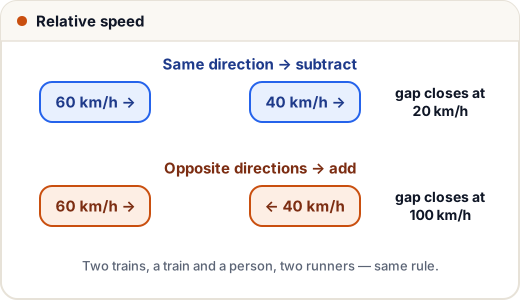
- Same direction → subtract the speeds
- Opposite directions → add the speeds
Example 5 — meeting
Two people start 90 km apart and walk towards each other at 5 km/h and 4 km/h. When do they meet?
Relative speed = 9 km/h → time = 90 ÷ 9 = 10 hours.
Example 6 — chasing
A thief runs at 8 km/h. A policeman starts chasing him 15 minutes later at 10 km/h. How long until he catches him?
Head start = 8 × ¼ = 2 km. Relative speed = 2 km/h → time = 2 ÷ 2 = 1 hour.
5. Ratio thinking
If two people race for the same time, distances are in the ratio of speeds. If they cover the same distance, times are in the inverse ratio of speeds.
Example 7
The speeds of A and B are in the ratio 3 : 4. A takes 20 minutes more than B to reach a place. How long does A take?
Time ratio = 4 : 3. The difference of 1 part = 20 min → A = 4 × 20 = 80 minutes.
6. Races
"A beats B by 20 m in a 100 m race" means when A finishes 100 m, B has run 80 m. So their speeds are in the ratio 100 : 80 = 5 : 4.
Example 8
In a 1 km race, A beats B by 100 m and B beats C by 100 m. By how much does A beat C?
When A runs 1000, B runs 900. When B runs 1000, C runs 900 → when B runs 900, C runs 810. So A beats C by 1000 − 810 = 190 m.
Common mistakes
- Mixing km/h with metres and seconds. Convert first.
- Averaging speeds as (a + b)/2.
- Adding speeds for people moving in the same direction.
Quick recap
- D = S × T; × 5/18 for km/h → m/s.
- Same distance: time ∝ 1/speed.
- Same distance twice: average speed = 2ab/(a + b).
- Same direction subtract, opposite direction add.