Quantitative Aptitude · Lesson 17 of 18 · Updated ·
Mensuration — Area, Perimeter, Volume and Surface Area (2D and 3D)
Mensuration means measuring shapes: how much space they cover (area), the length around them (perimeter), and for solid objects how much they hold (volume) and how much wrapping they need (surface area).
1. 2D shapes
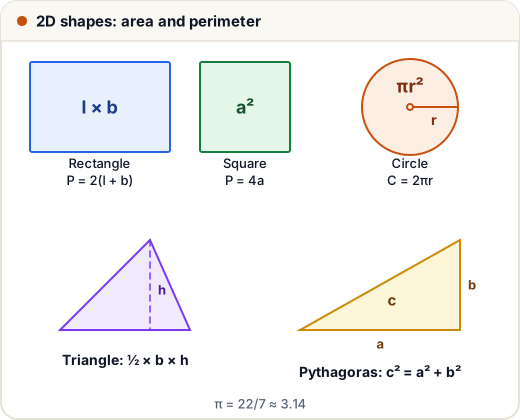
| Shape | Area | Perimeter |
|---|---|---|
| Rectangle | l × b | 2(l + b) |
| Square | a² | 4a |
| Triangle | ½ × base × height | sum of sides |
| Equilateral triangle | (√3/4) a² | 3a |
| Circle | πr² | 2πr (circumference) |
| Semicircle | ½πr² | πr + 2r |
| Parallelogram | base × height | 2(a + b) |
| Trapezium | ½ × (sum of parallel sides) × height | sum of sides |
| Rhombus | ½ × d₁ × d₂ | 4a |
Diagonal of a square = a√2. Diagonal of a rectangle = √(l² + b²).
Example 1
A rectangular field is 40 m by 30 m. Find its area, perimeter and diagonal.
Area = 1200 m². Perimeter = 2(70) = 140 m. Diagonal = √(1600 + 900) = √2500 = 50 m.
Example 2
A wire bent into a square encloses 484 cm². The same wire is bent into a circle. Find the circle's area. (π = 22/7)
Side = 22 → wire = 88 cm = 2πr → r = 88 × 7 ÷ 44 = 14 → area = 22/7 × 14 × 14 = 616 cm².
Example 3 — wheels
A wheel of radius 35 cm makes how many turns to cover 1.1 km?
One turn = 2πr = 2 × 22/7 × 35 = 220 cm. 1.1 km = 110,000 cm → turns = 500.
2. 3D shapes
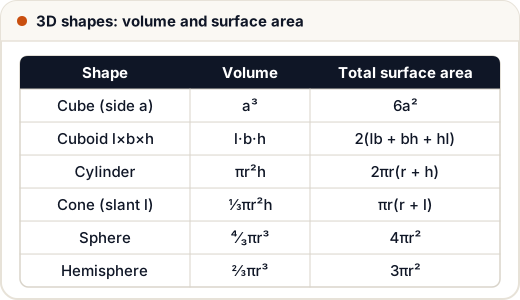
Extra formulas:
- Cuboid diagonal = √(l² + b² + h²). Cube diagonal = a√3.
- Cylinder curved surface area = 2πrh. Cone curved surface = πrl, where slant height l = √(r² + h²).
Example 4
Find the volume of a cylindrical tank of radius 7 m and height 10 m, in litres.
V = 22/7 × 49 × 10 = 1540 m³. 1 m³ = 1000 litres → 15,40,000 litres.
Example 5 — melting and recasting
A metal sphere of radius 6 cm is melted into small spheres of radius 2 cm. How many small spheres?
Volume is the same: (6/2)³ = 27 small spheres. (Volume ∝ r³, so you do not need π.)
Example 6
How many 10 cm cubes fit in a box 1 m × 50 cm × 40 cm?
(100 × 50 × 40) ÷ (10 × 10 × 10) = 200,000 ÷ 1000 = 200.
3. Percentage change in dimensions
- If every length grows by x%, area grows by 2x + x²/100 % (successive change twice).
- Volume grows by about three times as much (apply the change three times).
Example 7
The radius of a circle increases by 10%. By what % does the area increase?
10 + 10 + 1 = 21%.
Example 8
A rectangle's length increases by 20% and breadth decreases by 10%. Change in area?
20 − 10 + (20 × −10)/100 = 10 − 2 = +8%.
Common mistakes
- Mixing units: cm and m in the same formula. Convert first (1 m = 100 cm, 1 m² = 10,000 cm², 1 m³ = 1000 L).
- Using height instead of slant height in the cone's surface area.
- Thinking area doubles when sides double. It becomes 4 times (and volume 8 times).
Quick recap
- Learn the two picture cards.
- Recasting → volumes are equal; volume ∝ r³.
- Wheels: distance = turns × 2πr.
- % change in area = successive % change of the two lengths.