Quantitative Aptitude · Lesson 15 of 18 · Updated ·
Probability — Coins, Dice, Cards and Balls Made Simple
Probability measures how likely something is, from 0 (impossible) to 1 (certain).
P(event) = number of favourable outcomes ÷ total number of outcomes
Also: P(not A) = 1 − P(A).
1. Coins
One coin: H or T → 2 outcomes. n coins → 2ⁿ outcomes.
Example 1
Three coins are tossed. What is the probability of exactly two heads?
Total = 2³ = 8. Two heads: HHT, HTH, THH = 3 → 3/8.
Example 2
Three coins are tossed. Probability of at least one head?
Only TTT has no head. P = 1 − 1/8 = 7/8.
"At least one" = 1 − P(none). The fastest method, again.
2. Dice
One die: 6 outcomes. Two dice: 36 outcomes. Draw the grid once and you will never get these wrong.
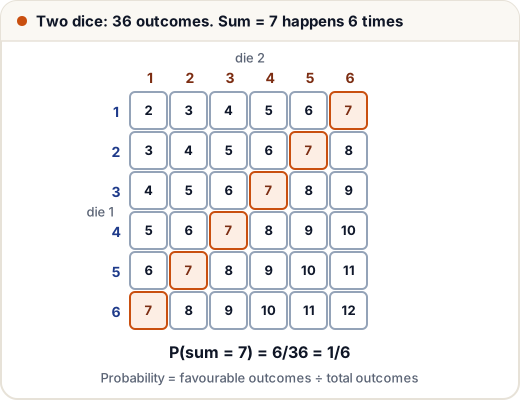
| Sum | 2 | 3 | 4 | 5 | 6 | 7 | 8 | 9 | 10 | 11 | 12 |
|---|---|---|---|---|---|---|---|---|---|---|---|
| Ways | 1 | 2 | 3 | 4 | 5 | 6 | 5 | 4 | 3 | 2 | 1 |
Example 3
Two dice are thrown. Probability that the sum is 9? 4/36 = 1/9.
Example 4
Two dice. Probability of a doublet (same number on both)? 6/36 = 1/6.
3. Playing cards
A deck has 52 cards: 4 suits of 13 (♠ spades and ♣ clubs are black; ♥ hearts and ♦ diamonds are red). Each suit has A, 2–10, J, Q, K. Face cards = J, Q, K → 12 in total.
Example 5
One card is drawn. Probability it is a king or a heart?
Kings = 4, hearts = 13, but the king of hearts is counted twice → 4 + 13 − 1 = 16 → 16/52 = 4/13.
P(A or B) = P(A) + P(B) − P(A and B). Subtract the overlap.
4. Balls in a bag (use combinations)
Example 6
A bag has 5 red and 3 blue balls. Two are drawn at random. Probability both are red?
Ways to pick 2 red = ⁵C₂ = 10. Ways to pick any 2 = ⁸C₂ = 28 → 10/28 = 5/14.
Example 7
Same bag. Probability of one red and one blue?
⁵C₁ × ³C₁ = 15 → 15/28.
5. Independent events (AND → multiply)
If one event does not affect the other, P(A and B) = P(A) × P(B).
Example 8
A can solve a problem with probability 1/2, B with probability 1/3. If both try, what is the probability it gets solved?
P(neither solves) = (1 − 1/2)(1 − 1/3) = 1/2 × 2/3 = 1/3. P(solved) = 1 − 1/3 = 2/3.
6. Odds
"Odds in favour 3 : 2" means 3 favourable for every 2 unfavourable → P = 3/(3 + 2) = 3/5.
Common mistakes
- Counting (1, 2) and (2, 1) as the same outcome for two dice. They are different cells → 36 outcomes, not 21.
- Double-counting the overlap in "A or B" questions.
- Forgetting that a probability can never be more than 1.
Quick recap
- P = favourable ÷ total; P(not A) = 1 − P(A).
- n coins → 2ⁿ outcomes; two dice → 36; a sum of 7 is the most likely (6 ways).
- Cards: 52, 4 suits, 12 face cards.
- Balls: use ⁿCᵣ for both favourable and total.
- AND (independent) → multiply; OR → add and subtract the overlap.