Quantitative Aptitude · Lesson 6 of 18 · Updated ·
Simple and Compound Interest — Formulas, Differences and Shortcuts
When you put money in a bank (or borrow it), the extra money paid for using it is called interest.
- Principal (P): the money at the start
- Rate (R): % per year
- Time (T): in years
- Amount (A): principal + interest
1. Simple vs compound — the picture
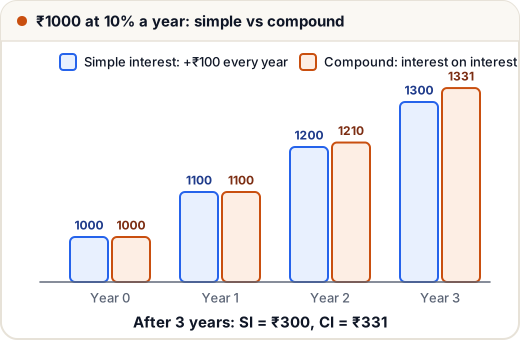
- Simple interest (SI): interest is always on the original principal → the same amount every year.
- Compound interest (CI): each year's interest is added to the principal, so next year you earn interest on interest.
2. Simple interest
SI = P × R × T ÷ 100 A = P + SI
Example 1
Find the SI on ₹8,000 at 6% per year for 3 years.
SI = 8000 × 6 × 3 ÷ 100 = ₹1,440. Amount = ₹9,440.
Example 2
At what rate will a sum double itself in 8 years at simple interest?
Doubling means SI = P. So P = P × R × 8 ÷ 100 → R = 100 ÷ 8 = 12.5%.
Shortcut: at simple interest, money becomes n times in (n − 1) × 100 ÷ R years.
3. Compound interest
A = P × (1 + R/100)ᵀ CI = A − P
Example 3
Find the CI on ₹10,000 at 10% per year for 2 years.
A = 10000 × 1.1 × 1.1 = 12,100. CI = ₹2,100.
Compounded half-yearly or quarterly
- Half-yearly: use R/2 and 2T
- Quarterly: use R/4 and 4T
Example 4
Find the amount on ₹20,000 at 10% per year compounded half-yearly for 1 year.
Rate per half-year = 5%, number of periods = 2. A = 20000 × 1.05 × 1.05 = ₹22,050.
4. The CI − SI shortcut (very common)
For the same P and R:
2 years: CI − SI = P × (R/100)² 3 years: CI − SI = P × (R/100)² × (3 + R/100)
Example 5
The difference between CI and SI on a sum for 2 years at 10% is ₹50. Find the sum.
50 = P × (0.1)² = P × 0.01 → P = ₹5,000.
Why it works: in year 2, CI also earns interest on year 1's interest (₹500 on ₹5,000 at 10% → ₹50 extra).
5. Percentage tricks for CI
Compound interest is just successive percentage increase. For 2 years at R%, the total growth is R + R + R²/100.
- 10% for 2 years → 10 + 10 + 1 = 21%
- 20% for 2 years → 20 + 20 + 4 = 44%
Example 6
A sum becomes ₹4,840 in 2 years at 10% compound interest. Find the sum.
It grew by 21%, so P × 1.21 = 4840 → P = ₹4,000.
Example 7
A sum doubles in 5 years at compound interest. In how many years will it become 8 times?
8 = 2³, so it needs 3 doublings → 3 × 5 = 15 years.
Rule of 72: money roughly doubles in 72 ÷ R years at compound interest. At 8%, about 9 years.
Common mistakes
- Using the CI formula for simple interest (or the other way round). Read the question.
- For half-yearly, forgetting to change both the rate (halve it) and the time (double it).
- Using CI − SI = P(R/100)² for 3 years. It is only for 2 years.
Quick recap
- SI = PRT/100, same interest every year.
- A = P(1 + R/100)ᵀ for CI.
- CI − SI for 2 years = P(R/100)².
- 2 years of CI at R% = R + R + R²/100 % growth.
- If a sum becomes k times in t years (CI), it becomes kⁿ times in n × t years.