Quantitative Aptitude · Lesson 4 of 18 · Updated ·
Percentages — Shortcuts, Successive Change and Exam Questions
Per cent means "out of 100". 35% means 35 out of every 100, or 35/100.
Percentages are the most important aptitude topic: profit & loss, interest, data interpretation and even probability questions use them.
1. Fractions you must know as percentages
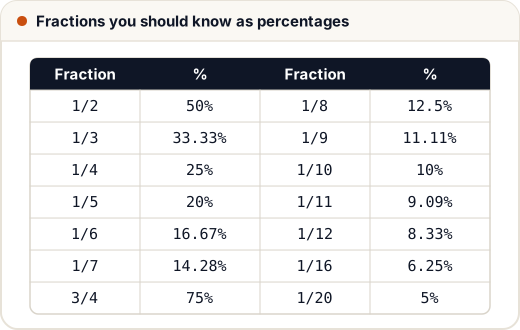
These turn hard percentages into easy fractions:
- 12.5% of 640 = ⅛ of 640 = 80
- 16.67% of 360 = ⅙ of 360 = 60
- 37.5% = ⅜, 62.5% = ⅝, 87.5% = ⅞
Trick: x% of y = y% of x. So 16% of 25 = 25% of 16 = 4.
2. Percentage change
% change = (change ÷ original) × 100
Always divide by the original (old) value.
Example 1
A phone's price went from ₹12,000 to ₹15,000. What is the % increase?
Change = 3,000. % increase = 3000 ÷ 12000 × 100 = 25%.
3. Increase or decrease by a percentage — use a multiplier
- Increase by 20% → multiply by 1.20
- Decrease by 15% → multiply by 0.85
Example 2
A town's population is 50,000 and grows 10% every year. What is it after 2 years?
50,000 × 1.1 × 1.1 = 60,500.
4. Successive percentage change
When one change happens after another, they do not simply add.
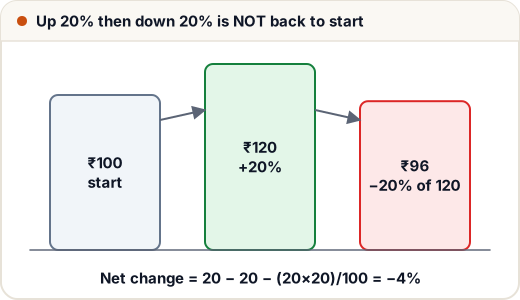
Net change for a% then b% = a + b + (a × b)/100 (use a negative sign for a decrease)
- +20% then −20% → 20 − 20 − 400/100 = −4%
- +10% then +10% → 10 + 10 + 100/100 = +21%
Example 3
A shirt's price is raised by 25% and then reduced by 20%. What is the net change?
25 − 20 + (25 × −20)/100 = 5 − 5 = 0%. The price is back where it started.
5. "By how much less?" — the reverse question
If A is r% more than B, then B is less than A by:
r ÷ (100 + r) × 100 %
Example 4
Ravi's salary is 25% more than Amit's. By what % is Amit's salary less than Ravi's?
25 ÷ 125 × 100 = 20%.
(Check with numbers: Amit = 100, Ravi = 125. Amit is 25 less than 125 → 25/125 = 20% ✓)
Similarly, if A is r% less than B, B is more than A by r ÷ (100 − r) × 100 %.
6. Price up, so use less — expenditure stays the same
Example 5
Petrol becomes 25% costlier. By what % should a family cut its usage so the monthly bill does not change?
Same formula: 25 ÷ 125 × 100 = 20%.
7. Working back to the original
Example 6
After spending 30% of her salary on rent and 20% on food, Priya has ₹20,000 left. What is her salary?
She spends 30 + 20 = 50%, so 50% of salary = 20,000 → salary = ₹40,000.
Example 7
In an exam, a student got 35% and failed by 15 marks. The pass mark is 260. What are the maximum marks?
35% of max = 260 − 15 = 245 → max = 245 ÷ 0.35 = 700.
Common mistakes
- Dividing by the new value in % change. Always divide by the original.
- Adding successive changes (20% up and 20% down is not 0%).
- Thinking "A is 25% more than B" means "B is 25% less than A". It is 20%.
Quick recap
- Learn the fraction table: ⅛ = 12.5%, ⅙ = 16.67%, etc.
- % change = change ÷ original × 100.
- Use multipliers: +20% → × 1.2, −15% → × 0.85.
- Successive: a + b + ab/100.
- "How much less": r/(100 + r) × 100.