Quantitative Aptitude · Lesson 10 of 18 · Updated ·
Time and Work (with Pipes and Cisterns) — The LCM Method
Time and work questions ask: if A takes 10 days and B takes 15 days, how long together? The fraction method (1/10 + 1/15 …) works, but there is a much faster way.
1. The LCM method
Pretend the job has a fixed number of units — the LCM of the days. Then everyone's daily work is a whole number.
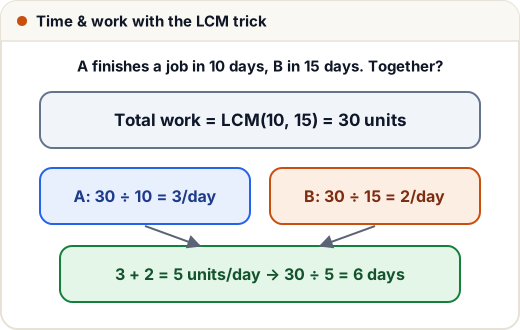
Example 1
A can finish a job in 10 days and B in 15 days. How long will they take together?
- Total work = LCM(10, 15) = 30 units
- A = 30/10 = 3 units/day, B = 30/15 = 2 units/day
- Together = 5 units/day → 30 ÷ 5 = 6 days
2. Someone leaves or joins midway
Example 2
A can do a job in 12 days and B in 18 days. They work together for 4 days, then A leaves. How many more days does B take?
- Total = LCM(12, 18) = 36 units. A = 3/day, B = 2/day.
- 4 days together = 4 × 5 = 20 units. Left = 16 units.
- B alone: 16 ÷ 2 = 8 more days.
Example 3
A and B together finish a job in 8 days. A alone takes 12 days. How long does B alone take?
Total = LCM(8, 12) = 24. A + B = 3/day, A = 2/day → B = 1/day → 24 days.
3. Efficiency
If A is twice as efficient as B, A does 2 units for every 1 of B — so A takes half the time.
Example 4
A is 50% more efficient than B. B alone takes 30 days. How long does A take?
Efficiency A : B = 150 : 100 = 3 : 2. Time is the inverse: 2 : 3. A takes 30 × 2/3 = 20 days.
4. The men-days formula
For groups of workers:
M₁ × D₁ × H₁ ÷ W₁ = M₂ × D₂ × H₂ ÷ W₂ (M = men, D = days, H = hours per day, W = work done)
Example 5
12 men can build a wall in 10 days. How many men are needed to build it in 8 days?
12 × 10 = M × 8 → M = 15 men.
Example 6
10 men working 6 hours a day finish 1 km of road in 12 days. How many days will 15 men working 8 hours a day take for 2 km?
(10 × 12 × 6)/1 = (15 × D × 8)/2 → 720 = 60D → D = 12 days.
5. Pipes and cisterns
The same idea, but a pipe that empties the tank does negative work.
Example 7
Pipe A fills a tank in 20 minutes, pipe B in 30 minutes, and pipe C empties it in 15 minutes. All three are opened together. How long to fill the tank?
- Tank = LCM(20, 30, 15) = 60 units
- A = +3, B = +2, C = −4 per minute
- Net = +1 unit/minute → 60 minutes
Example 8
A tap fills a tank in 6 hours. Because of a leak, it takes 8 hours. How long would the leak take to empty the full tank?
Tank = 24 units. Tap = 4/hour. With the leak, 3/hour → leak = −1/hour → 24 hours.
6. Wages are shared by work done
Example 9
A and B finish a job together for ₹3,000. A alone takes 6 days, B alone 12 days. How much should A get?
A's rate : B's rate = 12/6 : 12/12 = 2 : 1 → A gets ⅔ × 3000 = ₹2,000.
Common mistakes
- Adding days (10 + 15 = 25) instead of adding work per day.
- Forgetting that a leak or emptying pipe is negative.
- In the men-days formula, forgetting to divide by the amount of work when it changes.
Quick recap
- Total work = LCM of the days. Find units per day. Add or subtract rates.
- Efficiency up → time down (inverse).
- M₁D₁H₁/W₁ = M₂D₂H₂/W₂.
- Pay is shared in the ratio of work done.