Quantitative Aptitude · Lesson 16 of 18 · Updated ·
Algebra for Aptitude — Linear Equations, Quadratics and Identities
Algebra is a tool for turning a sentence into an equation. Many aptitude questions (ages, numbers, money) become easy once you write the equation.
1. An equation is a balance
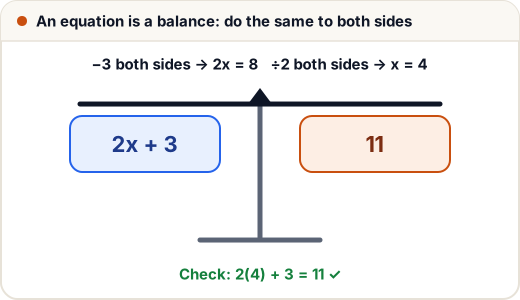
Whatever you do to one side, do to the other side. The goal is to get x alone.
Example 1
Solve 5x − 7 = 3x + 9.
Move x terms to one side: 5x − 3x = 9 + 7 → 2x = 16 → x = 8.
2. Word problems → equations
| Words | Algebra |
|---|---|
| "a number" | x |
| "5 more than a number" | x + 5 |
| "twice a number" | 2x |
| "a number decreased by 4" | x − 4 |
| "the sum of two consecutive numbers" | x + (x + 1) |
| "a two-digit number with digits a and b" | 10a + b |
Example 2
The sum of three consecutive odd numbers is 75. Find the largest.
x + (x + 2) + (x + 4) = 75 → 3x + 6 = 75 → x = 23 → numbers 23, 25, 27 → largest 27.
Example 3 — digits
A two-digit number is 4 times the sum of its digits. When 27 is added, the digits swap. Find the number.
Number = 10a + b.
- 10a + b = 4(a + b) → 6a = 3b → b = 2a
- 10a + b + 27 = 10b + a → 9a + 27 = 9b → b = a + 3
- 2a = a + 3 → a = 3, b = 6 → number = 36. (Check: 3 + 6 = 9, 4 × 9 = 36 ✓; 36 + 27 = 63 ✓)
3. Two equations, two unknowns
Example 4
5 pens and 3 notebooks cost ₹120. 2 pens and 3 notebooks cost ₹84. Find the price of a pen and a notebook.
Subtract the second from the first: 3 pens = 36 → pen = ₹12. Then 2 × 12 + 3n = 84 → 3n = 60 → notebook = ₹20.
Example 5
x + y = 20 and x − y = 4. Find x and y.
Add: 2x = 24 → x = 12, y = 8.
4. Quadratic equations
ax² + bx + c = 0. The fastest method in exams is factorisation: find two numbers that multiply to ac and add to b.
Example 6
Solve x² − 5x + 6 = 0.
Two numbers that multiply to 6 and add to −5: −2 and −3 → (x − 2)(x − 3) = 0 → x = 2 or 3.
If factors are hard, use the formula: x = [−b ± √(b² − 4ac)] ÷ 2a.
Useful facts for roots α and β:
- α + β = −b/a
- α × β = c/a
Example 7
The product of two consecutive positive numbers is 132. Find them.
x(x + 1) = 132 → x² + x − 132 = 0 → (x + 12)(x − 11) = 0 → x = 11 → 11 and 12.
5. Identities you must know
- (a + b)² = a² + 2ab + b²
- (a − b)² = a² − 2ab + b²
- a² − b² = (a + b)(a − b)
- (a + b)³ = a³ + b³ + 3ab(a + b)
- a³ + b³ = (a + b)(a² − ab + b²)
Example 8
If a + b = 10 and ab = 21, find a² + b².
a² + b² = (a + b)² − 2ab = 100 − 42 = 58.
Example 9
If x + 1/x = 5, find x² + 1/x².
Square: x² + 2 + 1/x² = 25 → x² + 1/x² = 23.
Common mistakes
- Changing the sign wrongly when moving a term across "=".
- Forgetting the negative root in quadratics (and then picking the wrong one for "positive number" questions).
- Not checking the answer in the original words.
Quick recap
- Keep the balance: same operation on both sides.
- Translate words into algebra with the table above.
- Two equations: add or subtract to remove one unknown.
- Quadratics: factorise (multiply to ac, add to b).
- Identities turn "find a² + b²" questions into one line.