Quantitative Aptitude · Lesson 12 of 18 · Updated ·
Trains, Boats and Streams — Every Case Explained with Pictures
These are time-speed-distance questions with one twist: you must work out the correct distance (trains) or the correct speed (boats).
Part A — Trains
How much distance to "cross" something?
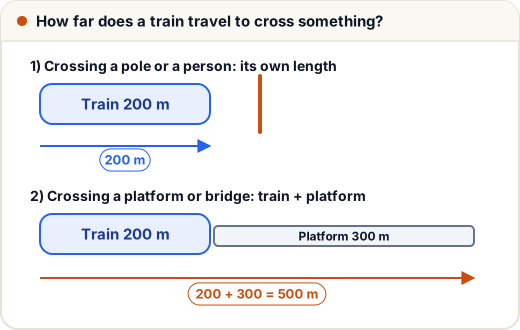
| The train crosses… | Distance to cover |
|---|---|
| A pole, a person standing, a tree | Its own length |
| A platform, a bridge, a tunnel | Train length + that length |
| Another train | Sum of both lengths (with relative speed) |
Trains are given in km/h and lengths in metres. Convert speed with × 5/18 first.
Example 1
A 200 m train runs at 72 km/h. How long does it take to cross a pole?
72 km/h = 20 m/s. Time = 200 ÷ 20 = 10 seconds.
Example 2
The same train crosses a 300 m platform. How long?
Distance = 200 + 300 = 500 m → 500 ÷ 20 = 25 seconds.
Example 3
A train crosses a pole in 15 seconds and a 150 m bridge in 25 seconds. Find its length and speed.
The extra 10 seconds are for the extra 150 m → speed = 15 m/s (= 54 km/h). Length = 15 × 15 = 225 m.
Two trains
Use relative speed (add for opposite directions, subtract for the same direction) and the sum of their lengths.
Example 4
Two trains, 150 m and 100 m long, run in opposite directions at 50 km/h and 40 km/h. How long do they take to cross each other?
Relative speed = 90 km/h = 25 m/s. Distance = 250 m → 10 seconds.
Example 5
A 120 m train at 60 km/h overtakes a man running at 6 km/h in the same direction. How long does it take to pass him?
Relative speed = 54 km/h = 15 m/s → 120 ÷ 15 = 8 seconds.
Part B — Boats and streams
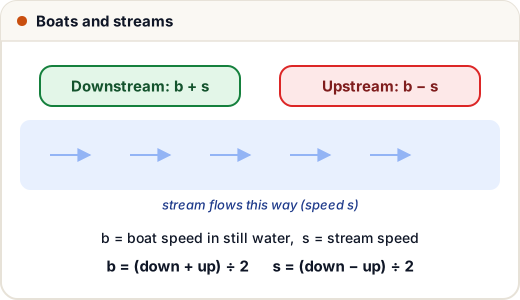
- Downstream (with the current): b + s
- Upstream (against the current): b − s
where b = speed of the boat in still water, s = speed of the stream.
b = (downstream + upstream) ÷ 2 s = (downstream − upstream) ÷ 2
Example 6
A boat goes 30 km downstream in 2 hours and comes back upstream in 3 hours. Find the boat's speed and the stream's speed.
Downstream = 15 km/h, upstream = 10 km/h → b = 12.5 km/h, s = 2.5 km/h.
Example 7
A man rows at 8 km/h in still water. The river flows at 2 km/h. He takes 4 hours to row to a place and back. How far is the place?
Down = 10, up = 6. D/10 + D/6 = 4 → (3D + 5D)/30 = 4 → D = 15 km.
Example 8
A swimmer takes twice as long to swim upstream as downstream for the same distance. Find the ratio of his speed in still water to the stream's speed.
Time up = 2 × time down → speed down = 2 × speed up. b + s = 2(b − s) → b = 3s → 3 : 1.
Common mistakes
- Forgetting to add the platform length.
- Not converting km/h to m/s before dividing metres.
- Adding the speeds of two trains going in the same direction.
- Swapping upstream and downstream: downstream is always the faster one.
Quick recap
- Pole/person → own length. Platform/bridge → both lengths. Two trains → both lengths, relative speed.
- Downstream b + s, upstream b − s.
- b = (D + U)/2, s = (D − U)/2.