Quantitative Aptitude · Lesson 8 of 18 · Updated ·
Averages — Formula, Shortcuts and Placement Exam Questions
The average of some numbers is the value each one would have if you shared the total equally.
Average = Sum of values ÷ Number of values so Sum = Average × Number
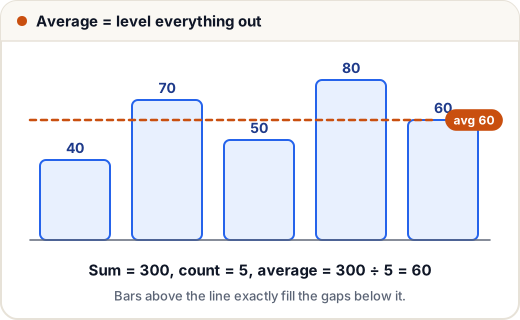
The picture shows the key idea: the amounts above the average exactly balance the amounts below it. That idea gives us a powerful shortcut.
1. The basic formula
Example 1
The marks of 5 students are 40, 70, 50, 80 and 60. Find the average.
Sum = 300, count = 5 → average = 60.
Most average questions are really about the sum. Whenever you are stuck, convert averages to sums.
2. Shortcut: deviation from an assumed average
Guess an average, then fix it with the deviations.
Example 2
Find the average of 47, 52, 49, 55 and 57.
Assume 50. Deviations: −3, +2, −1, +5, +7 → total = +10 → average = 50 + 10/5 = 52.
3. Someone joins or leaves
Example 3
The average age of 30 students is 15. When the teacher's age is included, the average becomes 16. Find the teacher's age.
- Old sum = 30 × 15 = 450
- New sum = 31 × 16 = 496
- Teacher = 496 − 450 = 46 years
Shortcut thinking: the teacher brings everyone up by 1 year (31 people × 1 = 31) on top of the old average 15 → 15 + 31 = 46 ✓.
Example 4
The average weight of 8 people rises by 2.5 kg when one person weighing 65 kg is replaced by a new person. Find the new person's weight.
Total rise = 8 × 2.5 = 20 kg → new person = 65 + 20 = 85 kg.
4. Consecutive numbers
For numbers in a regular sequence (equal steps), average = (first + last) ÷ 2 = the middle number.
- Average of 1 to 50 = (1 + 50)/2 = 25.5
- Average of the first n natural numbers = (n + 1)/2
- Average of the first n odd numbers = n
Example 5
The average of 5 consecutive even numbers is 36. What is the largest?
The middle (3rd) number is 36 → the numbers are 32, 34, 36, 38, 40 → largest = 40.
5. Combined average
Example 6
Section A (40 students) averages 70 marks; section B (60 students) averages 80. Find the overall average.
(40 × 70 + 60 × 80) ÷ 100 = (2800 + 4800) ÷ 100 = 76.
(Notice it is closer to 80 because section B is bigger. It is not (70 + 80)/2 = 75.)
6. Average speed — a classic trap
If you travel the same distance at speeds a and b:
Average speed = 2ab ÷ (a + b) (not (a + b)/2)
Example 7
A car goes from Jaipur to Ajmer at 60 km/h and returns at 40 km/h. Find the average speed.
2 × 60 × 40 ÷ 100 = 48 km/h.
Why not 50? You spend more time at the slower speed, so the average is pulled towards 40.
7. Cricket averages
Example 8
A batsman's average after 16 innings is 40. How many runs must he score in the 17th innings to raise his average to 42?
New total = 17 × 42 = 714. Old total = 16 × 40 = 640. Needed = 74.
Common mistakes
- Averaging two averages directly when the groups have different sizes.
- Using (a + b)/2 for average speed.
- Forgetting that the number of people changes when someone joins (n becomes n + 1).
Quick recap
- Sum = average × count. Work with sums.
- Assumed average + average of deviations = true average.
- Consecutive numbers: average = middle = (first + last)/2.
- Same distance at a and b: average speed = 2ab/(a + b).