Quantitative Aptitude · Lesson 9 of 18 · Updated ·
Mixtures and Alligation — The Cross Method Made Easy
When two things with different prices (or strengths) are mixed, the mixture's price lies between them. Alligation tells you the ratio in which to mix them to get a target price.
1. The alligation cross
Cheaper : Dearer = (Dearer − Mean) : (Mean − Cheaper)
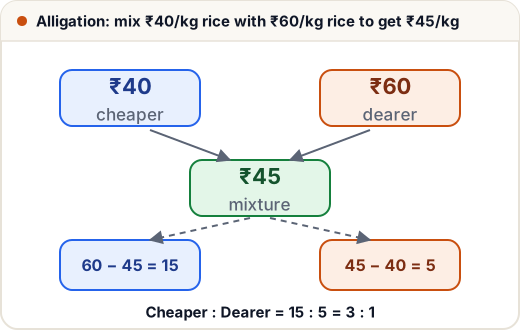
Write the two prices at the top, the mixture (mean) price in the middle, and subtract diagonally.
Example 1
In what ratio should rice at ₹40/kg be mixed with rice at ₹60/kg to get a mixture worth ₹45/kg?
Cheaper : Dearer = (60 − 45) : (45 − 40) = 15 : 5 = 3 : 1.
Check: 3 kg at 40 + 1 kg at 60 = 180 for 4 kg = ₹45/kg ✓
2. Alligation also works for percentages
Example 2
How much water must be added to 30 litres of 80% milk to make it 60% milk?
Treat water as 0% milk. Mix 80% (milk solution) with 0% (water) to get 60%.
Milk solution : Water = (60 − 0) : (80 − 60) = 60 : 20 = 3 : 1.
30 litres is 3 parts → 1 part = 10 → add 10 litres of water.
Example 3
A shop sells part of its stock at 10% profit and the rest at 20% loss, making an overall loss of 5%. In what ratio were the parts?
Mix +10 and −20 to get −5. Part at 10% : part at −20% = (−5 − (−20)) : (10 − (−5)) = 15 : 15 = 1 : 1.
3. Milk and water ratio questions
Example 4
Two vessels contain milk and water in the ratios 3 : 1 and 5 : 3. Equal amounts are mixed. Find the new ratio.
Make the totals equal: 3 : 1 has 4 parts, 5 : 3 has 8 parts. Double the first → 6 : 2 (8 parts).
Milk = 6 + 5 = 11, water = 2 + 3 = 5 → 11 : 5.
Example 5
A 60-litre mixture has milk and water in the ratio 2 : 1. How much water must be added to make the ratio 1 : 1?
Milk = 40 L, water = 20 L. For 1 : 1 we need 40 L of water → add 20 litres.
4. Repeated replacement (a favourite)
A container has x litres of pure liquid. Each time, y litres are taken out and replaced with water. After n operations:
Pure liquid left = x × (1 − y/x)ⁿ
Example 6
A 40-litre can is full of milk. 4 litres are taken out and replaced by water. This is done twice more (3 times in total). How much milk is left?
40 × (1 − 4/40)³ = 40 × 0.9³ = 40 × 0.729 = 29.16 litres.
Common mistakes
- Subtracting straight down instead of diagonally in the cross.
- Forgetting that water is 0% milk (or 0% acid, 0% alcohol).
- In two-vessel questions, adding ratios before making the totals equal.
Quick recap
- Cheaper : Dearer = (Dearer − Mean) : (Mean − Cheaper).
- Works for price, %, speed, marks — any "average of two groups".
- Repeated replacement: x(1 − y/x)ⁿ.