Quantitative Aptitude · Lesson 5 of 18 · Updated ·
Profit, Loss and Discount — Formulas, Tricks and Solved Questions
Every shop buys something and sells it. Profit and loss questions just follow the money.
1. The three prices
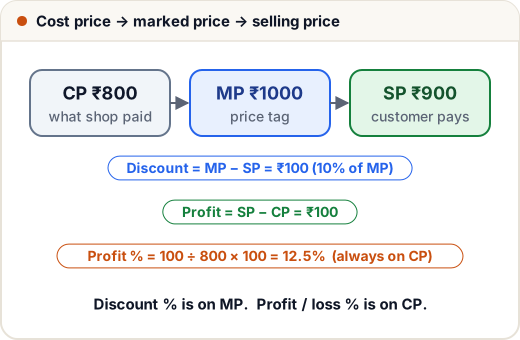
| Term | Meaning |
|---|---|
| CP — Cost Price | What the shopkeeper paid |
| MP — Marked Price (list price) | The price on the tag |
| SP — Selling Price | What the customer actually pays |
- Profit = SP − CP (when SP > CP)
- Loss = CP − SP (when CP > SP)
- Discount = MP − SP
The golden rule: profit % and loss % are always on CP. Discount % is always on MP.
- Profit % = Profit ÷ CP × 100
- Discount % = Discount ÷ MP × 100
2. Use multipliers
- Sold at 20% profit → SP = CP × 1.2
- Sold at 15% loss → SP = CP × 0.85
- 10% discount → SP = MP × 0.9
Example 1
A bicycle bought for ₹4,000 is sold at a 15% profit. Find the SP.
SP = 4000 × 1.15 = ₹4,600.
Example 2
By selling a watch for ₹1,140 a man loses 5%. At what price should he sell to gain 5%?
CP × 0.95 = 1140 → CP = 1200. For 5% gain: 1200 × 1.05 = ₹1,260.
3. Marked price and discount together
Example 3
A shopkeeper marks his goods 40% above cost and gives a 20% discount. What is his profit %?
Take CP = 100. MP = 140. SP = 140 × 0.8 = 112. Profit = 12%.
Trick: take CP = 100. Most profit questions become one-line calculations.
4. Successive discounts
Two discounts of a% and b% are not a + b. Use the same rule as successive percentages:
Single equivalent discount = a + b − ab/100
Example 4
Discounts of 20% and 10% one after another equal what single discount?
20 + 10 − 200/100 = 28% (not 30%).
5. Same SP, one profit and one loss
If two items are sold at the same SP, one at x% profit and one at x% loss, there is always a loss of x²/100 %.
Example 5
Two phones are sold for ₹9,900 each. One at 10% profit, one at 10% loss. Net result?
Loss = 10²/100 = 1% loss. (Check: CPs are 9000 and 11000, total 20,000; SP total 19,800 → loss 200 = 1% ✓)
6. The dishonest shopkeeper (false weights)
Example 6
A shopkeeper claims to sell at cost price but uses a 900 g weight instead of 1 kg. What is his profit %?
He gives 900 g but charges for 1000 g. He gains 100 g on 900 g.
Profit % = (error ÷ true weight given) × 100 = 100 ÷ 900 × 100 = 11.11%
7. "Buy x, get y free"
Example 7
"Buy 4, get 1 free". What is the effective discount?
The customer pays for 4 and gets 5. Discount = 1 ÷ 5 × 100 = 20%.
8. CP of many vs SP of fewer
Example 8
The CP of 20 pens equals the SP of 16 pens. Find the profit %.
Let each pen cost ₹1. CP of 16 pens = 16, SP of 16 pens = 20 (same as CP of 20). Profit = 4 on 16 → 25%.
Common mistakes
- Calculating profit % on SP. It is always on CP.
- Calculating discount % on CP. It is always on MP.
- Adding successive discounts (20% + 10% is 28%, not 30%).
Quick recap
- Profit/loss % on CP; discount % on MP.
- Take CP = 100 and use multipliers.
- Successive discount: a + b − ab/100.
- Same SP, x% profit and x% loss → x²/100 % loss.
- False weight: error ÷ (true weight given) × 100.