Quantitative Aptitude · Lesson 1 of 18 · Updated ·
Number System — Types, Divisibility, Unit Digit and Remainders
Almost every aptitude question uses numbers, so this lesson is the foundation. You will learn four things:
- The types of numbers (and which one contains which)
- Divisibility rules — check if a number divides another without long division
- The unit digit (last digit) of huge powers like 7¹⁰⁵
- Remainders — the most common "number system" question in placement tests
1. Types of numbers
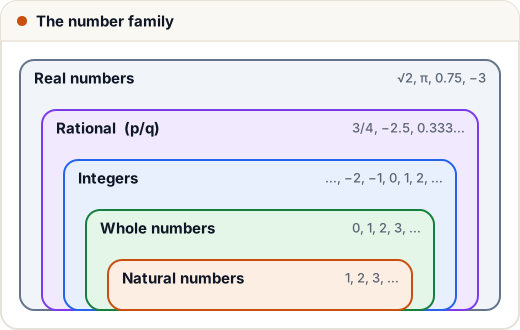
| Type | What it means | Examples |
|---|---|---|
| Natural | Counting numbers | 1, 2, 3, … |
| Whole | Natural numbers plus 0 | 0, 1, 2, … |
| Integers | Whole numbers plus negatives | −3, 0, 7 |
| Rational | Can be written as p/q (q ≠ 0) | 3/4, −2.5, 0.333… |
| Irrational | Cannot be written as p/q | √2, π |
| Real | Rational + irrational | everything above |
Two more you must know:
- Prime number: exactly two factors, 1 and itself → 2, 3, 5, 7, 11, 13, … (2 is the only even prime; 1 is not prime).
- Composite number: more than two factors → 4, 6, 8, 9, …
Remember: there are 25 primes below 100. A number is prime if no prime up to its square root divides it. To test 97: √97 ≈ 9.8, so try 2, 3, 5, 7 — none divide 97, so 97 is prime.
2. Divisibility rules
| Divisible by | Rule | Example |
|---|---|---|
| 2 | Last digit is even | 3,584 ✓ |
| 3 | Sum of digits divisible by 3 | 2+3+4 = 9 → 234 ✓ |
| 4 | Last two digits divisible by 4 | 7,316 → 16 ✓ |
| 5 | Last digit 0 or 5 | 1,235 ✓ |
| 6 | Divisible by 2 and 3 | 114 ✓ |
| 8 | Last three digits divisible by 8 | 9,128 ✓ |
| 9 | Sum of digits divisible by 9 | 7+2+9 = 18 → 729 ✓ |
| 10 | Last digit 0 | 450 ✓ |
| 11 | (Sum of odd-place digits) − (sum of even-place digits) is 0 or a multiple of 11 | 1331: (1+3) − (3+1) = 0 ✓ |
For 12, 15, 18, 24… split into two numbers that have no common factor: 12 = 3 × 4, 15 = 3 × 5, 24 = 3 × 8. Check both rules. (Do not use 12 = 2 × 6 — 2 and 6 share the factor 2.)
Example 1
If the number 5 7 x 2 is divisible by 9, what is x?
Digit sum = 5 + 7 + x + 2 = 14 + x. The next multiple of 9 after 14 is 18, so x = 4. (27 would need x = 13, which is not a digit.)
3. Unit digit of big powers
The last digit of powers repeats in a cycle. Only the last digit of the base matters.
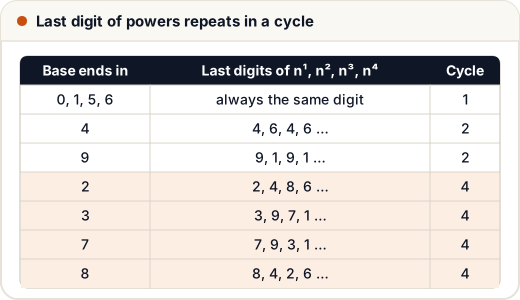
Method (for bases ending in 2, 3, 7, 8):
- Divide the power by 4 and take the remainder.
- Remainder 1, 2, 3 → the 1st, 2nd, 3rd digit of the cycle. Remainder 0 → the 4th digit.
Example 2
Find the unit digit of 7¹⁰⁵.
105 ÷ 4 leaves remainder 1 → 1st digit of 7's cycle (7, 9, 3, 1) = 7.
Example 3
Find the unit digit of 23⁴⁸ × 12⁵¹.
- 23⁴⁸ → base ends in 3, 48 ÷ 4 remainder 0 → 4th digit of (3, 9, 7, 1) = 1
- 12⁵¹ → base ends in 2, 51 ÷ 4 remainder 3 → 3rd digit of (2, 4, 8, 6) = 8
- Unit digit = 1 × 8 = 8
4. Remainders
Rule 1 — remainders multiply. The remainder of (a × b) ÷ n equals the remainder of (remainder of a × remainder of b) ÷ n. The same works for adding.
Example 4
What is the remainder when 856 × 501 is divided by 13?
- 856 ÷ 13 → 13 × 65 = 845, remainder 11
- 501 ÷ 13 → 13 × 38 = 494, remainder 7
- 11 × 7 = 77; 77 ÷ 13 → 13 × 5 = 65, remainder 12
Answer: 12. You never had to multiply the big numbers.
Rule 2 — negative remainders save time. 11 is 2 less than 13, so think of it as −2. Then (−2) × 7 = −14, and −14 + 26 = 12. Same answer, smaller numbers.
Example 5
Find the remainder when 2³¹ is divided by 5.
2⁴ = 16 leaves remainder 1 when divided by 5. 2³¹ = (2⁴)⁷ × 2³ → remainder = 1⁷ × 8 → 8 ÷ 5 → 3.
Common mistakes
- Calling 1 a prime number. It is not (it has only one factor).
- Using 12 = 2 × 6 for divisibility. The two parts must have no common factor: use 3 × 4.
- For unit digits, a remainder of 0 means the last digit of the cycle, not the first.
Quick recap
- Natural ⊂ Whole ⊂ Integers ⊂ Rational ⊂ Real. 2 is the only even prime.
- Learn divisibility rules for 2–11; split bigger numbers into co-prime parts.
- Unit digit: find the cycle, divide the power by the cycle length (4 works for every digit).
- Remainders: replace each number with its remainder first, then multiply or add.