Quantitative Aptitude · Lesson 7 of 18 · Updated ·
Ratio, Proportion and Partnership — Simple Methods with Examples
A ratio compares two quantities of the same kind. If a class has 20 boys and 30 girls, boys : girls = 20 : 30 = 2 : 3.
Think of a ratio as parts: for every 2 parts of boys there are 3 parts of girls.
1. The parts method
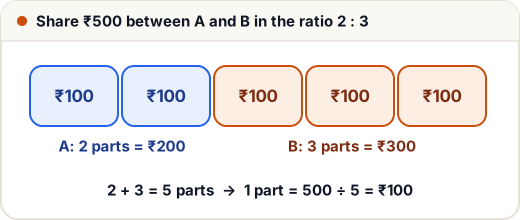
Example 1
Share ₹500 between A and B in the ratio 2 : 3.
Total parts = 5. One part = 500 ÷ 5 = 100. A = 2 × 100 = ₹200, B = ₹300.
This one idea solves most ratio questions: find the value of one part.
Example 2
The ratio of boys to girls is 4 : 5. There are 36 boys. How many girls?
4 parts = 36 → 1 part = 9 → girls = 5 × 9 = 45.
2. Combining two ratios
A : B = 2 : 3 and B : C = 4 : 5. Find A : B : C.
B is in both. Make B the same: multiply the first by 4 and the second by 3.
- A : B = 8 : 12
- B : C = 12 : 15
- So A : B : C = 8 : 12 : 15
3. Proportion
Four numbers a, b, c, d are in proportion if a : b = c : d, i.e. a × d = b × c ("product of extremes = product of means").
- Mean proportional of a and b = √(ab). Of 4 and 16 → √64 = 8.
- Third proportional of a and b is c where a : b = b : c → c = b²/a. Of 4 and 6 → 36/4 = 9.
Example 3
Find x if 3 : 5 = x : 40.
3 × 40 = 5x → x = 24.
4. Adding to a ratio
Example 4
Two numbers are in the ratio 3 : 5. If 9 is added to each, the ratio becomes 3 : 4. Find the numbers.
Let them be 3k and 5k. (3k + 9)/(5k + 9) = 3/4 → 12k + 36 = 15k + 27 → k = 3. Numbers: 9 and 15.
5. Coins
Example 5
A bag has ₹1, 50 p and 25 p coins in the ratio 1 : 2 : 4. The total value is ₹90. How many 25 p coins are there?
Value per set of coins = 1 × ₹1 + 2 × ₹0.50 + 4 × ₹0.25 = 1 + 1 + 1 = ₹3. Number of sets = 90 ÷ 3 = 30. 25 p coins = 4 × 30 = 120.
6. Partnership
Business profit is shared in the ratio of money × time each partner invested.
Profit share ∝ Investment × Time
Example 6
A invests ₹40,000 for 12 months; B invests ₹60,000 for 6 months. The profit is ₹35,000. Find each share.
- A: 40,000 × 12 = 4,80,000
- B: 60,000 × 6 = 3,60,000
- Ratio = 480 : 360 = 4 : 3 → total 7 parts → 1 part = 5,000
- A = ₹20,000, B = ₹15,000
Example 7
A starts a business with ₹50,000. After 4 months B joins with ₹75,000. What is the profit ratio after 1 year?
A: 50,000 × 12 = 6,00,000. B: 75,000 × 8 = 6,00,000. Ratio = 1 : 1.
Common mistakes
- Forgetting to make the common term equal when combining ratios.
- In partnership, using only the investment and forgetting the time.
- Mixing units (₹ and paise, months and years). Convert first.
Quick recap
- Ratio = parts. Find one part, then everything else.
- To combine A : B and B : C, make B equal.
- a : b = c : d ⇔ ad = bc. Mean proportional = √(ab).
- Partnership: share ∝ money × time.