AdvancedQuantitative Aptitude · Lesson 25 of 25 · Updated ·
Partnership — Profit Sharing with Time, Changing Capital and Working Partners
When two or more people put money into a business, they are partners. The money each one puts in is their capital (or investment). At the end, the profit is divided among them.
The fair rule is simple: the more money you put in, and the longer you keep it there, the bigger your share. This lesson turns that rule into a quick method and covers every common twist: late joiners, money added or taken out midway, and a partner who is paid for running the business.
1. The core rule
Profit share ∝ Capital × Time
(∝ means "is proportional to".) Capital × time is often called capital-months when time is in months.
Why multiply? ₹10,000 kept in the business for 6 months is as useful to the business as ₹5,000 kept for 12 months. Both give 60,000 "rupee-months" of use. So the product is the fair measure.
If everyone invests for the same time, time cancels and the shares are simply in the ratio of capital. This is called a simple partnership. When times differ, it is a compound partnership.
Example 1 (simple partnership)
A, B and C invest ₹40,000, ₹60,000 and ₹80,000 for a year. The profit is ₹27,000. Find each share.
Ratio = 40 : 60 : 80 = 2 : 3 : 4. Total 9 parts → 1 part = 3,000. A = ₹6,000, B = ₹9,000, C = ₹12,000.
2. Partners who join late
Count only the months each partner's money was actually in the business.
Example 2 (compound partnership)
A starts a business with ₹40,000. After 3 months B joins with ₹60,000, and after 8 months (from the start) C joins with ₹90,000. The profit after one year is ₹46,000. Find each share.
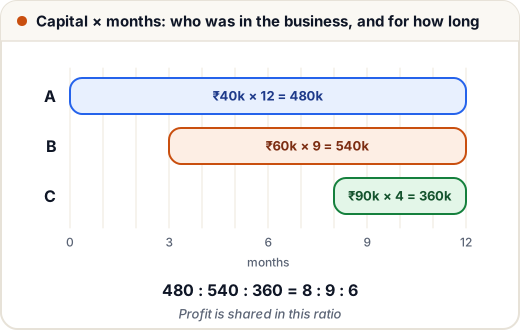
- A: 40,000 × 12 = 4,80,000
- B: 60,000 × 9 = 5,40,000
- C: 90,000 × 4 = 3,60,000
Ratio = 480 : 540 : 360 = 8 : 9 : 6. Total 23 parts → 1 part = 46,000 ÷ 23 = 2,000.
A = ₹16,000, B = ₹18,000, C = ₹12,000.
Notice that C put in the most money but gets the least, because his money worked for only 4 months.
3. Capital that changes midway
Split each partner's year into pieces with a constant amount, multiply each piece, and add.
Example 3 (Infosys / Wipro style)
A starts with ₹60,000 and withdraws ₹20,000 after 4 months. B starts with ₹40,000 and adds ₹20,000 after 6 months. The year's profit is ₹58,000. Find the shares.
| Partner | Pieces | Capital-months (in thousands) |
|---|---|---|
| A | 60 × 4 + 40 × 8 | 240 + 320 = 560 |
| B | 40 × 6 + 60 × 6 | 240 + 360 = 600 |
Ratio = 560 : 600 = 14 : 15. Total 29 parts → 1 part = 58,000 ÷ 29 = 2,000.
A = ₹28,000, B = ₹30,000.
Check the months add up to 12 for each partner (4 + 8 and 6 + 6). This catches most mistakes.
4. Working and sleeping partners
A sleeping partner only invests money. A working partner also runs the business and is paid for that work, usually as a fixed salary or a percentage of the profit. The rule:
First take out the working partner's payment. Then divide the rest in the capital-time ratio.
The working partner gets both the payment and a share of the rest.
Example 4
A (sleeping partner) invests ₹1,20,000 and B (working partner) invests ₹80,000 for a year. B gets 10% of the profit for managing the business. The profit is ₹50,000. How much does B get in total?
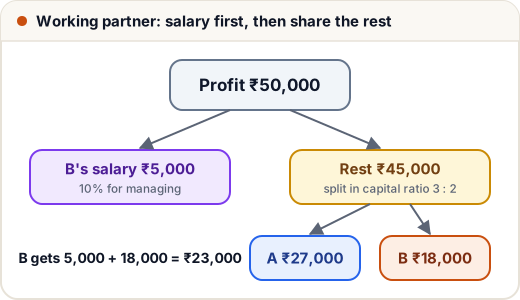
- B's payment = 10% of 50,000 = 5,000.
- Rest = 45,000, shared 1,20,000 : 80,000 = 3 : 2 → A = 27,000, B = 18,000.
- B's total = 5,000 + 18,000 = ₹23,000.
5. Working backwards: find the time or the capital
Set up the ratio with the unknown, and match it to the given profit ratio.
Example 5 (find the time)
A invests ₹45,000 for the whole year. B invests ₹30,000 but joins some months later. At the end, the profit is shared 3 : 1. After how many months did B join?
Let B's money stay for x months. 45,000 × 12 : 30,000 × x = 3 : 1 → 5,40,000 = 3 × 30,000x → x = 6. B's money was in for 6 months, so B joined after 6 months.
The question asks when B joined, not how long he stayed. Read it twice.
Example 6 (ratios only)
Capitals are in the ratio 3 : 5 and the times are in the ratio 2 : 3. Find the profit ratio.
Multiply term by term: 3 × 2 : 5 × 3 = 6 : 15 = 2 : 5.
Going the other way: if profits are 5 : 7 and times are 3 : 5, capitals = profit ÷ time = 5/3 : 7/5 = 25 : 21.
Common mistakes
- Using capital alone when partners stayed for different times.
- Using "joined after 3 months" as 3 months in the business. It is 12 − 3 = 9 months.
- Splitting the whole profit before paying the working partner's salary.
- Forgetting that the working partner also gets a share of the remaining profit.
- In capital-change questions, letting the months add up to more or less than 12.
Quick recap
- Profit ∝ capital × time. Same time for all → ratio of capitals.
- Late joiner: months in business = 12 − months waited.
- Capital changes: add up the pieces; the months for each partner must total 12.
- Working partner: pay the salary or commission first, then split the rest.
- Profit ratio = capital ratio × time ratio, term by term. Capital = profit ÷ time.