AdvancedQuantitative Aptitude · Lesson 23 of 25 · Updated ·
Inequalities and Quadratic Comparison — Solve, Compare and Decide x vs y
An inequality compares two quantities using <, >, ≤ (less than or equal to) or ≥ (greater than or equal to). Instead of one answer, it usually has a whole range of answers.
This lesson covers three things placement and bank-style tests ask: solving linear inequalities, solving quadratic inequalities, and the popular question type "Two equations are given. Find the relation between x and y."
1. Linear inequalities and the sign flip
You can solve an inequality like an equation — add, subtract, multiply or divide both sides — with one extra rule:
When you multiply or divide both sides by a negative number, flip the sign.
Why? 2 < 5 is true. Multiply both sides by −1: −2 and −5. Now −2 is bigger than −5, so the sign must turn around: −2 > −5. Multiplying by a negative number reverses the order of numbers on the number line.
Example 1
Solve −2x + 7 > 1.
−2x > −6. Divide by −2 and flip: x < 3.
Example 2 (two conditions)
Find the integers that satisfy both 3x − 5 < 2x + 4 and 2x + 1 > −7.
First: x < 9. Second: 2x > −8 → x > −4. Both together: −4 < x < 9, so the integers are −3, −2, …, 8 (12 integers).
2. Modulus inequalities
|x| means the distance of x from 0 on the number line. So |x − 3| is the distance of x from 3.
- |x − a| < k means x is within k of a: a − k < x < a + k
- |x − a| > k means x is more than k away: x < a − k or x > a + k
Example 3
Solve |x − 3| < 5.
x is within 5 of 3: −2 < x < 8. The integers are −1 to 7, which is 9 integers.
Example 4
How many integers satisfy |2x − 1| ≤ 7?
−7 ≤ 2x − 1 ≤ 7 → −6 ≤ 2x ≤ 8 → −3 ≤ x ≤ 4. That is 8 integers.
3. Quadratic inequalities with a sign chart
To solve something like (x − 2)(x − 5) < 0:
- Find the roots, 2 and 5. They cut the number line into three regions.
- Test one number in each region.
- Pick the regions with the sign you want.
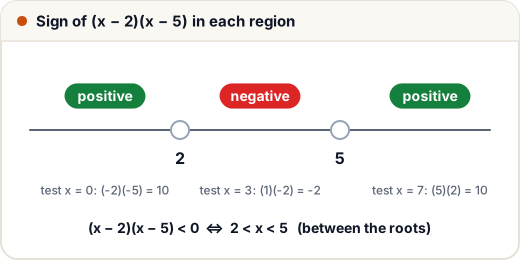
For an expression x² + bx + c (with a positive x² term), the pattern is always the same:
- < 0 between the roots
- > 0 outside the roots
Example 5
Solve x² − x − 12 ≤ 0.
x² − x − 12 = (x − 4)(x + 3). Roots −3 and 4. "≤ 0" means between them, including the ends: −3 ≤ x ≤ 4.
4. Finding roots fast
For ax² + bx + c = 0, the two roots satisfy:
sum of roots = −b/a, product of roots = c/a
So for x² − 7x + 12 = 0 you need two numbers with sum 7 and product 12: 3 and 4. No formula needed.
Sign shortcut (when a = 1):
| Signs of b and c | Roots are |
|---|---|
| b −, c + | both positive |
| b +, c + | both negative |
| c − | one positive, one negative |
For x² + 5x + 6 = 0: b and c are both positive, so both roots are negative: −2 and −3.
If the numbers do not come quickly, use the formula x = [−b ± √(b² − 4ac)] / 2a.
5. The "x vs y" question (bank and placement tests)
You get two equations, one in x and one in y. The options are usually:
- x > y, x < y, x ≥ y, x ≤ y, or x = y or no relation can be found
Method: solve both, put all four roots on one number line, and compare every x with every y.
Example 6
I. x² − 7x + 12 = 0 II. y² − 9y + 20 = 0
x = 3 or 4. y = 4 or 5.
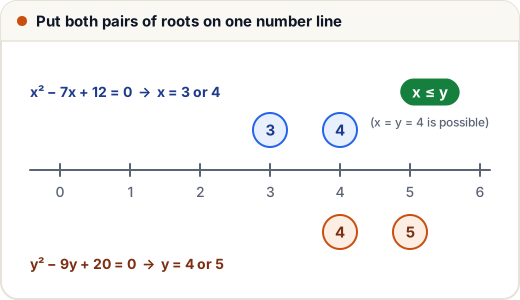
Every x is at most every y, and x = y = 4 is possible. Answer: x ≤ y.
Example 7
I. x² − 8x + 15 = 0 II. y² − 3y + 2 = 0
x = 3 or 5. y = 1 or 2. Every x is bigger than every y: x > y.
Example 8
I. x² + 5x + 6 = 0 II. y² − y − 12 = 0
x = −3 or −2. y = −3 or 4. Compare: x = −2 is bigger than y = −3, but smaller than y = 4. The order changes, so no relation can be established.
Example 9 (a common trap)
I. x = √1764 II. y² = 1764
√ means the positive square root only, so x = 42. But y² = 1764 gives y = 42 or −42. So x ≥ y.
Quick rules for the comparison:
| Situation | Answer |
|---|---|
| Smallest x > largest y | x > y |
| Smallest x = largest y | x ≥ y |
| Largest x < smallest y | x < y |
| Largest x = smallest y | x ≤ y |
| The ranges overlap | no relation |
Common mistakes
- Forgetting to flip the sign after dividing by a negative number.
- Treating √1764 as ±42. The √ sign gives only the positive root; it is y² = 1764 that has two answers.
- Comparing only one pair of roots. Check the extreme pairs: smallest x with largest y, and largest x with smallest y.
- Writing x² < 9 as x < 3. The correct answer is −3 < x < 3.
- Dividing both sides by x when you do not know the sign of x.
Quick recap
- Multiply or divide by a negative → flip the sign.
- |x − a| < k → a − k < x < a + k. |x − a| > k → outside that range.
- Quadratic (positive x²): < 0 between roots, > 0 outside.
- Sum of roots = −b/a, product = c/a. Use the sign table to guess signs.
- x vs y: put all roots on one number line. Overlap means no relation.