AdvancedQuantitative Aptitude · Lesson 20 of 25 · Updated ·
Indices and Surds — Laws of Powers, Roots and Fast Simplification
In 2⁵, the number 2 is the base and 5 is the index (also called the power or exponent). It means 2 × 2 × 2 × 2 × 2 = 32.
A surd is a root that does not come out as a whole number or fraction, like √2 or ∛5. Its decimal value never ends and never repeats.
Questions on indices and surds look scary but almost always fall to a few rules. This lesson gives you those rules, explains why they hold, and shows the standard question types.
1. The laws of indices
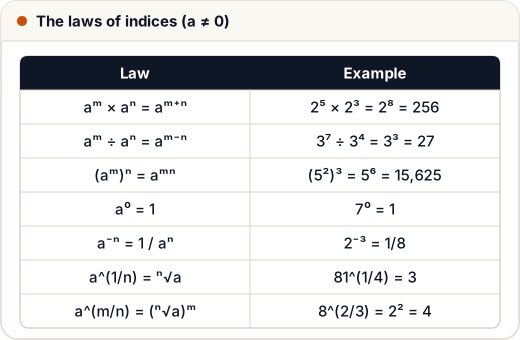
Why they work:
- aᵐ × aⁿ = aᵐ⁺ⁿ — you are writing m copies of a, then n more copies. That is m + n copies.
- aᵐ ÷ aⁿ = aᵐ⁻ⁿ — n copies cancel from the top.
- a⁰ = 1 — a³ ÷ a³ is 1, and by the rule above it is also a⁰.
- a⁻ⁿ = 1/aⁿ — a⁰ ÷ aⁿ = 1/aⁿ, and by the rule it is a⁰⁻ⁿ.
- a^(1/n) = ⁿ√a — (a^(1/n))ⁿ = a¹ = a, so a^(1/n) is the number whose nth power is a.
The rules only combine powers of the same base. 2³ × 3³ cannot become 6⁶; it becomes (2 × 3)³ = 6³, using aⁿ × bⁿ = (ab)ⁿ.
2. The golden habit: break everything into primes
Write every number as a power of a prime, then add or subtract the indices.
Example 1
Simplify (9³ × 27²) ÷ 3¹⁰.
9³ = (3²)³ = 3⁶ and 27² = (3³)² = 3⁶. So the value is 3⁶⁺⁶⁻¹⁰ = 3² = 9.
Example 2 (Wipro / AMCAT style)
Find (0.04)^(−1.5).
0.04 = 4/100 = 1/25 = 5⁻². So (5⁻²)^(−1.5) = 5³ = 125.
Example 3
Simplify (2³⁰ + 2²⁹ + 2²⁸) ÷ (2³¹ + 2³⁰ − 2²⁹).
Take the smallest power, 2²⁸, out of both: top = 2²⁸(4 + 2 + 1) = 2²⁸ × 7, bottom = 2²⁸(8 + 4 − 2) = 2²⁸ × 10. Answer = 7/10.
3. Equations with the unknown in the power
If the bases are the same, the indices must be equal: aˣ = aʸ ⇒ x = y (for a > 0, a ≠ 1).
Example 4
Solve 9ˣ = 27ˣ⁻¹.
Both are powers of 3: 3²ˣ = 3³⁽ˣ⁻¹⁾. So 2x = 3x − 3 → x = 3. Check: 9³ = 729 and 27² = 729. ✓
Example 5 (TCS NQT style)
Solve 3ˣ⁺¹ + 3ˣ = 108.
Take 3ˣ common: 3ˣ(3 + 1) = 108 → 3ˣ = 27 → x = 3.
4. Comparing surds
Which is the largest: √2, ∛3, ⁴√4 or ⁶√6?
You cannot compare roots of different orders directly. Raise all of them to the LCM of the root orders. LCM of 2, 3, 4 and 6 is 12, and raising to the same positive power keeps the order.
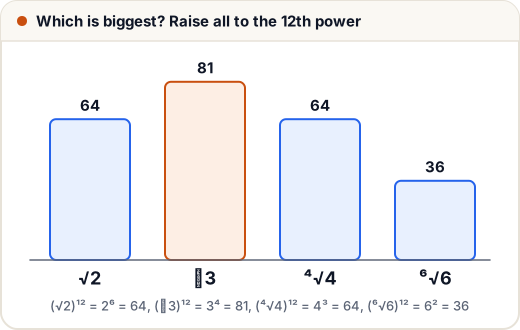
The 12th powers are 64, 81, 64 and 36. So ∛3 is the largest and ⁶√6 the smallest. (Notice √2 = ⁴√4 exactly.)
Comparing sums of roots. Which is bigger: √10 + √3 or √7 + √6? Square both: 13 + 2√30 and 13 + 2√42. The second is bigger, so √7 + √6 wins. When the numbers inside add up to the same total (10 + 3 = 7 + 6), the pair that is closer together gives the bigger sum.
5. Simplifying and rationalising surds
Simplify: pull out square factors. √75 = √(25 × 3) = 5√3. Like surds add like terms: √12 + √27 = 2√3 + 3√3 = 5√3.
Rationalise: remove a root from the denominator. Multiply top and bottom by the conjugate (the same two terms with the opposite sign in the middle). This works because (a + b)(a − b) = a² − b², and squaring kills the root.
Example 6
Rationalise 1 / (√3 + √2).
Multiply by (√3 − √2)/(√3 − √2): the bottom becomes 3 − 2 = 1. Answer = √3 − √2.
Square root of a surd expression: √(a + 2√b) = √x + √y, where x + y = a and xy = b.
Find √(5 + 2√6). Two numbers with sum 5 and product 6 are 3 and 2. Answer = √3 + √2.
6. Never-ending roots
Find √(6 + √(6 + √(6 + …))).
Call the value x. The part under the first root, after the 6, is x again. So x = √(6 + x) → x² − x − 6 = 0 → (x − 3)(x + 2) = 0 → x = 3 (a root cannot be negative).
Shortcut: √(n + √(n + …)) equals the bigger of two consecutive numbers whose product is n. For 6 = 2 × 3 it is 3; for 12 = 3 × 4 it is 4. With a minus sign, √(n − √(n − …)), it is the smaller one: √(20 − √(20 − …)) = 4 since 20 = 4 × 5.
Common mistakes
- Adding powers of different bases: 2³ × 3² is not 6⁵.
- Writing (a + b)² = a² + b². The middle term 2ab is missing.
- Thinking a⁻ⁿ is negative. 2⁻³ = 1/8, which is positive.
- Comparing ∛3 and √2 by the number inside the root. Raise both to the LCM power first.
- Writing √(a + b) = √a + √b. √(9 + 16) = 5, but √9 + √16 = 7.
Quick recap
- Same base: multiply → add indices, divide → subtract, power of a power → multiply.
- a⁰ = 1, a⁻ⁿ = 1/aⁿ, a^(m/n) = (ⁿ√a)ᵐ.
- Break numbers into primes, then compare indices: aˣ = aʸ ⇒ x = y.
- Compare roots of different orders by raising all to the LCM of the orders.
- Rationalise with the conjugate. √(a + 2√b) = √x + √y with x + y = a, xy = b.
- √(n + √(n + …)) = the larger factor when n = k(k + 1).