AdvancedQuantitative Aptitude · Lesson 21 of 25 · Updated ·
Logarithms for Aptitude — Rules, Change of Base and Number of Digits
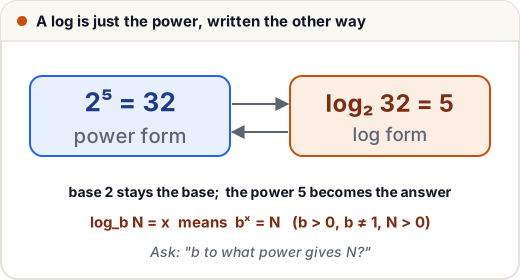
You know that 2⁵ = 32. A logarithm asks the reverse question: "2 to what power gives 32?" The answer, 5, is written log₂ 32 = 5 and read "log of 32 to the base 2".
Logarithm questions appear in AMCAT, CoCubes-style tests and many campus tests. They are short and scoring once you know the five rules below.
1. The definition
log_b N = x means bˣ = N.
Here b is the base. It must be positive and not 1, and N must be positive. (No power of a positive base gives zero or a negative number, so log 0 and log(−5) do not exist.)
Some values to read off directly:
| Question | Think | Answer |
|---|---|---|
| log₃ 81 | 3 to what power is 81? | 4 |
| log₅ (1/125) | 5⁻³ = 1/125 | −3 |
| log₄ 8 | 4^(3/2) = (√4)³ = 8 | 3/2 |
| log₇ 1 | 7⁰ = 1 | 0 |
| log₉ 9 | 9¹ = 9 | 1 |
When no base is written ("log 100"), aptitude tests mean base 10. So log 100 = 2 and log 0.0001 = −4.
2. The rules — and why they work
Every log rule comes from a law of indices.
| Rule | Comes from |
|---|---|
| log(mn) = log m + log n | aˣ × aʸ = aˣ⁺ʸ: multiplying adds powers |
| log(m/n) = log m − log n | aˣ ÷ aʸ = aˣ⁻ʸ |
| log(mᵏ) = k · log m | (aˣ)ᵏ = aᵏˣ |
| log_b b = 1, log_b 1 = 0 | b¹ = b, b⁰ = 1 |
| b^(log_b N) = N | the power that gives N, applied to b, gives N |
Example 1
Find log 8 + log 125 (base 10).
log 8 + log 125 = log(8 × 125) = log 1000 = 3.
Example 2 (AMCAT style)
Find 2 log 5 + log 4.
2 log 5 = log 25. So the sum = log(25 × 4) = log 100 = 2.
3. Change of base
log_b N = log N / log b (any common base on the right, usually 10)
This lets you turn any log into base-10 logs. Two useful results follow:
- log_b a × log_a b = 1 (the logs cancel: (log a / log b) × (log b / log a) = 1)
- Chain rule: log_a b × log_b c = log_a c. The middle base cancels like a fraction.
Example 3
Find log₂ 3 × log₃ 4 × log₄ 5 × log₅ 6 × log₆ 7 × log₇ 8.
Write each as a fraction of base-10 logs: (log 3/log 2)(log 4/log 3)…(log 8/log 7). Everything cancels except log 8 / log 2 = log₂ 8 = 3.
Example 4
Find log₂ 9 × log₃ 8.
log₂ 9 = 2 log₂ 3 and log₃ 8 = 3 log₃ 2. Product = 6 × (log₂ 3 × log₃ 2) = 6 × 1 = 6.
4. Values to remember
| log 2 | log 3 | log 5 | log 7 |
|---|---|---|---|
| 0.3010 | 0.4771 | 0.6990 | 0.8451 |
You can build others from these. log 5 = log(10/2) = 1 − 0.3010 = 0.6990. log 6 = log 2 + log 3 = 0.7781. log 72 = log(2³ × 3²) = 3(0.3010) + 2(0.4771) = 0.9030 + 0.9542 = 1.8572.
5. Number of digits in a huge power
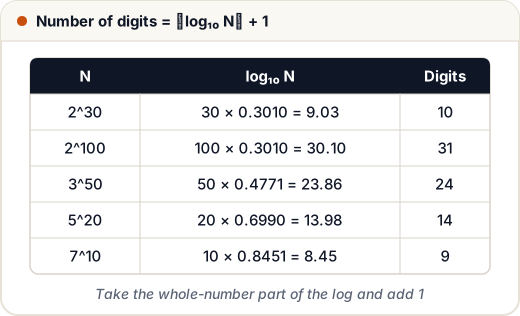
A number with d digits lies between 10^(d−1) and 10^d, so its log is between d − 1 and d. Therefore:
Number of digits of N = (whole-number part of log₁₀ N) + 1
Example 5 (a favourite)
How many digits does 2¹⁰⁰ have? (log 2 = 0.3010)
log 2¹⁰⁰ = 100 × 0.3010 = 30.10. Whole part = 30, so 2¹⁰⁰ has 31 digits.
Be careful near a whole number. If the log comes out as 19.99, a rounded log value could mislead you; use 4 decimal places and you will be safe in test questions.
6. Solving log equations
Steps: combine the logs into one log, then switch to power form. Always check the answer — the number inside every log must be positive.
Example 6 (Infosys / TCS style)
Solve log₂ x + log₂ (x − 2) = 3.
log₂ [x(x − 2)] = 3 → x(x − 2) = 2³ = 8 → x² − 2x − 8 = 0 → (x − 4)(x + 2) = 0.
x = 4 or x = −2. But log₂(−2) does not exist, so x = 4 only.
Example 7
Solve log x + log (x + 15) = 2.
x(x + 15) = 10² = 100 → x² + 15x − 100 = 0 → (x + 20)(x − 5) = 0 → x = 5 (reject −20).
Common mistakes
- Writing log(m + n) = log m + log n. The rule is for a product, not a sum.
- Writing (log m)/(log n) = log m − log n. That rule is for log(m/n).
- Keeping a root that makes the inside of a log zero or negative.
- Forgetting that log means base 10 in aptitude questions when no base is given.
- Using log 2 = 0.3 for digit counting of very large powers. Use 0.3010.
Quick recap
- log_b N = x ⇔ bˣ = N. Base > 0 and ≠ 1; N > 0.
- Product → add logs, quotient → subtract, power → multiply in front.
- Change of base: log_b N = log N / log b. log_a b × log_b a = 1, and chains cancel.
- log 2 = 0.3010, log 3 = 0.4771, log 5 = 0.6990, log 7 = 0.8451.
- Digits of N = ⌊log N⌋ + 1.
- In log equations, check every answer against the "inside must be positive" rule.