AdvancedQuantitative Aptitude · Lesson 22 of 25 · Updated ·
Progressions — Arithmetic, Geometric and Harmonic (AP, GP, HP)
A sequence is a list of numbers in order. When the list follows a fixed rule, it is called a progression. Two rules cover almost every aptitude question:
- Arithmetic progression (AP): add the same number each time. 3, 7, 11, 15, … (add 4)
- Geometric progression (GP): multiply by the same number each time. 3, 6, 12, 24, … (multiply by 2)
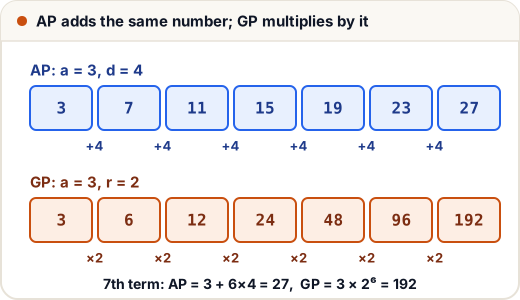
1. Arithmetic progression (AP)
Let the first term be a and the common difference be d (any term minus the one before it).
nth term: Tₙ = a + (n − 1)d
Why n − 1? To reach the 1st term you add d zero times; to reach the 2nd you add it once; to reach the nth you add it n − 1 times.
Example 1
Find the 20th term of 3, 7, 11, ….
a = 3, d = 4. T₂₀ = 3 + 19 × 4 = 79.
Example 2
The 4th term of an AP is 14 and the 10th term is 32. Find the first term and d.
a + 3d = 14 and a + 9d = 32. Subtract: 6d = 18 → d = 3, so a = 14 − 9 = 5. The AP is 5, 8, 11, 14, ….
2. Counting terms
Number of terms = (last − first) ÷ d + 1
The "+1" is the same idea as counting fence posts: from 7 to 207 in steps of 4 there are 200 ÷ 4 = 50 gaps and 51 terms.
Example 3 (TCS NQT style)
How many three-digit numbers are divisible by 7?
The first is 105 (7 × 15) and the last is 994 (7 × 142). Number of terms = (994 − 105) ÷ 7 + 1 = 127 + 1 = 128.
3. Sum of an AP
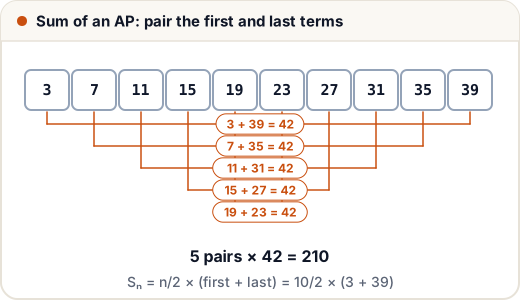
Sₙ = n/2 × (first + last) = n/2 × [2a + (n − 1)d]
Why it works. Pair the first term with the last, the second with the second-last, and so on. Every pair has the same total, because one number goes up by d exactly when the other goes down by d. There are n/2 pairs.
Example 4
Find the sum of all three-digit numbers divisible by 7.
From Example 3: n = 128, first = 105, last = 994. Sum = 128/2 × (105 + 994) = 64 × 1099 = 70,336.
Example 5 (salary question)
A fresher's yearly salary starts at ₹3,00,000 and rises by ₹20,000 every year. What is the total earned in 10 years?
AP with a = 3,00,000, d = 20,000, n = 10. S = 10/2 × [6,00,000 + 9 × 20,000] = 5 × 7,80,000 = ₹39,00,000.
Standard sums to know
| Sum | Formula | Example |
|---|---|---|
| 1 + 2 + … + n | n(n + 1)/2 | n = 100 → 5,050 |
| 1 + 3 + 5 + … (n odd numbers) | n² | 25 terms → 625 |
| 1² + 2² + … + n² | n(n + 1)(2n + 1)/6 | n = 10 → 385 |
| 1³ + 2³ + … + n³ | [n(n + 1)/2]² | n = 10 → 3,025 |
4. Geometric progression (GP)
First term a, common ratio r (any term divided by the one before it).
nth term: Tₙ = a × rⁿ⁻¹
Sum of n terms: Sₙ = a(rⁿ − 1)/(r − 1) (for r ≠ 1)
Why the sum formula works. Write S = a + ar + … + arⁿ⁻¹. Multiply by r: rS = ar + ar² + … + arⁿ. Subtract: rS − S = arⁿ − a. Every middle term cancels.
Example 6
The 2nd term of a GP is 6 and the 5th term is 162. Find the sum of the first 6 terms.
ar = 6 and ar⁴ = 162. Divide: r³ = 27 → r = 3, a = 2. S₆ = 2(3⁶ − 1)/(3 − 1) = 729 − 1 = 728.
5. Infinite GP
When −1 < r < 1, the terms shrink towards 0 and the whole endless sum has a fixed value:
S∞ = a / (1 − r)
(From the formula above: rⁿ becomes almost 0 for large n.)
- 16 + 8 + 4 + 2 + … = 16 / (1 − 1/2) = 32
- 0.4545… = 0.45 + 0.0045 + … = 0.45 / (1 − 0.01) = 45/99 = 5/11
Example 7 (bouncing ball)
A ball is dropped from 10 m. Each time it bounces back to 3/5 of its previous height. What total distance does it travel before it stops?
Down 10 m first. After that, every bounce goes up and comes down the same height: 2 × (6 + 3.6 + 2.16 + …). The bracket is an infinite GP: 6 / (1 − 3/5) = 15. Total = 10 + 2 × 15 = 40 m.
6. Harmonic progression and the three means
A harmonic progression (HP) is a list whose reciprocals form an AP. 1/2, 1/5, 1/8, … is an HP because 2, 5, 8, … is an AP. To find its 10th term, find the AP's 10th term (2 + 9 × 3 = 29) and flip it: 1/29.
For two positive numbers a and b:
| Mean | Formula | For 4 and 16 |
|---|---|---|
| Arithmetic (AM) | (a + b)/2 | 10 |
| Geometric (GM) | √(ab) | 8 |
| Harmonic (HM) | 2ab/(a + b) | 6.4 |
Two facts are tested often: AM ≥ GM ≥ HM (equal only when a = b), and AM × HM = GM² (10 × 6.4 = 64 = 8²).
Common mistakes
- Using n instead of n − 1 in Tₙ = a + (n − 1)d.
- Counting terms as (last − first) ÷ d and forgetting the +1.
- Using S∞ = a/(1 − r) when r is 1 or more. Then the sum has no fixed value.
- In bouncing-ball questions, forgetting that every bounce after the first drop is travelled twice (up and down).
- Writing the three-number AP as a, a + d, a + 2d. Use a − d, a, a + d: the d's cancel when you add.
Quick recap
- AP: Tₙ = a + (n − 1)d, Sₙ = n/2 (first + last). Terms = (last − first)/d + 1.
- GP: Tₙ = arⁿ⁻¹, Sₙ = a(rⁿ − 1)/(r − 1). Infinite GP (|r| < 1): a/(1 − r).
- HP: flip it into an AP, solve, flip back.
- AM ≥ GM ≥ HM and AM × HM = GM².
- Know n(n + 1)/2, n², n(n + 1)(2n + 1)/6 and [n(n + 1)/2]².