AdvancedQuantitative Aptitude · Lesson 28 of 38 · Updated ·
Geometry for Aptitude — Lines, Angles and Triangles
Geometry questions in placement tests (AMCAT, eLitmus, Capgemini, CAT-style company tests) mostly check a small set of facts. You don't need long proofs — you need to know which fact to use and to apply it quickly.
This lesson covers lines, angles and triangles. Circles and polygons come in the next lesson.
1. Angle facts
| Name | Rule | Example |
|---|---|---|
| Complementary angles | add up to 90° | 35° and 55° |
| Supplementary angles | add up to 180° | 110° and 70° |
| Angles on a straight line | add up to 180° | |
| Angles around a point | add up to 360° | |
| Vertically opposite angles | are equal | where two lines cross |
Why are vertically opposite angles equal? Each one makes 180° with the same neighbouring angle, so they must be the same size.
2. Parallel lines and a transversal
A transversal is a line that cuts two parallel lines. It creates eight angles, but only two different sizes, and those two add up to 180°.
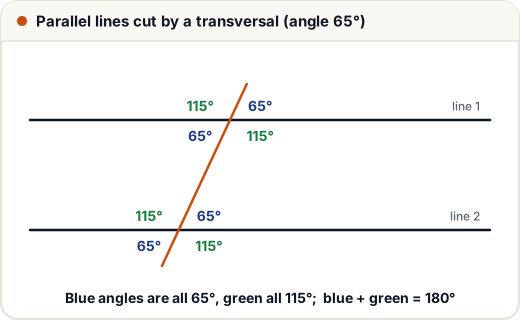
- Corresponding angles (same position at each crossing) are equal.
- Alternate angles (on opposite sides of the transversal, between the lines — a "Z" shape) are equal.
- Co-interior angles (same side, between the lines — a "C" shape) add up to 180°.
Example 1
Two corresponding angles are (2x + 10)° and (3x − 20)°. Find x and the angle.
Corresponding angles are equal: 2x + 10 = 3x − 20 → x = 30, angle = 70°.
Example 2
Two co-interior angles are x and 3x. Find them.
x + 3x = 180 → x = 45. The angles are 45° and 135°.
3. Triangle angles
Angle sum: the three angles of a triangle add up to 180°.
Exterior angle: an exterior angle equals the sum of the two opposite interior angles.
Why the exterior rule holds: the exterior angle and its neighbouring interior angle add to 180° (straight line). The three interior angles also add to 180°. Remove the shared angle from both, and what is left must be equal.
Example 3
The angles of a triangle are in the ratio 2 : 3 : 4. Find them.
9 parts = 180° → 1 part = 20°. Angles = 40°, 60°, 80°.
Example 4
An exterior angle of a triangle is 110°, and one of the opposite interior angles is 45°. Find the other.
110 = 45 + x → x = 65°.
In an isosceles triangle (two equal sides), the angles opposite the equal sides are equal. If the top (vertex) angle is 40°, each base angle is (180 − 40)/2 = 70°.
4. Which side lengths can make a triangle?
Triangle inequality: each side must be less than the sum of the other two, and more than their difference.
Why: the straight line is the shortest path between two points. Going "around" through the third corner must be longer.
Example 5 (Wipro / AMCAT style)
Two sides of a triangle are 5 cm and 9 cm. How many whole-number values can the third side take?
9 − 5 < x < 9 + 5 → 4 < x < 14 → x = 5, 6, …, 13. That is 9 values.
5. Right triangles and Pythagoras
In a right triangle with legs a, b and hypotenuse c (the longest side, opposite the 90° angle):
a² + b² = c²
Learn these Pythagorean triples — they save a lot of time: 3-4-5, 5-12-13, 8-15-17, 7-24-25, and their multiples like 6-8-10 and 9-12-15.
Example 6 (ladder question)
A 13 m ladder leans against a wall with its foot 5 m from the wall. How high up the wall does it reach?
5-12-13 triple → 12 m. (Check: 13² − 5² = 169 − 25 = 144 = 12².)
What kind of triangle? For sides a ≤ b ≤ c:
- a² + b² = c² → right-angled
- a² + b² > c² → acute (all angles under 90°)
- a² + b² < c² → obtuse (one angle over 90°)
So 6, 7, 8 is acute (36 + 49 = 85 > 64), and 4, 5, 7 is obtuse (16 + 25 = 41 < 49).
6. Area of a triangle
| Situation | Formula |
|---|---|
| Base and height known | ½ × base × height |
| All three sides known (Heron) | √[s(s − a)(s − b)(s − c)], where s = (a + b + c)/2 |
| Equilateral, side a | (√3/4) a²; height = (√3/2) a |
| Right triangle | ½ × leg × leg |
Example 7
Find the area of a triangle with sides 13, 14 and 15 cm.
s = 21. Area = √(21 × 8 × 7 × 6) = √7056 = 84 cm².
An equilateral triangle of side 6 cm has area (√3/4) × 36 = 9√3 ≈ 15.59 cm².
7. Similar triangles
Two triangles are similar when their angles are equal. Then their sides are in the same ratio, and:
Ratio of areas = (ratio of sides)²
Why squared: area uses two lengths multiplied (base × height), and both are scaled by the same factor.
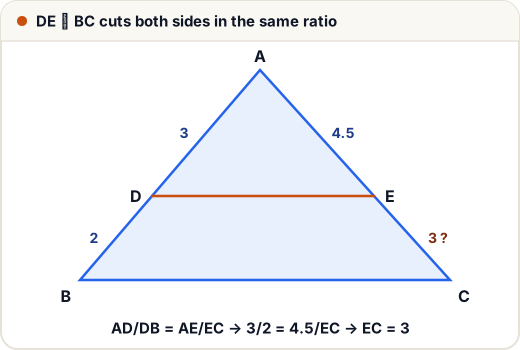
Basic proportionality theorem: a line drawn parallel to one side of a triangle cuts the other two sides in the same ratio.
Example 8
In triangle ABC, DE ∥ BC with D on AB and E on AC. AD = 3, DB = 2 and AE = 4.5. Find EC.
AD/DB = AE/EC → 3/2 = 4.5/EC → EC = 3.
Example 9 (shadows)
A 6 m pole casts a 4 m shadow. At the same time, a tower casts a 30 m shadow. How tall is the tower?
The sun's rays make similar triangles: height/shadow is the same. 6/4 = h/30 → h = 45 m.
Common mistakes
- Using area ratio = side ratio. It is the square of the side ratio.
- Accepting a "triangle" whose longest side equals or exceeds the sum of the other two.
- Forgetting that alternate and corresponding angles are equal only when the lines are parallel.
- In Heron's formula, using the perimeter instead of the semi-perimeter s.
Quick recap
- Line: 180°. Point: 360°. Vertically opposite angles are equal.
- Parallel lines: corresponding and alternate angles equal; co-interior add to 180°.
- Triangle: angles add to 180°; exterior angle = sum of the two opposite interior angles.
- Third side lies strictly between the difference and the sum of the other two.
- a² + b² = c²; learn 3-4-5, 5-12-13, 8-15-17, 7-24-25.
- Similar triangles: sides in one ratio, areas in its square.