AdvancedQuantitative Aptitude · Lesson 38 of 38 · Updated ·
Maximum and Minimum Values — AM-GM, Quadratics and Squares
"What is the largest area a farmer can fence with 100 m of wire?" "What is the least value of x² − 6x + 13?" Questions like these appear in TCS, Infosys and eLitmus-style papers, in CAT-type quant and in engineering maths. Calculus can solve them, but in an aptitude test you need a faster way.
This lesson gives you four tools: equal parts, completing the square, the vertex formula, and a few standard results. Each one comes with the reason it works.
1. Fixed sum → biggest product when the parts are equal
If two positive numbers have a fixed sum, their product is largest when they are equal.
If x + y = S, then xy is largest at x = y = S/2, and the largest product is S²/4.
Why: write x = S/2 + d and y = S/2 − d. Then xy = S²/4 − d². The d² can only take something away, so the best is d = 0.
Example 1
Two numbers add up to 20. What is the largest possible product?
10 × 10 = 100. Compare: 9 × 11 = 99, 8 × 12 = 96, 5 × 15 = 75 — always smaller.
This is a special case of the AM-GM inequality: for positive numbers, the arithmetic mean (AM) is at least the geometric mean (GM), with equality only when all numbers are equal. For two numbers: (x + y)/2 ≥ √(xy). The same rule works for three or more parts.
2. Fixed product → smallest sum when the parts are equal
Turn the same idea around: if xy = P is fixed, x + y is smallest when x = y = √P.
x + y ≥ 2√(xy)
Example 2
Two positive numbers multiply to 36. What is the smallest possible sum?
6 + 6 = 12. (4 + 9 = 13, 3 + 12 = 15, 2 + 18 = 20.)
A favourite: for any positive x, x + 1/x ≥ 2, with equality at x = 1. Here the product x × (1/x) = 1 is fixed, so the smallest sum is 2√1 = 2.
3. Rectangles and fencing
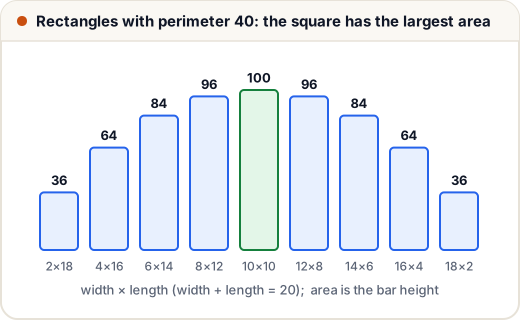
For a rectangle of fixed perimeter, length + width is fixed, so by section 1 the area is largest for a square.
Example 3 (fence with a wall)
A farmer has 100 m of fencing to enclose a rectangular field. One side is a long wall and needs no fence. Find the largest area.
Let the two sides touching the wall be w each. The side opposite the wall is 100 − 2w. Area = w(100 − 2w).
Careful: the "parts" w and 100 − 2w do not have a fixed sum, but 2w and 100 − 2w do (their sum is 100). Their product is largest when 2w = 100 − 2w → w = 25. Area = 25 × 50 = 1,250 m².
So with a wall, the best field is twice as long as it is wide, not a square.
4. Completing the square
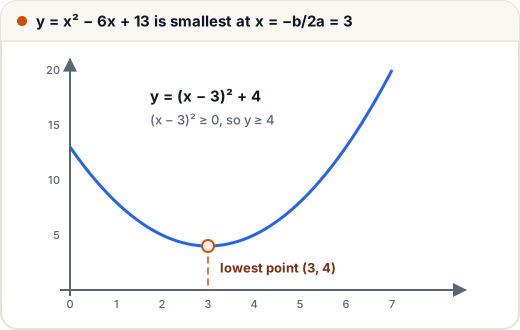
A perfect square is never negative: (anything)² ≥ 0. So if you can write an expression as (x − h)² + k, its smallest value is k, reached at x = h.
Example 4
Find the least value of x² − 6x + 13.
x² − 6x + 13 = (x² − 6x + 9) + 4 = (x − 3)² + 4. The square is at least 0, so the least value is 4, at x = 3.
5. The vertex formula for any quadratic
For y = ax² + bx + c, the turning point (vertex) is at:
x = −b ÷ 2a, and the value there is c − b² ÷ 4a.
- If a > 0, the curve is a "U" and this is the minimum.
- If a < 0, the curve is an upside-down "U" and this is the maximum.
Example 5
Find the maximum value of −2x² + 8x + 5.
a = −2 < 0, so there is a maximum. x = −8 ÷ (−4) = 2. Value = −8 + 16 + 5 = 13.
Example 6 (pricing)
A shop sells (100 − 2p) units when the price is ₹p. What price gives the largest revenue?
Revenue R = p(100 − 2p) = −2p² + 100p. Vertex: p = −100 ÷ (−4) = ₹25. Revenue = 25 × 50 = ₹1,250.
Notice it is the same numbers as the fencing problem — the same quadratic in a different story.
6. Two standard results worth memorising
a sin θ + b cos θ lies between −√(a² + b²) and +√(a² + b²).
Maximum of 3 sin θ + 4 cos θ = √(9 + 16) = 5. (Not 3 + 4 = 7: sin θ and cos θ cannot both be 1 at the same angle.)
Sum of distances |x − a| + |x − b| (with a < b) is smallest, and equal to b − a, for every x between a and b.
Least value of |x − 2| + |x − 8| = 8 − 2 = 6 (for any x from 2 to 8). Think of it as walking: the total distance from a point to two posts is smallest when you stand between them. For three points, stand at the middle one.
Common mistakes
- Using AM-GM with negative numbers. It is true only for positive (non-negative) values.
- Assuming the square is always best in fencing problems. With a wall on one side, it is not.
- Forgetting to check the sign of a: a > 0 gives a minimum, a < 0 a maximum.
- Adding the coefficients for a sin θ + b cos θ. The maximum is √(a² + b²), not a + b.
- Giving the x where the extreme happens when the question asks for the extreme value (or the other way round).
Quick recap
- Fixed sum → product is largest when the parts are equal (S²/4 for two parts).
- Fixed product → sum is smallest when the parts are equal (2√P); x + 1/x ≥ 2.
- Fixed perimeter → the square has the largest area; with one wall, length = 2 × width.
- (x − h)² + k has least value k at x = h.
- ax² + bx + c turns at x = −b/2a; minimum if a > 0, maximum if a < 0.
- Max of a sin θ + b cos θ = √(a² + b²); min of |x − a| + |x − b| = b − a.