AdvancedQuantitative Aptitude · Lesson 32 of 38 · Updated ·
Problems on Numbers — Digits, Consecutive Numbers, Fractions
Problems on numbers are short word puzzles: "a two-digit number becomes 27 more when its digits are reversed", "the sum of three consecutive even numbers is 78". They appear in almost every placement paper, including TCS NQT, Wipro, Capgemini and bank exams.
There is no new formula here. The whole skill is translating English into an equation with the right letters, and knowing a few patterns that save time.
1. Translate the words
| Words | Write |
|---|---|
| a number | x |
| 5 more than a number | x + 5 |
| 5 less than a number | x − 5 |
| twice a number, increased by 3 | 2x + 3 |
| the sum of a number and its reciprocal | x + 1/x |
| a number exceeds another by 7 | a − b = 7 |
| two numbers are in the ratio 3 : 4 | 3k and 4k |
The phrase "5 less than x" is x − 5, not 5 − x. Read it as "start from x and take 5 away".
2. Two-digit numbers and reversed digits
A two-digit number with tens digit a and units digit b is 10a + b, not "ab". For 36, a = 3 and b = 6, and 36 = 10 × 3 + 6.
Reversing the digits gives 10b + a. Two facts follow from simple subtraction and addition:
Reversed − original = 9(b − a) Original + reversed = 11(a + b)
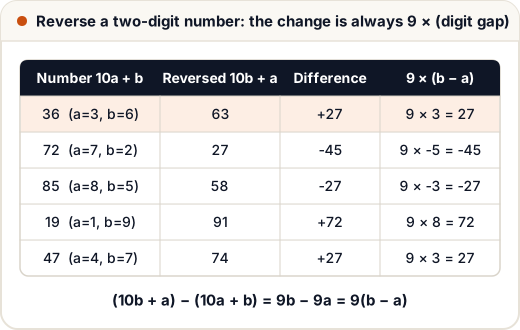
So any reversal question that gives a difference tells you the gap between the digits directly: divide by 9.
Example 1
The digits of a two-digit number add up to 9. Reversing the digits increases the number by 27. Find the number.
a + b = 9 and 9(b − a) = 27, so b − a = 3. Adding: 2b = 12 → b = 6, a = 3. The number is 36. Check: 63 − 36 = 27. ✓
Example 2
A two-digit number is 8 times the sum of its digits. If 45 is subtracted from it, the digits are reversed. Find the number.
The original is bigger, so a − b = 45/9 = 5. Also 10a + b = 8(a + b) → 2a = 7b. Try digits with gap 5: a = 7, b = 2 fits 2 × 7 = 7 × 2. The number is 72. Check: 72 − 45 = 27. ✓
Exam habit: with the options in front of you, test them. 72: digit sum 9, 8 × 9 = 72 ✓; 72 − 45 = 27 = reversed ✓. This takes ten seconds.
3. Consecutive numbers
| Type | Write them as | Example |
|---|---|---|
| consecutive integers | x, x + 1, x + 2 | 14, 15, 16 |
| consecutive even numbers | x, x + 2, x + 4 (x even) | 24, 26, 28 |
| consecutive odd numbers | x, x + 2, x + 4 (x odd) | 35, 37, 39 |
Even and odd both step by 2. The only difference is where you start.
Shortcut: for an odd count of consecutive numbers, the middle number = sum ÷ count.
Example 3
The sum of three consecutive even numbers is 78. Find the largest.
Middle = 78 ÷ 3 = 26. The numbers are 24, 26, 28, so the largest is 28.
Example 4
The product of two consecutive positive integers is 156. Find them.
x(x + 1) = 156. The square root of 156 is a little above 12, so try 12 × 13 = 156. ✓ The numbers are 12 and 13.
4. Sum, difference and product of two numbers
If you know a + b and a − b: a = (sum + difference)/2, b = (sum − difference)/2.
Sum 25, difference 7: a = 32/2 = 16, b = 18/2 = 9.
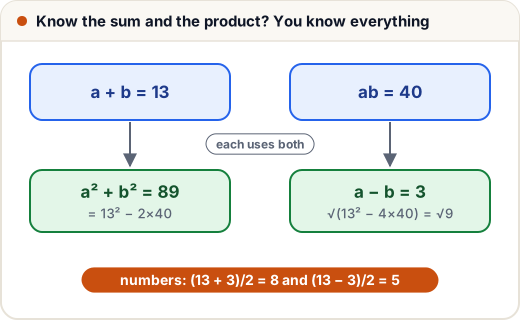
If you know the sum and the product, use these identities:
a² + b² = (a + b)² − 2ab (a − b)² = (a + b)² − 4ab
Example 5
Two numbers add up to 13 and their product is 40. Find the sum of their squares and the numbers.
a² + b² = 169 − 80 = 89. (a − b)² = 169 − 160 = 9, so a − b = 3. The numbers are 8 and 5.
Difference of squares is also common: a² − b² = (a + b)(a − b). If two consecutive numbers have squares that differ by 25, then (a + b) × 1 = 25, so the numbers are 13 and 12.
5. Fractions and reciprocals
Example 6
If 1 is added to both the numerator and the denominator of a fraction, it becomes 4/5. If 5 is subtracted from both, it becomes 1/2. Find the fraction.
Let the fraction be n/d.
- (n + 1)/(d + 1) = 4/5 → 5n + 5 = 4d + 4 → 5n − 4d = −1.
- (n − 5)/(d − 5) = 1/2 → 2n − 10 = d − 5 → d = 2n − 5.
Substitute: 5n − 4(2n − 5) = −1 → −3n + 20 = −1 → n = 7, d = 9. The fraction is 7/9. Check: 8/10 = 4/5 and 2/4 = 1/2. ✓
Example 7
A number plus its reciprocal is 10/3. Find the number.
x + 1/x = 10/3. Spot that 3 + 1/3 = 10/3. So x = 3 or 1/3 (both work).
6. The "wrong operation" problem (TCS favourite)
Example 8
A student was asked to multiply a number by 5/3. By mistake he multiplied it by 3/5 and got an answer 32 less than the correct one. Find the number.
Correct − wrong = x(5/3 − 3/5) = x × 16/15 = 32 → x = 30. Check: 30 × 5/3 = 50 and 30 × 3/5 = 18. 50 − 18 = 32. ✓
The pattern: the error equals the number times the difference between the two operations.
7. Dividing a number into two parts
Example 9
Divide 56 into two parts so that one-third of the first equals one-fourth of the second.
a/3 = b/4 means a : b = 3 : 4. So a = 56 × 3/7 = 24 and b = 32.
When a condition says "one part of A equals another part of B", turn it into a ratio first; it is faster than two equations.
Common mistakes
- Writing a two-digit number as a × b or "ab" instead of 10a + b.
- Using x, x + 1, x + 2 for consecutive odd numbers. Odd and even steps are 2.
- Reading "a number exceeds another by 7" as b − a = 7. The one that exceeds is the bigger.
- Stopping at a − b = 3 when the question asks for the numbers or their squares.
- Forgetting the second answer in reciprocal questions (3 and 1/3).
Quick recap
- Two-digit number = 10a + b; reversed − original = 9(b − a); their sum = 11(a + b).
- Consecutive integers step by 1; consecutive odd or even numbers step by 2; middle = sum ÷ count.
- From sum s and product p: a² + b² = s² − 2p, (a − b)² = s² − 4p.
- Fractions: write one equation per condition and cross-multiply.
- Wrong-operation error = number × (difference of the two operations).
- Always check the answer against every condition — or test the options.