AdvancedQuantitative Aptitude · Lesson 27 of 38 · Updated ·
Races, Games and Circular Tracks — Beats, Head Starts and Meeting Points
Race questions are speed questions with a story. Two ideas solve almost all of them:
- In the same time, distances are in the ratio of speeds.
- On a circular track, use relative speed (how fast the gap between two runners changes).
1. The words used in race questions
| Phrase | Meaning (in a 1,000 m race) |
|---|---|
| A beats B by 100 m | When A finishes 1,000 m, B has run only 900 m |
| A beats B by 10 s | B finishes 10 seconds after A |
| A gives B a start of 100 m | B starts 100 m ahead, so B runs only 900 m |
| Dead heat | Both reach the finish at the same moment |
| In a game of 100 points, A gives B 20 points | When A scores 100, B scores 80 |
2. "Beats by" means a speed ratio
If A beats B by 100 m in a 1,000 m race, A ran 1,000 m while B ran 900 m in the same time. So:
Speed of A : Speed of B = 1000 : 900 = 10 : 9
Every race question becomes a ratio question this way.
Example 1 (chained races)
In a 1 km race, A beats B by 100 m, and B beats C by 100 m. By how much does A beat C?
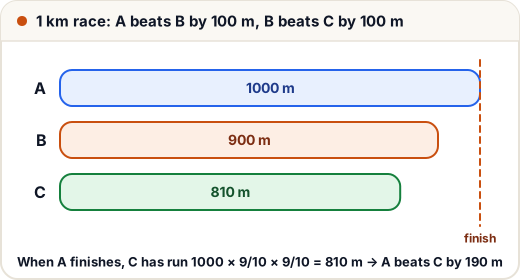
When A runs 1,000 m, B runs 900 m. While B runs 900 m, C runs 9/10 of that = 810 m. So A beats C by 190 m — not 200 m. The second loss is 10% of a shorter distance.
Example 2 (beats by distance AND time)
In a 1,000 m race, A beats B by 50 m or 10 seconds. Find A's time.
The two facts describe the same gap: B needs 10 seconds to cover the last 50 m. So B's speed = 50 ÷ 10 = 5 m/s.
B's time for 1,000 m = 200 s. A finishes 10 s earlier: 190 seconds.
Example 3 (beat from times)
A runs 1 km in 3 min 10 s and B in 3 min 20 s. By how many metres does A beat B?
B is 10 s behind. B's speed = 1000/200 = 5 m/s, so in 10 s B covers 50 m. A beats B by 50 m.
3. Head starts and dead heats
Example 4
A runs 5/3 times as fast as B. In a 1 km race, how much start should A give B so that they finish together (a dead heat)?
Speeds A : B = 5 : 3. In the time A runs 1,000 m, B runs 1000 × 3/5 = 600 m. So B can start 1,000 − 600 = 400 m ahead.
Why: a dead heat means both use the same time, so the distances they run must be in the speed ratio.
4. Games of points
These work exactly like races, with points instead of metres.
Example 5
In a game of 100 points, A can give B 20 points and C 28 points. How many points can B give C in a game of 90?
When A scores 100, B scores 80 and C scores 72. So B : C = 80 : 72 = 10 : 9.
In a game of 90, when B scores 90, C scores 90 × 9/10 = 81. B can give C 9 points.
5. Circular tracks: when do they first meet?
Picture the gap between two runners on a track of length L. They meet whenever one has gained (or closed) a whole lap on the other.
Opposite directions: first meet after L ÷ (a + b)
Same direction: first meet after L ÷ (b − a) (b is the faster speed)
Why: in opposite directions they close the gap at a + b per second, and together they must cover one full lap. In the same direction, the faster one gains b − a per second and must gain a full lap.
Example 6 (TCS / Infosys style)
Two runners start together from the same point on a 360 m circular track at 6 m/s and 10 m/s.
- Opposite directions: first meet after 360 ÷ 16 = 22.5 s.
- Same direction: first meet after 360 ÷ 4 = 90 s.
6. When do they meet at the starting point?
Now each runner must be back at the start at the same moment, so the time must be a whole number of laps for each runner:
First meeting at the start = LCM of their lap times
In Example 6, lap times are 360/6 = 60 s and 360/10 = 36 s. LCM(60, 36) = 180 s. This answer does not depend on the direction.
For three runners with lap times 12, 15 and 20 minutes, they are all at the start together after LCM = 60 minutes.
7. How many different meeting points?
Reduce the speed ratio to its simplest form, a : b.
Same direction: number of distinct meeting points = b − a
Opposite directions: number of distinct meeting points = a + b
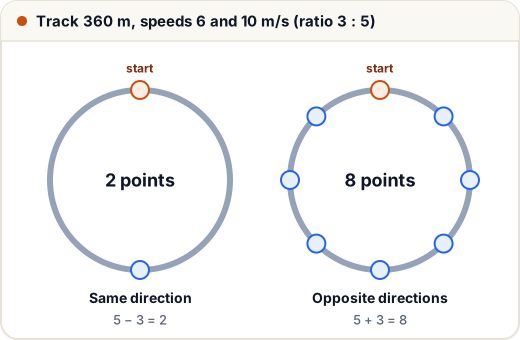
For 6 : 10 = 3 : 5: same direction → 5 − 3 = 2 points; opposite → 5 + 3 = 8 points.
Why: in the opposite case, between two meetings the slower runner covers a/(a + b) of a lap, so meeting points step around the track in jumps of 3/8 of a lap. After 8 jumps they are back at the start, having visited 8 different spots.
Common mistakes
- Chaining "beats by" amounts by adding them (100 + 100 = 200). Multiply the ratios instead.
- Using the race length instead of the shorter distance B ran when building ratios.
- Using a + b for same direction or b − a for opposite directions. Same direction → the gap closes slowly (difference).
- Not reducing the speed ratio before counting meeting points: 6 : 10 must become 3 : 5.
- Confusing "first meeting anywhere" (relative speed) with "first meeting at the start" (LCM of lap times).
Quick recap
- A beats B by x m in a D m race → speed ratio D : (D − x).
- Chained races: multiply the fractions, don't add the distances.
- Beats by x m or t s → the slower runner's speed = x ÷ t.
- Circular track first meeting: L/(a + b) opposite, L/(b − a) same direction.
- Meeting at the start: LCM of lap times.
- Distinct meeting points (ratio a : b in lowest terms): b − a same direction, a + b opposite.