AdvancedQuantitative Aptitude · Lesson 36 of 38 · Updated ·
Instalments and EMI — Repaying a Loan in Equal Parts
When you buy a phone "on EMI" or take an education loan, you do not repay everything at once. You pay equal instalments at regular intervals. Aptitude questions ask: how big must each instalment be so that the loan is fully cleared?
The idea behind every answer is the same: the instalments, moved to one common date, must equal the loan moved to that date. With simple interest we move everything to the end; with compound interest it is easiest to move everything to today (present worth).
This lesson builds on the simple and compound interest lesson and the present-worth idea from true discount.
1. Instalments under simple interest
Question type: "What equal annual instalment will discharge a debt of ₹A due in n years at R% simple interest?"
Each instalment is paid early, so it earns interest until the due date:
- The 1st instalment (end of year 1) earns interest for n − 1 years.
- The 2nd earns for n − 2 years, … the last earns nothing.
Add them all and set the total equal to A:
A = n·x + x·R·[1 + 2 + … + (n − 1)]/100, so x = 100A ÷ [100n + R·n(n − 1)/2]
Example 1
Find the annual instalment that will discharge a debt of ₹1,092 due in 2 years at 8% SI.
The first instalment x earns 1 year's interest: x + 8% of x = 1.08x. The second is paid on the due date: x. 1.08x + x = 1,092 → 2.08x = 1,092 → x = ₹525.
Formula check: 100 × 1,092 ÷ (200 + 8 × 1) = 109,200 ÷ 208 = 525. ✓
Example 2
What annual instalment discharges a debt of ₹3,240 due in 3 years at 8% SI?
Interest years: 2 + 1 + 0 = 3. So 3x + x × 8 × 3/100 = 3x + 0.24x = 3.24x = 3,240 → x = ₹1,000.
Check by thinking: ₹1,000 paid after year 1 grows to ₹1,160 by the end, ₹1,000 paid after year 2 grows to ₹1,080, and the last ₹1,000 is paid on the day. Total ₹3,240. ✓
2. Instalments under compound interest
Question type: "A sum of ₹P is borrowed at r% compound interest and repaid in n equal annual instalments. Find each instalment."
Bring every instalment back to today. An amount x paid after k years is worth x ÷ (1 + r/100)ᵏ now. The present worths must add up to the loan:
P = x/(1 + r/100) + x/(1 + r/100)² + … + x/(1 + r/100)ⁿ
Example 3
₹21,000 is borrowed at 10% per annum compound interest and repaid in 2 equal annual instalments. Find each instalment.
With 1 + r/100 = 1.1: 21,000 = x/1.1 + x/1.21 = x(1.1 + 1)/1.21 = 2.1x/1.21. x = 21,000 × 1.21 ÷ 2.1 = ₹12,100.
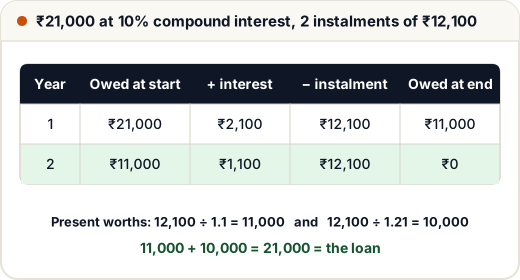
The table checks the answer the way a bank would: add interest, subtract the payment, repeat. The balance reaches exactly zero.
Fast trick with fractions: at 10%, use 1.1 = 11/10. Then x/1.1 = 10x/11 and x/1.21 = 100x/121. Many exam numbers (21,000; 33,100; 3,310) are chosen so that powers of 11 cancel neatly.
Example 4
₹3,310 is repaid in 3 equal annual instalments at 10% CI. Find each instalment.
3,310 = x(1/1.1 + 1/1.21 + 1/1.331) = x × (1.21 + 1.1 + 1)/1.331 = 3.31x/1.331. x = 3,310 × 1.331 ÷ 3.31 = ₹1,331.
3. Why the two methods differ
| Simple interest | Compound interest | |
|---|---|---|
| Interest is earned on | the original amount only | amount + earlier interest |
| Easiest common date | the due date (end) | today (present worth) |
| Typical wording | "a debt due in n years" | "a sum borrowed, repaid in n instalments" |
Read the wording. "Due in n years" gives you the final amount; "borrowed" gives you today's amount.
4. EMI: monthly instalments
Banks charge compound interest monthly and collect an EMI (equated monthly instalment). The same present-worth equation, summed with the GP formula from the progressions lesson, gives:
EMI = P × i × (1 + i)ⁿ ÷ [(1 + i)ⁿ − 1]
where i is the monthly rate (annual % ÷ 12 ÷ 100) and n is the number of months.
Example 5
Find the EMI on ₹1,00,000 at 12% per annum (1% per month) for 12 months.
(1.01)¹² ≈ 1.12683. EMI = 1,00,000 × 0.01 × 1.12683 ÷ 0.12683 ≈ ₹8,884.88. Total paid ≈ 12 × 8,884.88 = ₹1,06,618.55, so the total interest is about ₹6,618.55.
Notice: the interest is about ₹6,619, not ₹12,000. You do not pay 12% on the whole ₹1,00,000 for a year, because the balance falls every month.
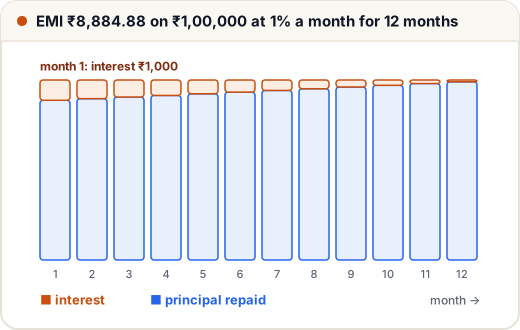
Each EMI is the same, but its make-up changes. In month 1 the interest is 1% of ₹1,00,000 = ₹1,000, so ₹7,884.88 goes to the principal. As the balance falls, the interest part shrinks and the principal part grows. Aptitude tests rarely ask for full EMI calculations, but this split is a common interview and finance-course question.
Common mistakes
- Using the SI formula when the question says compound interest (or the reverse).
- In SI problems, giving interest to the last instalment. It is paid on the due date and earns nothing.
- In CI problems, dividing by (1 + r/100) only once for every instalment. The k-th instalment is divided k times.
- Using the annual rate in the EMI formula. Convert to a monthly rate.
- Thinking total EMI interest = rate × principal × years. The balance reduces, so the interest is less.
Quick recap
- Same idea everywhere: instalments moved to a common date = the loan moved to that date.
- SI, debt A due in n years: x = 100A ÷ [100n + R·n(n − 1)/2].
- CI, sum P borrowed: P = Σ x/(1 + r/100)ᵏ for k = 1 … n.
- EMI = P·i·(1 + i)ⁿ / [(1 + i)ⁿ − 1] with a monthly rate i.
- In an EMI, the interest part falls and the principal part rises each month.