AdvancedQuantitative Aptitude · Lesson 34 of 38 · Updated ·
Stocks and Shares — Face Value, Market Value, Dividend, Yield
Stocks and shares questions appear in bank exams, some campus papers and the business-maths part of BCA/BBA courses. The maths is only percentages. What trips students up is the vocabulary — and one rule: the dividend is paid on the face value, not on the price you paid.
A note before we start: the rules below are the conventions used in exam questions. Real stock markets have more detail (tax, demat charges, dividends declared per share, prices changing every second). The exam versions are simplified on purpose.
1. The words
| Word | Meaning |
|---|---|
| Share | one small unit of ownership in a company |
| Face value (FV) | the value printed on the share, also called nominal or par value — e.g. ₹10 or ₹100 |
| Market value (MV) | the price at which it is actually bought or sold today |
| At par | MV = FV |
| At a premium | MV > FV (e.g. a ₹100 share selling at ₹120 is "at 20 premium") |
| At a discount | MV < FV (e.g. ₹100 share at ₹90 is "at 10 discount") |
| Dividend | the part of profit the company pays per share, given as a % of FV |
| Brokerage | the fee paid to the broker for buying or selling |
| Yield (rate of return) | income as a % of the money you actually invested |
The key relations:
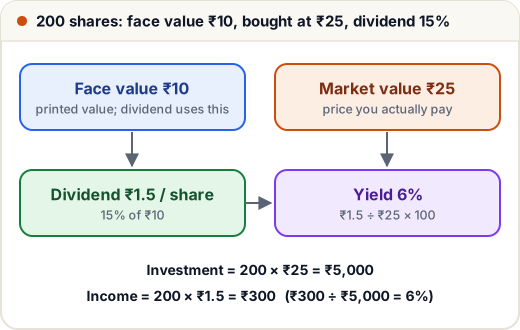
Dividend per share = dividend % × FV Yield % = dividend per share ÷ MV × 100
2. Income and investment
Example 1
Ravi buys 200 shares of face value ₹10 at ₹25 each. The company declares a 15% dividend. Find his investment, his income and the yield.
Investment = 200 × 25 = ₹5,000. Dividend per share = 15% of ₹10 = ₹1.50. Income = 200 × 1.50 = ₹300. Yield = 300 ÷ 5,000 × 100 = 6%.
The company paid "15%", but Ravi earns only 6% on his money because he paid 2.5 times the face value.
3. "x% stock at y" questions
Many questions say "9% stock at 120". Read it as: face value ₹100, market value ₹120, dividend 9% of ₹100 = ₹9 a year per unit.
For every ₹120 invested you get ₹100 of stock and ₹9 of income. Keep this little table in your head:
| Per unit of stock | Amount |
|---|---|
| Money paid (MV) | ₹120 |
| Stock (FV) received | ₹100 |
| Income | ₹9 |
Every question is then a simple proportion.
Example 2
How much income does ₹6,000 give when invested in 9% stock at 120? What is the yield?
Stock bought = 6,000 × 100/120 = ₹5,000 (face value). Income = 9% of 5,000 = ₹450. Yield = 9 ÷ 120 × 100 = 7.5% (check: 450 ÷ 6,000 = 7.5%).
Example 3 (investment needed)
How much must be invested in 12% stock at 110 to get an annual income of ₹1,200?
Each ₹110 gives ₹12. Units needed = 1,200 ÷ 12 = 100. Investment = 100 × 110 = ₹11,000. (Face value of stock = ₹10,000.)
4. Brokerage
Brokerage is usually given as a rupee amount (or %) per ₹100 stock. Exam convention:
- When buying, brokerage is added: you pay MV + brokerage.
- When selling, brokerage is subtracted: you receive MV − brokerage.
Example 4
Find the cost of ₹5,000 stock of 10% at 96, brokerage ¼.
Cost per ₹100 stock = 96 + 0.25 = ₹96.25. For ₹5,000 stock (50 units): 50 × 96.25 = ₹4,812.50.
If the question gives brokerage as a % of the market value instead, compute it on MV. Read the wording carefully — it varies between books.
5. Comparing two stocks
To compare, find the yield of each. Higher yield means more income per rupee invested.
Example 5
Which is better: 8% stock at 90 or 9% stock at 108?
Yields: 8/90 × 100 ≈ 8.89%, and 9/108 × 100 ≈ 8.33%. The 8% stock at 90 is better, even though its dividend rate is lower.
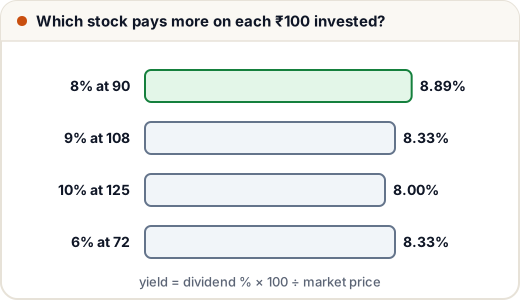
Shortcut: compare dividend ÷ price as fractions. 8/90 vs 9/108: cross-multiply 8 × 108 = 864 and 9 × 90 = 810. 864 is bigger, so 8/90 is bigger.
6. Selling one stock and buying another
Example 6
A man sells ₹5,000 of 6% stock at 96 and invests the money in 8% stock at 120. Find the change in his income.
Old income = 6% of 5,000 = ₹300. Money received = 5,000 × 96/100 = ₹4,800. New stock = 4,800 × 100/120 = ₹4,000. New income = 8% of 4,000 = ₹320. Change = ₹20 more per year.
7. A five-step method
- Write MV, FV and the dividend % for each stock.
- Convert the money invested into units: units = investment ÷ (MV + brokerage).
- Stock (face value) = units × FV.
- Income = dividend % × stock.
- Yield = income ÷ investment × 100.
Common mistakes
- Taking the dividend % on the market value. It is always on the face value.
- Confusing "₹5,000 stock" (face value) with "₹5,000 invested" (money paid). Read which one is given.
- Adding brokerage when selling. When selling you receive less, so subtract it.
- Comparing stocks by dividend rate alone. Compare by yield.
- Forgetting that "at par" means the yield equals the dividend rate.
Quick recap
- FV = printed value; MV = price paid; premium if MV > FV, discount if MV < FV.
- Dividend = % of FV. Yield = dividend ÷ MV × 100.
- "r% stock at p": pay ₹p, get ₹100 of stock and ₹r of income.
- Brokerage: add when buying, subtract when selling.
- To choose between stocks, compare yields (cross-multiply r/p).