How to Prepare for Campus Placements in 90 Days (2026 Plan for Freshers)
Pankaj Sharma ·
Most students start placement preparation too late and too wide — a bit of everything, nothing finished. Ninety days is enough to be test-ready and interview-ready for mass recruiters like TCS, Infosys, Wipro, Accenture and Cognizant, if you follow the order in which companies actually filter you.
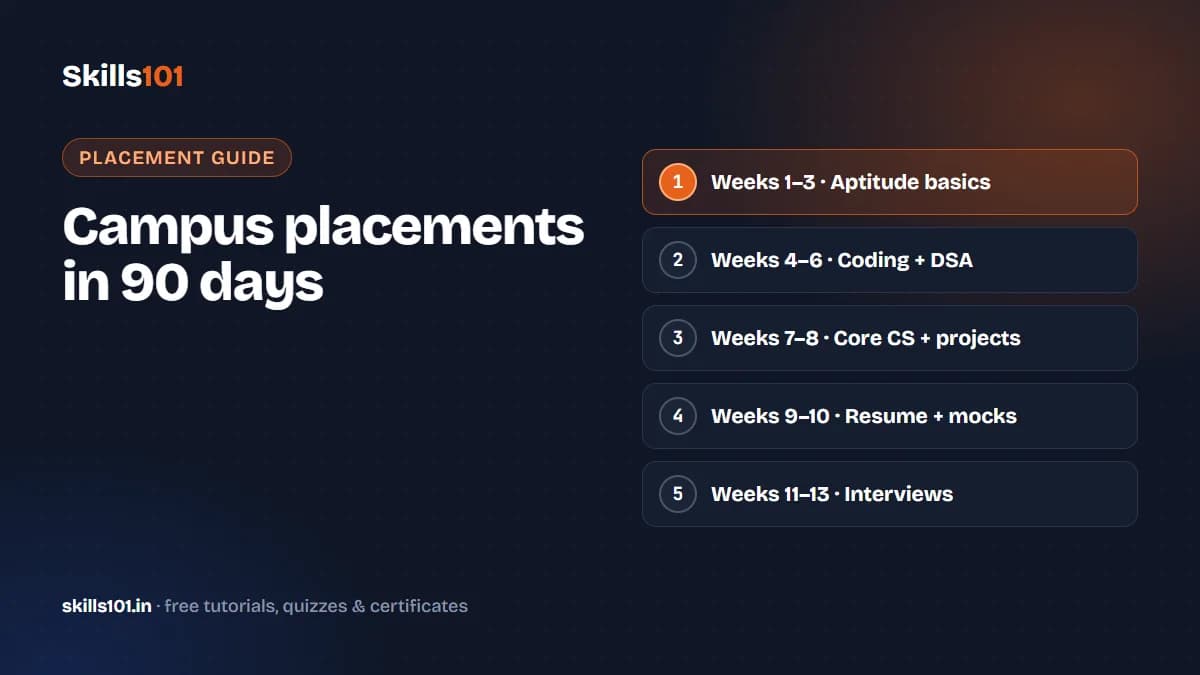
The 90-day plan in one line: clear the aptitude test first (it removes the most candidates), then coding, then core subjects and your project, then resume and mock tests, and finally interviews. Study 3–4 hours a day, and take a timed mock every week from week 3.
Why the order matters
A typical fresher hiring process has four filters:
| Stage | What it checks | Why students fail |
|---|---|---|
| 1. Online test | aptitude, reasoning, verbal, sometimes coding | sectional cut-offs, rushing easy questions |
| 2. Coding round / section | 1–3 programs | no practice under a timer, poor input/output handling |
| 3. Technical interview | your project, one language, OOP, DBMS basics | can't explain their own project |
| 4. HR interview | communication, attitude, relocation | memorised, unnatural answers |
The first filter removes the most people, so it gets your first weeks. Company-specific patterns differ — see the latest TCS NQT, Infosys, Accenture and Wipro patterns before you plan.
The week-by-week plan
Weeks 1–3: Aptitude, reasoning and verbal basics
Goal: finish every core topic once, with a quiz after each.
- Quantitative: number system, percentages, profit & loss, ratio, time & work, time, speed & distance, averages, interest, probability, P&C.
- Reasoning: series, coding–decoding, blood relations, directions, seating, syllogisms.
- Verbal: error spotting, tenses, vocabulary, reading comprehension.
- End of week 3: take your first full mock without preparing for it. The score tells you where you really stand.
Tip from our own data: time and work and number system cause the most lost marks — do them first.
Weeks 4–6: Coding and core DSA
Goal: solve easy problems quickly and correctly in one language.
- Pick one language (C++, Java or Python) and stay with it. Switching costs weeks.
- Topics in this order: arrays and strings → hashing → two pointers → sorting and searching → recursion → linked lists → stacks and queues. Follow the free DSA tutorials and the DSA sheet.
- Solve 3 problems a day on a judge, under a 30-minute timer each. Test edge cases: empty input, one element, duplicates, large numbers.
- Keep doing 20 aptitude questions a day so the first three weeks don't fade.
Weeks 7–8: Core subjects and your project
Goal: answer the five questions every technical interviewer asks.
- OOP: the four pillars with your own example — OOP basics.
- DBMS and SQL: keys, normalisation, joins, GROUP BY — DBMS & SQL.
- Operating systems and networks: processes vs threads, deadlock, TCP vs UDP, what happens when you type a URL — OS, networks.
- Your project: write a one-page explanation — the problem, your role, the tech stack, one hard bug you fixed, and what you would improve. Practise saying it aloud in two minutes.
Weeks 9–10: Resume and timed mocks
Goal: a one-page resume and steady mock scores above the cut-off.
- Build a one-page resume: education, skills you can defend, 2 projects with results, certificates — see fresher resume.
- Take two timed company mocks a week with sectional timers (placement mocks). Review every wrong answer the same day.
- Set up a clean LinkedIn and GitHub.
Weeks 11–13: Interviews and company-specific practice
Goal: speak clearly about yourself, your project and your basics.
- Practise the common HR questions aloud — record yourself and listen back.
- Revise the technical interview guide and one interview-question set for your language (Java, OOP, SQL).
- Do mock interviews with friends: one asks, one answers, swap.
- Before each company's test, solve its question set — for example Capgemini pseudocode + aptitude or Cognizant.
A daily timetable that fits around college
| Time | What | Why |
|---|---|---|
| 45 min (morning) | 20 aptitude / reasoning questions | short daily practice beats weekend marathons |
| 90 min (evening) | coding: 2–3 problems on a judge | the skill that takes longest to build |
| 30 min | one core-subject topic or your project notes | interviews ask "why", not just "what" |
| 15 min | English: read one article aloud, write 5 sentences | verbal sections and interviews both reward it |
On weekends, replace this with one full timed mock and a review of every mistake.
Seven mistakes that cost freshers their placement
- Starting with HR answers — the online test eliminates far more people than HR does.
- Watching videos without solving — learning happens when you get answers wrong and fix them.
- Collecting too many resources — one course per area, finished, beats five started.
- Ignoring sectional cut-offs — a high total doesn't help if one section is below the line.
- Switching programming languages every few weeks.
- Not practising with a timer — real tests feel twice as fast as practice.
- A resume that lists skills you can't defend — every line is a possible interview question.
Free resources mapped to this plan
| Need | Free on Skills101 |
|---|---|
| Aptitude, reasoning, verbal lessons + certificate | Free tutorials |
| Company patterns and solved questions | Placement prep by company |
| Coding practice with a judge | Practice |
| Timed company mocks with all-India rank | Mock tests |
| A personal week-by-week plan | 90-day roadmap |
Frequently asked questions
Is 90 days enough to prepare for campus placements?
Yes, for mass-recruiter tests and interviews, if you study 3–4 hours a day and follow the order of the hiring filters: aptitude, coding, core subjects and project, resume and mocks, then interviews. Product-company DSA rounds usually need longer.
What should I study first for placements?
Aptitude and reasoning. The online test removes the most candidates, and most of its marks come from a small set of topics like percentages, ratios, time and work, and number system.
Which programming language is best for placements?
The one you already know best. C++, Java and Python are all accepted in coding rounds. Switching languages costs more time than any language advantage gives you.
How many coding problems should I solve before placements?
Quality matters more than count. Around 150–200 well-understood problems across arrays, strings, hashing, recursion, linked lists and stacks is a solid base for service-company coding rounds.
Do I need certificates for campus placements?
They help only if you can back them up in the interview. A finished project you can explain well is worth more than several certificates.