Logical Reasoning · Lesson 8 of 13 · Updated ·
Syllogisms — Solve with Venn Diagrams, Including "Possibility" Questions
A syllogism gives two or three statements (which you must accept as true, even if they sound silly) and asks which conclusions definitely follow.
1. Draw each statement
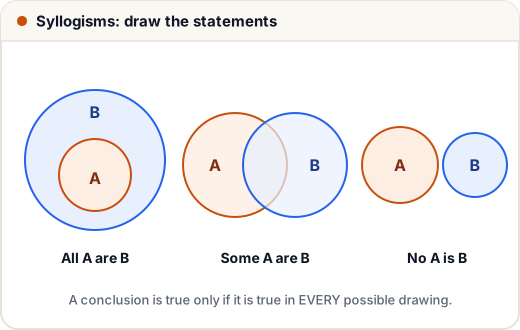
| Statement | Drawing | Note |
|---|---|---|
| All A are B | A inside B | B may still have things that aren't A |
| Some A are B | A and B overlap | At least one A is B. Possibly all! |
| No A is B | A and B separate | Nothing in common |
| Some A are not B | part of A outside B |
The golden rule: a conclusion is valid only if it is true in every drawing that fits the statements. If you can draw even one picture where it is false, it does not follow.
2. Solved examples
Example 1
Statements: All dogs are animals. All animals are living things. Conclusions: I. All dogs are living things. II. Some living things are dogs.
Dogs inside animals inside living things. I ✓ (always). II ✓ (the dogs are inside living things, so some living things are dogs). Both follow.
Example 2
Statements: Some pens are books. Some books are bags. Conclusions: I. Some pens are bags. II. No pen is a bag.
Draw pens overlapping books, books overlapping bags. Pens and bags may or may not touch.
- I does not always hold. II does not always hold.
- But one of them must be true (either some pens are bags or none are) → Either I or II follows.
Either-or applies when the two conclusions are about the same pair, one is "some" and the other "no" (or "all" and "some … not"), and neither follows alone.
Example 3
Statements: All cars are vehicles. No vehicle is a toy. Conclusions: I. No car is a toy. II. Some vehicles are cars.
Cars inside vehicles; toys outside vehicles → toys can't touch cars. I ✓. II ✓ (cars are inside vehicles). Both follow.
3. Possibility questions
"Some A being C is a possibility" asks: can you draw it at all without breaking the statements?
Example 4
Statements: All roses are flowers. No flower is a stone. Conclusion: Some roses being stones is a possibility.
Roses are inside flowers, and flowers can't touch stones → roses can never touch stones → does not follow.
Example 5
Statements: Some apps are games. All games are free. Conclusion: All apps being free is a possibility.
Could every app be free? Yes — draw apps inside "free" as well. Nothing forbids it → follows.
Quick rules
- Some + Some → no definite conclusion.
- All + All → All (A ⊂ B ⊂ C gives all A are C).
- All + No → No (if all A are B and no B is C, no A is C).
- "Some" is reversible: some A are B ⇔ some B are A. "All" is not: all A are B does not mean all B are A.
Common mistakes
- Using real-world knowledge. Only the statements count.
- Thinking "some" means "not all". In syllogisms, "some" allows "all".
- Reversing an "all" statement.
Quick recap
- Draw every statement; test conclusions in every valid drawing.
- Some is reversible; all is not.
- Either-or: same pair, complementary conclusions, neither definite alone.
- Possibility: can you draw it without breaking anything?