Logical Reasoning · Lesson 10 of 13 · Updated ·
Calendars — Find the Day of Any Date with Odd Days
Calendar questions ask "what day of the week was this date?" The method is counting odd days — the days left over after full weeks.
1. Leap years
- A year divisible by 4 is a leap year (2024, 2028).
- But a century year (1900, 2000) is a leap year only if divisible by 400.
- So 2000 was a leap year; 1900 and 2100 are not.
2. Odd days
An odd day is a day beyond complete weeks. 8 days = 1 week + 1 odd day.
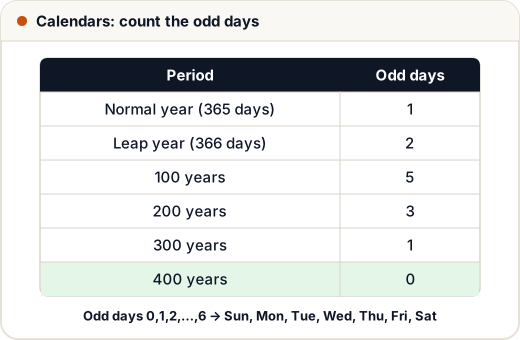
- Normal year = 365 days = 52 weeks + 1 odd day
- Leap year = 366 days = 52 weeks + 2 odd days
- 100 years (24 leap + 76 normal) = 124 days → 5 odd days
- 400 years → 0 odd days (so the calendar repeats every 400 years)
Month odd days (non-leap year): Jan 3, Feb 0, Mar 3, Apr 2, May 3, Jun 2, Jul 3, Aug 3, Sep 2, Oct 3, Nov 2, Dec 3. (In a leap year Feb has 1.)
3. Day shifts: the fast method
Most questions give one date and ask about another nearby. Just count odd days between them.
Example 1
1 January 2025 was a Wednesday. What day is 1 January 2026?
2025 is a normal year → +1 odd day → Thursday.
Example 2
15 August 2024 was a Thursday. What day was 15 August 2025?
From 15 Aug 2024 to 15 Aug 2025 there is no 29 February in between (it was in Feb 2024, before August) → +1 → Friday.
Example 3
If 5 March 2023 was a Sunday, what day was 5 March 2024?
This period includes 29 Feb 2024 → +2 → Tuesday.
Example 4 — within a year
If 1 March is a Monday, what day is 1 June in the same year?
Odd days: March 3 + April 2 + May 3 = 8 → 8 mod 7 = 1 → Tuesday.
4. Day of the week from scratch
Count odd days from 1 January of year 1 (which counts as a Monday). Use the table: 0 = Sunday, 1 = Monday, … 6 = Saturday.
Example 5
What day was 26 January 1950?
- 1600 years → 0 odd days. 300 more (1601–1900) → 1.
- 1901–1949: 49 years with 12 leap years → 49 + 12 = 61 → 61 mod 7 = 5.
- 26 days of January 1950 → 26 mod 7 = 5.
- Total = 0 + 1 + 5 + 5 = 11 → 11 mod 7 = 4 → Thursday. ✓ (India's first Republic Day was a Thursday.)
5. Same calendar years
Two years have the same calendar if they start on the same day and are both leap or both normal.
Example 6
Which is the next year with the same calendar as 2023?
Add up the odd days year by year, starting from 2023, until the running total is a multiple of 7 — and the year you land on is also a normal (non-leap) year like 2023.
| Year | Type | Odd days | Running total |
|---|---|---|---|
| 2023 | normal | 1 | 1 |
| 2024 | leap | 2 | 3 |
| 2025 | normal | 1 | 4 |
| 2026 | normal | 1 | 5 |
| 2027 | normal | 1 | 6 |
| 2028 | leap | 2 | 8 |
| 2029 | normal | 1 | 9 |
| 2030 | normal | 1 | 10 |
| 2031 | normal | 1 | 11 |
| 2032 | leap | 2 | 13 |
| 2033 | normal | 1 | 14 ✓ |
After 2033 the total is 14 (a multiple of 7), so 2034 starts on the same day as 2023, and both are normal years → same calendar.
Common mistakes
- Calling 1900 or 2100 a leap year.
- Adding 2 for a leap year when 29 February is not inside the period.
- Forgetting to reduce totals mod 7.
Quick recap
- Leap year: divisible by 4; century years only if divisible by 400.
- Normal year → 1 odd day, leap year → 2.
- Count odd days between dates; reduce mod 7; shift the day.
- 0 = Sunday … 6 = Saturday.