Logical Reasoning · Lesson 12 of 13 · Updated ·
Data Sufficiency — Decide If You Can Answer, Without Solving
A data sufficiency (DS) question gives a question and two statements. You don't find the answer — you decide whether the statements give enough information to find it.
1. The method
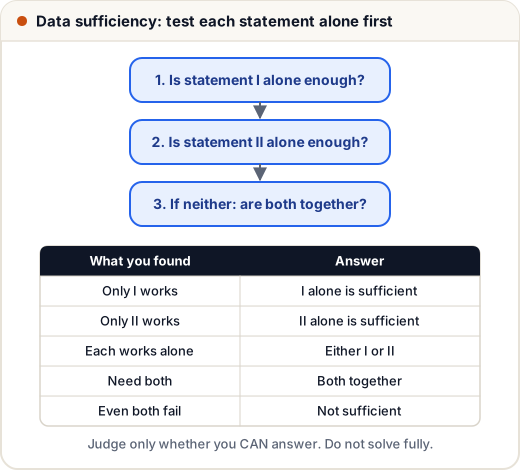
The five standard options (the wording varies):
- I alone is sufficient, II alone is not.
- II alone is sufficient, I alone is not.
- Either I alone or II alone is sufficient.
- Both together are needed (neither alone works).
- Not sufficient even together.
When you test statement II alone, forget everything statement I told you. This is the most common mistake.
2. Solved examples
Example 1
What is the value of x? I. 2x + 3 = 11 II. x² = 16
- I alone: x = 4 ✓ (one value)
- II alone: x = 4 or −4 ✗ (two values)
- Answer: I alone.
Example 2
Is A taller than B? I. A is taller than C. II. C is taller than B.
- I alone: nothing about B ✗. II alone: nothing about A ✗.
- Together: A > C > B → yes ✓.
- Answer: Both together.
Example 3
What is Ravi's age? I. Ravi is 5 years older than Sunil. II. The sum of their ages is 45.
- Each alone ✗. Together: R − S = 5, R + S = 45 → R = 25 ✓.
- Answer: Both together.
Example 4
How many students are in the class? I. Riya is 10th from the top and 21st from the bottom. II. There are 18 boys and the girls are 12.
- I alone: 10 + 21 − 1 = 30 ✓.
- II alone: 18 + 12 = 30 ✓.
- Answer: Either statement alone.
Example 5 — a yes/no question
Is n an even number? I. n is divisible by 4. II. n is a multiple of 3.
- I: every multiple of 4 is even → definitely yes ✓.
- II: 6 is even, 9 is odd → could be either ✗.
- Answer: I alone.
For yes/no questions, a statement is sufficient if it gives a definite yes or a definite no. "Definitely no" also counts as sufficient!
Traps
- Don't solve fully. Once you know there's exactly one answer, stop.
- Two values are not sufficient (like x² = 16).
- Don't assume things that aren't stated (e.g. that x is positive or a whole number).
Quick recap
- Test I alone, II alone (forget I), then both.
- Map the result to one of the five options.
- A definite "no" is sufficient.
- Watch for hidden second values and unstated assumptions.