Logical Reasoning · Lesson 6 of 13 · Updated ·
Seating Arrangement — Linear and Circular, Step by Step
Seating puzzles give 5–8 clues about where people sit. They take time, but they follow a fixed method — and one puzzle usually gives you 3–5 marks.
The method (works for every seating puzzle)
- Draw the seats first (a row or a circle).
- Place the definite clues ("A sits at an end", "B is opposite C").
- Then clues that link two people ("D sits second to the right of A").
- If a clue has two possibilities, draw both and continue each until one breaks.
- Leave "negative" clues ("E does not sit next to F") for checking at the end.
1. Linear seating (a row)
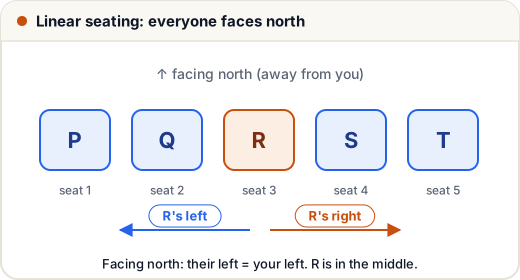
- Facing north (away from you as you look at the paper): their left = your left.
- Facing south (towards you): their left = your right. Flip it.
Example 1
Five friends A, B, C, D, E sit in a row facing north. C is in the middle. A is to the immediate left of C. B sits at the right end. E is not at an end. Find the order.
- Seats 1–5 (left to right). C = seat 3. A = seat 2. B = seat 5.
- E is not at an end → E = seat 4. D = seat 1.
- Order: D A C E B.
Example 2 — "second to the right"
In the answer above: who is second to the right of A? A is seat 2 → seat 4 = E.
2. Circular seating (a round table)
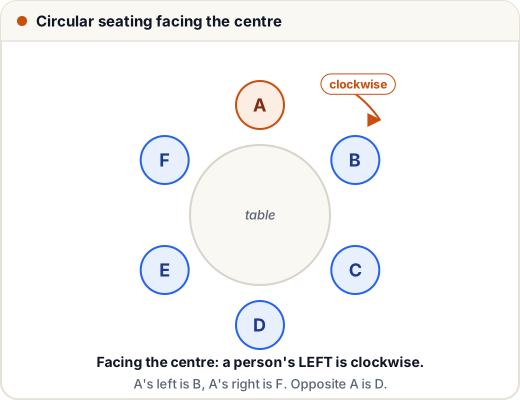
Facing the centre: LEFT = clockwise, RIGHT = anticlockwise. (If they face outside, it flips.)
With 6 people, the person opposite is 3 seats away. With 8 people, 4 seats away.
Example 3
Six people P, Q, R, S, T, U sit around a round table facing the centre. P is opposite S. Q is to the immediate left of P. T sits between S and U. U is not next to Q. Who is opposite Q?
Number the seats 1–6 clockwise.
- Put P at seat 1. P is opposite S → S at seat 4.
- Q is immediately left of P. Left = clockwise → Q at seat 2.
- Free seats: 3, 5, 6. T is between S and U, so T sits next to S → T is at 3 or 5.
- If T = 3, U must be on T's other side = seat 2. But Q is there ✗.
- So T = 5 and U = 6. Check: U is next to seats 5 and 1, not Q ✓.
- The last person, R, takes seat 3.
Clockwise order: P, Q, R, S, T, U. Opposite Q (seat 2) is seat 5 → T.
When a clue allows two places, try both — one of them breaks another clue, exactly as in step 3.
Example 4
Eight friends sit around a round table facing the centre. A sits opposite E. B is second to the left of A. C is to the immediate right of E. D is opposite B. Who is to the immediate left of E?
- 8 seats; A at seat 1, E at seat 5 (opposite).
- Left = clockwise. B is second to the left of A → seat 3.
- D opposite B → seat 7.
- C immediately right of E (anticlockwise) → seat 4.
- Immediate left of E (clockwise) → seat 6 → whoever is left (F, G or H) — not fixed by these clues.
So the clues fix A, B, C, D, E but not who sits at seat 6. In an exam the answer would be "cannot be determined" unless one more clue is given. Reading what is not fixed is as important as what is.
Common mistakes
- Using your own left and right for people facing south or facing outwards.
- Forgetting that around a table, "left" for people facing the centre is clockwise.
- Fixing a doubtful clue too early instead of drawing both cases.
Quick recap
- Draw seats → sure clues → linking clues → branch on doubtful clues → check negatives.
- Row facing north: their left = your left. Facing south: flip.
- Round table facing centre: left = clockwise. Opposite = n/2 seats away.
- "Cannot be determined" is a real answer when the clues don't fix someone.