Logical Reasoning · Lesson 13 of 13 · Updated ·
Statements, Assumptions and Conclusions — Critical Reasoning Made Simple
These questions give a short statement (an advert, a notice, a news line) and ask what is assumed, what follows, or what action makes sense. You must use only the statement and common sense — not extra knowledge.
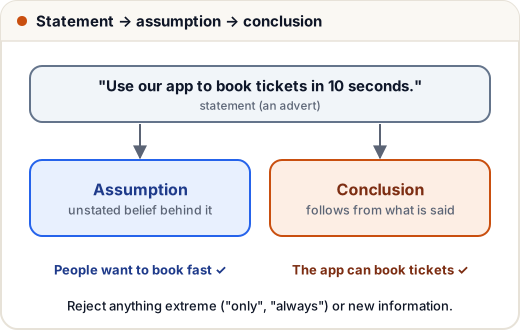
1. Assumptions (what is taken for granted)
An assumption is something the speaker must believe for the statement to make sense — but did not say.
Test: negate it. If the statement now makes no sense, it was an assumption.
Example 1
Statement: "Join our weekend coding classes to get placed in a top company." I. People want to get placed in top companies. II. Weekend classes are the only way to get placed.
- I: if nobody wanted good placements, the advert would be pointless → implicit ✓
- II: "only" is extreme; the advert doesn't claim that → not implicit ✗
- Answer: Only I is implicit.
2. Conclusions (what follows)
A conclusion must follow directly from the statement. No new information.
Example 2
Statement: "All students who scored above 90% in the mock got a free certificate. Asha scored 94%." I. Asha got a free certificate. II. Asha is the best student in the class.
- I follows directly ✓.
- II needs information we don't have ✗.
- Answer: Only I follows.
3. Course of action
A good course of action is practical, directly addresses the problem, and is not extreme.
Example 3
Statement: "Many students in a college failed the placement aptitude test." I. The college should start aptitude training for final-year students. II. The college should stop all placement drives.
- I is practical and addresses the problem ✓.
- II is extreme and makes things worse ✗.
- Answer: Only I should be followed.
Words that usually mean "reject"
only, always, never, all, every, best, worst, definitely, must — when they appear in an option that the statement did not say, the option is usually too strong.
Words like some, may, can, likely are softer and more often acceptable.
Common mistakes
- Using your own knowledge instead of the statement.
- Accepting an option because it is true in real life, not because it follows.
- Choosing extreme actions ("ban", "shut down") that don't solve the problem sensibly.
Quick recap
- Assumption: unstated but necessary. Negate to test.
- Conclusion: follows directly, no new information.
- Course of action: practical, directly addresses the problem, not extreme.
- Be suspicious of only / always / never / best.