Verbal Ability (English) · Lesson 2 of 8 · Updated ·
Tenses — All 12 on One Card, With the Rules Tests Check
A tense tells when something happens. English has 3 times (past, present, future) and 4 forms of each, giving 12 tenses. You don't need grammar terms in the exam — you need to pick the right form quickly.
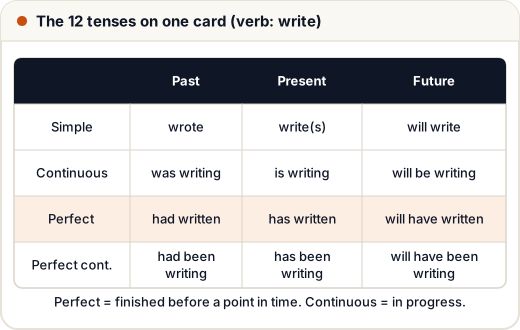
1. The four forms
| Form | Meaning | Example |
|---|---|---|
| Simple | a fact, habit or completed action | She writes code every day. |
| Continuous | in progress at that time | She is writing code now. |
| Perfect | completed before a point in time | She has written 200 programs. |
| Perfect continuous | started earlier and still going (or just stopped) | She has been writing since 9 am. |
2. Time words are your clue
| Clue word | Tense |
|---|---|
| yesterday, last year, ago, in 2020 | Simple past (I went) |
| every day, usually, always | Simple present (He goes) |
| now, at the moment, look! | Present continuous (She is going) |
| just, already, yet, ever, never, so far | Present perfect (I have finished) |
| since + point, for + duration (still continuing) | Present perfect (continuous) (I have lived here for 5 years) |
| by the time, before (in the past) | Past perfect for the earlier action |
| tomorrow, next week | Simple future (I will call) |
3. The rules tests check most
Rule 1 — no present perfect with a finished past time
- ✗ "I have seen him yesterday." → ✓ "I saw him yesterday."
The present perfect connects the past to now, so it can't be used with "yesterday", "last year", "in 2020".
Rule 2 — since vs for
- since + a point in time: since 2019, since Monday, since morning
- for + a length of time: for 5 years, for two hours
✓ "He has been working here since 2021" / "for five years."
Rule 3 — past perfect for the earlier of two past actions
✓ "When I reached the station, the train had left." (The train left first.)
Rule 4 — after "did / does / do", use the base verb
- ✗ "She did not went." → ✓ "She did not go."
- ✗ "Does he knows?" → ✓ "Does he know?"
Rule 5 — state verbs are not used in continuous forms
Verbs like know, understand, believe, like, want, own, belong describe states, not actions.
- ✗ "I am knowing the answer." → ✓ "I know the answer."
Rule 6 — no "will" after if/when for the future
- ✗ "If it will rain, we will stay home." → ✓ "If it rains, we will stay home."
Common mistakes
- Using "have seen" with "yesterday".
- Using "since" with a duration ("since five years" ✗).
- Using continuous forms of know, like, want.
- Using "will" after "if" or "when".
Quick recap
- Look for time words — they decide the tense.
- Present perfect = past connected to now; never with "yesterday".
- since + point, for + duration.
- Past perfect = the earlier of two past actions.
- did/does/do + base verb; no "will" after if/when.