Verbal Ability (English) · Lesson 4 of 8 · Updated ·
Vocabulary — Synonyms, Antonyms, One-Word Substitutes and Idioms
Vocabulary questions are quick marks if you know the word — and impossible if you don't. The smartest way to grow vocabulary is to learn roots, because one root unlocks many words.
1. Learn roots, not lists
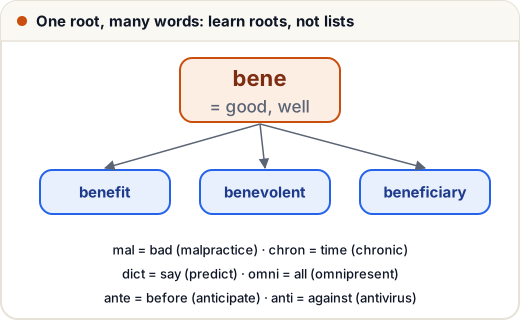
| Root | Meaning | Words |
|---|---|---|
| bene | good | benefit, benevolent |
| mal | bad | malpractice, malicious |
| chron | time | chronic, chronological |
| dict | say | predict, contradict, verdict |
| omni | all | omnipresent, omnivore |
| ante / pre | before | antecedent, predict |
| anti / contra | against | antibiotic, contradict |
| graph | write | autograph, biography |
| phil | love | philosophy, philanthropist |
| aud | hear | audible, audience |
2. Synonyms and antonyms (frequently asked)
| Word | Synonym | Antonym |
|---|---|---|
| Abundant | plentiful | scarce |
| Candid | frank | secretive |
| Diligent | hard-working | lazy |
| Eminent | famous | unknown |
| Frugal | thrifty | extravagant |
| Hostile | unfriendly | friendly |
| Lucid | clear | confusing |
| Obsolete | outdated | modern |
| Prudent | wise, careful | reckless |
| Transparent | clear, open | opaque |
| Vague | unclear | precise |
| Zeal | enthusiasm | apathy |
Exam trick: if you don't know the word, use charge: does it sound positive or negative? Benevolent (bene = good) is positive, so its antonym must be negative (cruel).
3. One-word substitutes
| Phrase | One word |
|---|---|
| A person who knows many languages | Polyglot |
| Fear of heights | Acrophobia |
| A list of items for a meeting | Agenda |
| Record of what was decided at a meeting | Minutes |
| Something that cannot be read | Illegible |
| Government by the people | Democracy |
| A person who does not believe in God | Atheist |
| Life story written by oneself | Autobiography |
| One who looks at the bright side | Optimist |
| A place where bees are kept | Apiary |
4. Idioms and phrases
| Idiom | Meaning |
|---|---|
| Break the ice | start a conversation in an awkward situation |
| Hit the nail on the head | say exactly the right thing |
| A piece of cake | very easy |
| Burn the midnight oil | work late into the night |
| Once in a blue moon | very rarely |
| Call it a day | stop working |
| Cost an arm and a leg | very expensive |
| Spill the beans | reveal a secret |
| Under the weather | slightly ill |
| Back to square one | back to the beginning |
5. Spelling rules that cover most errors
- i before e, except after c: believe, receive, ceiling (exceptions: weird, seize).
- Doubling: begin → beginning, occur → occurred (stress on the last syllable).
- Commonly misspelt: accommodate, necessary, separate, occasion, embarrass, definitely, environment, guarantee.
Common mistakes
- Picking a word that is related but not a synonym (e.g. "doctor" for "hospital").
- Choosing the synonym when the question asks for the antonym — read the question twice.
- Taking idioms literally.
Quick recap
- Learn roots: one root → many words.
- Use positive/negative charge to guess unknown words.
- Keep a small notebook of one-word substitutes and idioms; revise weekly.