Verbal Ability (English) · Lesson 1 of 8 · Updated ·
Sentence Basics and Subject–Verb Agreement — The Most Tested Grammar Rule
Most "spot the error" questions in TCS, Infosys and Wipro tests are about one rule: the verb must agree with its subject. A singular subject takes a singular verb; a plural subject takes a plural verb.
1. Find the subject and the verb
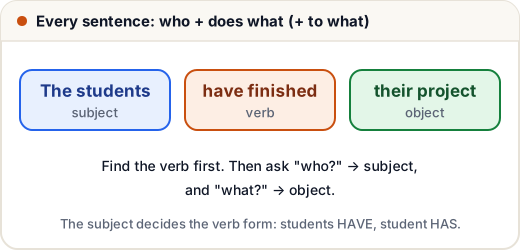
- Find the verb (the action or "being" word: is, are, has, works, finished).
- Ask "who or what?" before it — that is the subject.
- Check: singular subject → singular verb (is, was, has, works); plural subject → plural verb (are, were, have, work).
Careful: in the present tense, a singular verb usually ends in -s (he works), while a plural noun ends in -s (students). That's why "The student works" and "The students work" both look right.
Example 1
"The list of items are on the desk."
What is on the desk? The list (singular) — "of items" is just extra detail. → "The list of items is on the desk."
Ignore the words between the subject and the verb (phrases with of, with, along with, in). They never change the subject.
2. The tricky subjects
Example 2
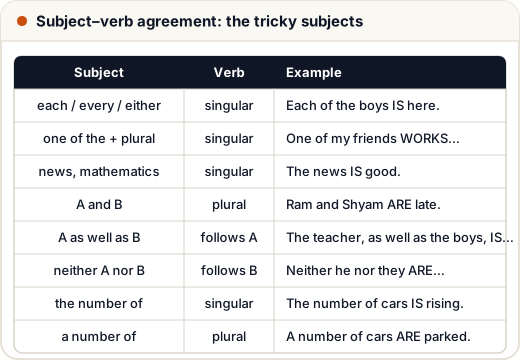
"One of my friends work at Infosys." → The subject is one → "One of my friends works at Infosys."
Example 3
"Neither the manager nor the employees was present." → the verb follows the nearer subject (employees) → "were present."
Example 4
"The captain, along with his players, are arriving today." → "along with" adds detail; the subject is the captain → "is arriving."
Example 5
"Mathematics are my favourite subject." → subjects ending in -ics (when they mean a subject of study), and news, are singular → "Mathematics is…"
3. Collective nouns
Words like team, family, committee, jury, class are usually singular when the group acts as one unit.
- "The team is playing well." (as one unit)
- "The jury were divided in their opinions." (members acting separately — less common, but correct)
4. Uncountable nouns
Information, advice, furniture, luggage, equipment, news have no plural and take singular verbs.
- ✗ "The informations are useful." → ✓ "The information is useful."
- ✗ "She gave me many advices." → ✓ "She gave me a lot of advice" / "some advice."
Common mistakes
- Matching the verb to the nearest noun instead of the real subject ("The quality of the mangoes is good").
- Adding -s to uncountable nouns (informations, furnitures).
- Using a plural verb after each, every, either, neither, everyone, somebody.
Quick recap
- Find the verb, then ask "who?" to find the subject.
- Ignore phrases between the subject and the verb.
- each/every/one of/the number of → singular; a number of / A and B → plural.
- neither/either … or/nor → the verb follows the nearer subject.
- information, advice, news, furniture → singular, no -s.