Interview & Career · Lesson 5 of 12 · Updated ·
Cracking the Technical Interview — Coding Rounds, CS Questions and Projects
In technical rounds, interviewers judge how you think, not only whether your final code runs. A candidate who explains clearly and reaches a decent solution often beats one who silently writes perfect code.
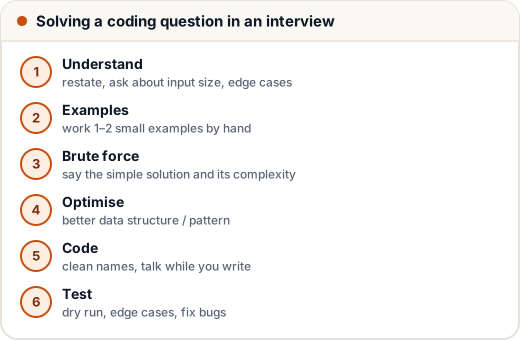
1. The 6-step approach to coding questions
Worked example (spoken aloud)
"Find two numbers in an array that add up to a target."
- Understand: "Can there be negative numbers? Exactly one answer? Return indexes or values? How big can the array be?"
- Examples:
[2, 7, 11, 15], target 9 → indexes 0 and 1. - Brute force: "Check every pair — O(n²) time, O(1) space."
- Optimise: "While scanning, store each number in a hash map; for each x, check if target − x is already there — O(n) time, O(n) space."
- Code it, naming variables clearly and explaining each line.
- Test: run the example by hand; then edge cases — empty array, duplicates, no answer.
(Practise this exact problem on our Two Sum page.)
2. What interviewers score
| Area | What they look for |
|---|---|
| Problem solving | asks good questions, finds a working approach, improves it |
| Coding | correct, readable code; handles edge cases |
| Communication | explains thinking; takes hints well |
| CS knowledge | DSA, OOP, DBMS, OS, networks basics |
| Projects | real understanding of what you built |
Getting stuck is normal. Say what you're thinking; interviewers often give hints — and using a hint well is a positive sign.
3. Talking about your projects
Expect: "Explain your best project." Prepare for each project:
- The problem it solves and who uses it.
- The architecture (draw it: frontend → API → database).
- Your part, if it was a team project.
- One technical challenge and how you solved it.
- What you'd improve with more time (shows maturity).
Interviewers dig into anything on your résumé — if you list Docker, be ready to explain a Dockerfile.
4. CS fundamentals: what to revise
| Subject | Must-know topics |
|---|---|
| DSA | arrays, strings, hashing, two pointers, recursion, trees, graphs basics, sorting, complexity |
| OOP | 4 pillars, overloading vs overriding, abstract class vs interface |
| DBMS & SQL | keys, normalization, joins, GROUP BY, transactions, indexing, 2nd highest salary query |
| OS | process vs thread, scheduling, deadlock, paging, virtual memory |
| Networks | OSI, TCP vs UDP, HTTP vs HTTPS, DNS, what happens when you type a URL |
5. Before the interview
- Revise your own résumé — every line.
- Practise 2–3 problems out loud with a timer.
- For online rounds: test the coding platform, camera and mic; keep water, paper and a pen.
Common mistakes
- Jumping into code without clarifying the problem.
- Silence for minutes.
- Not testing your code before saying "done".
- Bluffing — "I don't know, but here's how I'd find out" is far better.
Quick recap
- 6 steps: understand → examples → brute force → optimise → code → test.
- Think aloud; use hints; mention complexity.
- Know every project deeply; draw its architecture.
- Revise DSA, OOP, DBMS, OS and networks basics.