Interview & Career · Lesson 12 of 12 · Updated ·
Job, GATE, MS Abroad, MBA or Government Jobs? — Choosing Your Path After B.Tech, BCA or MCA
"Should I do a job, GATE, MS or MBA?" is one of the most common questions final-year students ask — usually with advice from relatives, seniors and social media all pulling in different directions. There's no single right answer, but there is a sensible way to decide.
1. The main paths at a glance
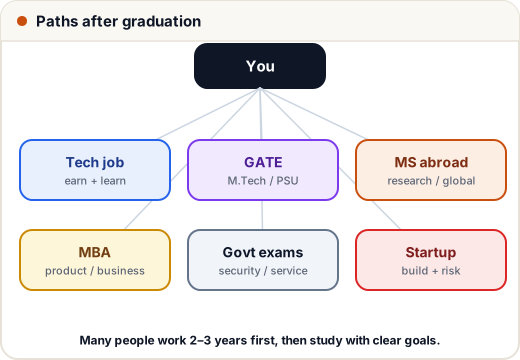
| Path | Good fit if you… | Main preparation | Watch out for |
|---|---|---|---|
| Tech job | want to build things and earn early | DSA, projects, core CS, interviews | first job may not be your dream role — that's fine |
| GATE → M.Tech (IITs/NITs) | love core CS/research, want deeper expertise or teaching | GATE syllabus (DSA, OS, DBMS, CN, TOC, COA, maths) | 2 more years; value depends on the institute and your goals |
| GATE → PSU jobs | want stable government-sector engineering roles | high GATE score + PSU interview | limited CS-specific PSU openings; cut-offs are high |
| MS abroad | want research or a global career, can manage costs/loans | GRE (if required), IELTS/TOEFL, SOP, LORs, projects/research | high cost, visa and job-market uncertainty — research carefully |
| MBA | want business, product, consulting or management roles | CAT/GMAT, often 1–3 years of work experience first | expensive; work experience usually improves outcomes |
| Government exams | value job security and public service | exam-specific (SSC, banking, state PSCs, UPSC) | long preparation cycles, intense competition |
| Startup / freelancing | have high risk tolerance and a problem to solve | building, selling, learning fast | income uncertainty; many founders work a few years first |
These paths aren't one-way doors: many people work 2–3 years, then do an MS or MBA with clearer goals and savings.
2. Tech job first — the default for most
For most CS/IT graduates, starting with a job is the lowest-risk option:
- you earn and become financially independent;
- you discover what you actually enjoy (backend? data? product? research?) before investing in a degree;
- work experience strengthens later applications for MS/MBA.
Tracks on Skills101 that map directly to entry-level roles: DSA, Java/Spring Boot, Web Development, Data Science & ML, AI Engineering, Cloud & DevOps, Test Automation, plus the Placement company mocks.
3. GATE
GATE (Graduate Aptitude Test in Engineering) is used for M.Tech/MS admissions at IITs, NITs and IIITs (often with a stipend), for some PSU recruitment, and for some research positions.
- The CS syllabus overlaps heavily with core subjects — Skills101's DSA, OS, DBMS, Computer Networks, COA, Discrete Maths and Theory of Computation tracks cover much of it, with GATE-style numericals.
- Preparation typically takes 6–12 months alongside college, with heavy practice of previous years' papers.
- Check the official GATE website each year for the exact syllabus, dates, eligibility and which PSUs are recruiting through it — these change.
4. MS abroad
Questions to answer honestly before spending lakhs on applications:
- Why? Research interest, a specialisation not available in India, or a plan to work abroad?
- Money: total cost (tuition + living) and how it will be funded; realistic loan repayment.
- Outcomes: the job market and visa rules in that country right now — read recent official sources and talk to current students, not agents with commissions.
- Profile: strong projects, research or work experience matter more than a long list of certificates. Many universities have made the GRE optional; English tests (IELTS/TOEFL) are usually required.
5. MBA
An MBA can open product management, consulting, finance and leadership roles. Many top programmes prefer (or require) work experience, and students with 2–4 years of experience often get better outcomes. A tech background plus an MBA is common for product manager roles — though many PMs also move into the role directly from engineering.
6. Government exams
Government jobs offer security and meaningful public work. Technical roles exist (e.g. in PSUs, ISRO and DRDO through their own recruitment processes, government IT departments, and banks' IT officer roles), alongside general exams. They need dedicated, long preparation — decide deliberately rather than as a fallback "just in case", and check official notifications for eligibility and patterns.
7. A decision framework
Score each option you're considering from 1–5 on what matters to you:
| Question | Job | GATE/M.Tech | MS | MBA |
|---|---|---|---|---|
| Do I enjoy the day-to-day work this leads to? | ||||
| Can I afford it (money and time)? | ||||
| Does it fit my 5-year goal? | ||||
| What's the downside if it doesn't work out? | ||||
| What do people currently on this path say? |
Then:
- Talk to 3 people currently on each path you're seriously considering (alumni are perfect — see the Networking lesson).
- Prefer options that keep doors open when you're unsure (e.g. a job while preparing for GATE or saving for an MS).
- Set a review date: "I'll reassess in 12 months."
8. Case studies (typical patterns)
- Riya loved OS and compilers, scored well in GATE, did an M.Tech with a stipend, and joined a systems team at a chip company — the depth fitted her interest.
- Arjun took a service-company job, built Spring Boot and cloud skills, switched to a product company in two years, and is now deciding on an MS with savings and a clear specialisation.
- Fatima worked as a developer for three years, moved into product management via an MBA, and uses her engineering background daily.
None of them followed a "best" path — each chose what fitted their interests, finances and timing.
Common mistakes
- Choosing a path because "everyone in my class is doing it".
- Taking large loans without researching costs, job markets and visa rules.
- Preparing for three different exams at once and doing none well.
- Treating the first job as permanent — careers are long, and switching is normal.
Quick recap
- Main paths: job, GATE (M.Tech/PSU), MS abroad, MBA, government exams, startup.
- A job first is the lowest-risk default for most and strengthens later applications.
- GATE overlaps with core CS subjects; check official details yearly.
- MS/MBA: be clear on why, cost and outcomes; work experience often helps.
- Decide with a scorecard, real conversations with alumni, doors kept open and a review date.