Interview & Career · Lesson 11 of 12 · Updated ·
Your First 90 Days as a Software Engineer — Onboarding, Asking Questions, Code Reviews, Standups and Growing Fast
Getting the offer is the start, not the finish. The first three months decide how your team sees you — and how quickly you get interesting work. The good news: what managers look for in freshers isn't brilliance, it's reliability, curiosity and communication.
1. The 30-60-90 plan
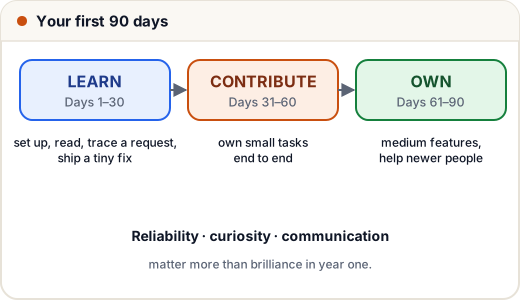
| Phase | Focus | A good sign you're on track |
|---|---|---|
| Days 1–30: learn | set up the dev environment, read docs, understand the product, meet the team | your first small PR (bug fix, test, docs) is merged |
| Days 31–60: contribute | own small tasks end to end | you deliver tasks with little hand-holding |
| Days 61–90: own | medium features, on-call shadowing, improving tooling | teammates start asking you about your area |
2. Onboarding into a big codebase
A real codebase may have hundreds of thousands of lines. Nobody reads it all. Instead:
- Run it locally first; write down every setup step that wasn't documented — then improve the setup doc (a perfect first PR).
- Follow one request end to end: from the UI click → API route → service → database and back. Use the debugger and logs.
- Read tests to learn how code is supposed to behave.
- Use
git log/git blameto see why code changed (the PR description often explains it). - Keep a personal notes file: architecture sketch, commands, who owns what, acronyms.
3. Asking good questions
Freshers worry about asking "stupid questions"; managers worry more about people who stay stuck silently for days. The rule of thumb: try for 30–60 minutes, then ask — with context.
Weak: "Hey, the build is not working."
Strong:
Hi Priya — running
./gradlew teston a fresh clone fails withConnection refused: localhost:5432. I've started Postgres viadocker compose up dband checked the port is free. Is there an extra step for test DB setup that I'm missing? (Full error in thread.)
What you tried + exact error + specific question = fast, happy answers. Ask in team channels rather than private messages when others might benefit, and write down the answer so you never ask twice.
4. Pull requests reviewers love
- Small: one change, ideally under ~300 lines. Big PRs get slow, shallow reviews.
- Clear title and description: what changed, why, how you tested, screenshots for UI, risks.
- Self-review first: read your own diff before requesting review; remove debug prints and commented-out code.
- Tests included and CI green.
- Respond to feedback graciously: "Good catch, fixed in 3f2a1c" — reviews critique code, not you. If you disagree, explain your reasoning politely and be open to being wrong.
Title: Add pagination to GET /api/courses

What: Adds `page` and `size` query params (default 20, max 100) to the course list.
Why: The list endpoint returned all 4,000 courses (~2 MB) and took 1.8 s on mobile.
How tested: Unit tests for edge cases (page 0, size 0, size > 100); manual test in Postman.
Result: Response now ~40 KB / 120 ms.
Risks: Mobile app v2.3 doesn't send params, so it gets page 1 only — confirmed with @mobile-team that v2.4 adds infinite scroll.
5. Standups and status updates
Daily standups are 15 minutes, not a report to the manager. Keep yours to ~30 seconds:
Yesterday: finished the pagination API, PR is in review. Today: address review comments, then start the filter by category. Blockers: need access to the staging database — I've raised a ticket with DevOps.
Raise blockers early. "I've been stuck for two days" at standup on Friday is a problem; "I'm stuck on X, could someone pair for 15 minutes?" on Tuesday is normal.
6. Estimates and deadlines
- Break tasks into small pieces and estimate each; add buffer for testing, review and surprises.
- If you'll miss a deadline, say so as soon as you know, with a new estimate and the reason. Surprises at the deadline damage trust far more than an early heads-up.
- "Done" means merged, tested and deployed (or whatever your team's definition is) — not "works on my machine".
7. When you break something
Everyone breaks production eventually. What matters is the response:
- Tell your team immediately — don't hide it or try to quietly fix it alone.
- Help mitigate (roll back, revert the PR) before finding the root cause.
- Join the blameless postmortem; suggest the guard rail that would have prevented it (a test, a check in CI).
Teams trust people who own mistakes openly. (See the Cloud & DevOps track's monitoring lesson for how incidents work.)
8. Professional communication
- Write messages that can be understood without a meeting: context, the question, the deadline.
- Use the right channel: quick questions in chat, decisions in the ticket or doc, sensitive topics privately.
- Email/meeting basics: clear subject, short paragraphs, action items with owners, follow up in writing.
- Respect time zones and working hours; avoid "hi" messages with no content.
- Keep commitments small and reliable rather than big and missed.
9. Growing fast
- Keep a brag document: a running list of what you shipped, problems you solved, numbers, praise. It makes appraisals and resume updates easy.
- Ask your manager in a 1:1: "What would make you say I'm doing great by the end of the quarter?"
- Volunteer for unglamorous but valuable work: flaky tests, docs, onboarding guides, small tooling.
- Learn the business: who the users are, how the company makes money, which metrics matter.
- Keep learning outside work in small steady doses — and protect your health and sleep. Burning out in year one helps nobody.
Common mistakes
- Staying stuck silently for days.
- Huge PRs with no description.
- Taking review comments personally.
- Missing deadlines without warning.
- Hiding mistakes.
- Comparing yourself with seniors who have 10 years more context.
Quick recap
- 30-60-90: learn → contribute → own.
- Onboard by running the app and tracing one request; keep notes; improve docs.
- Ask after 30–60 minutes of trying, with context and the exact error.
- Small, well-described PRs; self-review; welcome feedback.
- Short standups, early blockers, honest estimates, own your mistakes, keep a brag document.