Interview & Career · Lesson 10 of 12 · Updated ·
Networking and Referrals — How Freshers Get Referred Without Knowing Anyone
Recruiters receive hundreds of applications for every opening. A referral — an employee saying "this person is worth a look" — moves you from the pile to the shortlist. You don't need family connections to get one; you need a system.
1. Why referrals work
- Companies trust their employees' judgement, and many pay referral bonuses — so employees want good candidates.
- Referred resumes are usually looked at by a human, not just filtered by software.
- Even when a referral doesn't lead to that job, it builds a relationship that can help later.
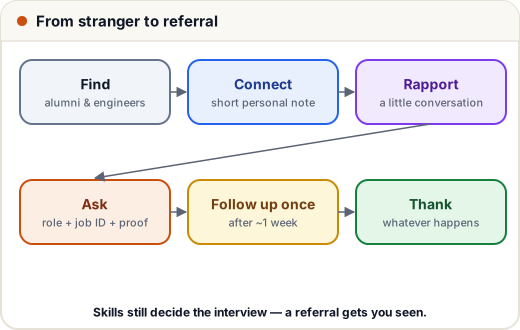
A referral doesn't replace skills — it gets your skills seen.
2. Who to reach out to (in order)
- Alumni of your college — the warmest cold contact. On LinkedIn: search the company → People → filter by your school.
- People one or two years ahead of you — they remember the process and are more likely to reply than senior managers.
- Engineers in the team you're applying to (not HR, not the CEO).
- People you met at hackathons, meetups, conferences, open-source projects, Discord/Slack communities.
- Second-degree connections — ask a mutual connection for an introduction.
3. The connection note (300 characters)
Keep it short, specific and about them first:
Hi Ankit, I'm a final-year CSE student at JECRC — saw your post on migrating your team's service to Spring Boot 3. I'm building a Spring Boot project myself and would love to follow your work. Thanks!
No resume, no "please refer me" in the first message. Many people won't accept a stranger who asks for a favour in line one.
4. The referral request
After they've accepted (and ideally after a short exchange), ask clearly and make it easy to say yes:
Hi Ankit, thanks for connecting! I'm applying for Software Engineer – Graduate (Job ID 48213) at Acme. I've solved 300+ DSA problems and built a booking app with Spring Boot + PostgreSQL that 150 students use (live link). Would you be open to referring me? I've attached my resume and a 3-line summary below — happy to share anything else.
Summary: Final-year B.Tech CSE, 8.4 CGPA · Spring Boot, React, PostgreSQL, Docker · Project: mess-feedback.app (180 users), 46 tests, CI
Why it works:
- exact role and job ID (they can submit it in two minutes)
- proof (numbers, links) so they're not risking their reputation
- a ready-made summary they can paste into the referral form
- a polite, no-pressure tone
5. Follow up — once
If there's no reply in 5–7 days, one short follow-up is fine:
Hi Ankit, just following up on my note about the Graduate SE role (48213). Totally understand if you're busy — thanks either way!
Then move on. People are busy; silence isn't rejection. Never send daily messages, voice calls or "sir please reply".
6. Build a network before you need it
The best time to network is before you need a job:
- Post about what you learn and build (a short weekly post: "Built X, learned Y, here's a screenshot").
- Comment thoughtfully on engineers' posts (not "great post!" — add something).
- Join communities: college coding clubs, Google Developer Groups, Women Techmakers, open-source projects, Skills101's WhatsApp group.
- Hackathons and contests — you meet engineers, and some companies hire directly from leaderboards.
- Help others — share notes, answer questions, refer juniors once you're in. Networks run on generosity.
7. Track your outreach
A simple sheet keeps you organised and stops you from messaging the same person twice:
| Name | Company | Role applied | Connected on | Asked on | Status | Next step |
|---|---|---|---|---|---|---|
| Ankit S. | Acme | Graduate SE (48213) | 2 Nov | 5 Nov | referred | wait for HR |
| Neha R. | Beta Labs | SDE-1 (A-77) | 3 Nov | — | chatting | ask after project demo |
Aim for 5–10 thoughtful new connections a week rather than 100 copy-paste requests.
8. Mistakes that get you ignored
- "Hi" / "Hello sir" with nothing else.
- Asking for a referral without a job ID or resume.
- Copy-pasting the same message with the wrong name or company.
- Asking someone to "find a job for me".
- Lying or exaggerating in the summary — they may be asked about you.
- Getting upset at no reply.
9. After you're referred
- Prepare as if there were no referral — interviews are the same.
- Tell your referrer how it went, and thank them regardless of the outcome.
- Once you're employed, refer others and reply to the juniors who message you. That's how your network compounds.
Common mistakes
- Waiting until final semester to start networking.
- Messaging only HR and senior leaders instead of engineers and alumni.
- Sending resumes in the first message to strangers.
- Following up too often.
Quick recap
- Referrals get your resume seen by humans; skills still decide the outcome.
- Reach alumni and engineers a year or two ahead; start with a short personal note.
- Ask with role + job ID + proof + a ready summary; follow up once after a week.
- Build your network early: posts, communities, hackathons, helping others. Track outreach.