Interview & Career · Lesson 9 of 12 · Updated ·
Portfolio Projects That Get You Hired — What to Build, How Deep to Go and How to Present It
For a fresher with no work experience, projects are your experience. A recruiter spends seconds on a resume; a hiring manager spends minutes on a project link. This lesson shows how to make those minutes count.
1. Two deep projects beat ten tutorials
Interviewers have seen thousands of to-do apps, weather apps and Netflix clones copied from YouTube. They can't tell what you did. What stands out:
| Weak signal | Strong signal |
|---|---|
| followed a tutorial step by step | solved a real problem someone actually has |
| 10 small unfinished repos | 2–3 finished, deployed projects |
| only the happy path works | handles errors, edge cases, empty states |
| no tests, no README | tests, CI, clear README with screenshots |
| "I built a full-stack app" | "120 students in my hostel use it daily" |
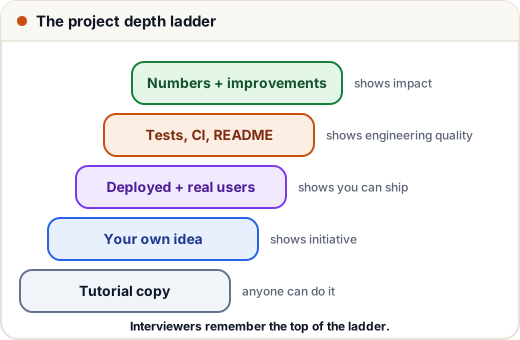
2. Find a real problem
The best projects start with people you know:
- College: attendance tracker for a society, mess feedback, event registration with QR check-in, lost-and-found, previous-year paper search.
- Family or local business: billing and stock for a kirana shop, appointment booking for a clinic, WhatsApp order catalogue for a home baker.
- Yourself: a study planner, expense splitter for trips, placement-prep tracker.
Real users give you real requirements, bugs and stories — "the canteen owner asked for a daily sales summary, so I added a scheduled report" is a great interview answer.
3. Ideas by target role
| Role | Strong project | What it proves |
|---|---|---|
| Full-stack web | event booking with payments (test mode), auth, admin panel | end-to-end product thinking |
| Backend (Java/Spring, Node, Python) | REST API with auth, pagination, caching, rate limits, tests, Docker | API design, databases, reliability |
| Data / ML | analysis of a public Indian dataset (e.g. data.gov.in) with a clear question and a dashboard | asking good questions, honest conclusions |
| AI engineering | document Q&A for college notes with retrieval, evaluation and cost limits | LLMs used responsibly |
| DevOps / cloud | your app with CI/CD, Docker, Terraform, monitoring and a runbook | operations skills |
| Testing / QA | automation framework (Selenium/Playwright + API tests) for an open-source app, running in CI | test design, reporting |
| Android / mobile | offline-first app with sync, published on the Play Store | shipping to real users |
Skills101's subject tracks each end with project ideas; the project showcase (/projects) lets you publish yours with a public page.
4. The depth checklist
Before calling a project "done", tick these:
- Deployed with a live link (Vercel, Render, Railway, a small VPS, or the Play Store)
- Authentication and authorisation done properly (not just a login screen)
- Validation and error handling — what happens with bad input, no internet, an empty list?
- Tests for the core logic, running in CI (GitHub Actions)
- Security basics — no secrets in the repo, hashed passwords, parameterised queries
- README with problem, screenshots, architecture, setup and decisions
- Numbers — users, response time, test coverage, data size
- One hard thing you can explain deeply (a tricky algorithm, a performance fix, a concurrency bug)
5. A README that sells
# Hostel Mess Feedback
Students rate each meal by scanning a QR code; the mess committee sees weekly trends.
**Live:** https://mess-feedback.example.app · **Demo video:** 90 seconds (link)

## Why
Complaints were lost in WhatsApp groups; the committee had no data. 180 students now submit
~400 ratings a week.
## How it works
React + Spring Boot + PostgreSQL. Ratings are aggregated nightly; the dashboard is cached for 5 minutes.
(architecture diagram)
## Decisions & trade-offs
- One rating per student per meal, enforced by a unique index (prevents spam).
- Chose server-side aggregation over live queries after the dashboard took 3 s with 10k rows (now 120 ms).
## Run locally
docker compose up · open http://localhost:3000 · seed data: `npm run seed`
## Tests
`./mvnw test` — 46 tests, CI on every push.
The "Decisions & trade-offs" section is what separates engineers from tutorial followers.
6. Demo and presentation
- Record a 60–120 second demo video (screen recording with voice): the problem, the main flow, one clever detail.
- Pin your best 2–3 repos on GitHub; add the live link and video to your resume, LinkedIn Featured section and Skills101 profile.
- Keep a short build log (or LinkedIn posts) — "Week 3: cut dashboard load from 3 s to 120 ms by…" doubles as networking content.
7. Talking about it in interviews
Prepare a 2-minute walkthrough using this structure:
- Problem and who uses it
- Architecture (draw it: client, API, database, external services)
- Your hardest problem and how you solved it (with numbers)
- What you'd do differently or next (shows maturity)
Expect follow-ups: "Why PostgreSQL and not MongoDB?", "What happens if two people book the last seat at once?", "How would this handle 100× users?" If you used AI tools, say how — and show you understand and tested every part (see the AI Coding Assistants track).
Common mistakes
- Many half-finished projects instead of a few finished ones.
- Copying a tutorial and listing it as your own work.
- No live link, or a link that's broken on interview day (check it the day before).
- Committing API keys or
.envfiles. - A README that just says "npm install, npm start".
Quick recap
- Depth beats breadth: 2–3 finished, deployed, tested projects.
- Start from a real problem for real users; collect numbers.
- Use the depth checklist; write a README with decisions and trade-offs.
- Demo video + pinned repos + live link; practise a 2-minute walkthrough.