Interview & Career · Lesson 6 of 12 · Updated ·
Group Discussion (GD) Tips — How to Speak, Lead and Get Selected
Some companies and colleges use a group discussion (GD) to filter candidates: 8–12 people discuss a topic for 10–15 minutes while evaluators watch. It's not a debate to "win" — it's a test of how you think and work with others.
1. What evaluators score
| Skill | Shown by |
|---|---|
| Content | relevant points, facts, examples |
| Communication | clear, concise, audible; simple English is fine |
| Listening | building on others' points |
| Leadership | starting, structuring, bringing the group back on track |
| Teamwork | including others, staying calm, no personal attacks |
Speaking the most isn't the goal; speaking well, 3–5 times, is.
2. A simple game plan
- First minute: note 4–5 points on paper — for, against, examples, numbers.
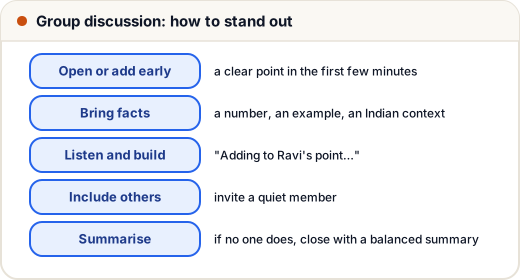
- Enter early (in the first 2–3 minutes) with a clear point or a definition of the topic.
- Add new angles: economic, social, technical, rural vs urban India, students.
- Use facts: "India has over 90 crore internet users…" (only if you're sure).
- Summarise at the end if the evaluator asks or nobody else does: both sides + a balanced conclusion.
3. Useful phrases
- Agreeing and adding: "I agree with Neha, and I'd like to add…"
- Polite disagreement: "I see it a little differently…" / "That's valid in cities, but in rural areas…"
- Getting in: "Can I add a point here?"
- Including others: "Ravi, we haven't heard your view yet."
- Back on track: "Let's come back to the main question — should…?"
4. When the group gets loud
- Don't shout over people. Wait for a pause, then speak clearly and slightly slower.
- Make short points — long speeches get interrupted.
- Calmly restructuring the discussion ("we've covered benefits; shall we discuss risks?") shows leadership.
5. Common GD topics
- AI: job creator or job killer?
- Work from home vs office.
- Should coding be taught from school?
- Online education vs classroom learning.
- UPI and digital payments — boon or risk?
- Social media: more harm than good for students?
- Electric vehicles in India: ready or not?
For each, prepare: 2 points for, 2 against, 1 Indian example, 1 balanced conclusion.
Common mistakes
- Staying silent (the most common reason for rejection).
- Aggression, interrupting repeatedly, personal comments.
- Made-up statistics.
- Repeating what others said without adding anything.
Quick recap
- Evaluators score content, communication, listening, leadership and teamwork.
- Enter early, add new angles with facts, include others, summarise.
- Disagree politely; keep points short in noisy groups.
- Prepare common topics: for, against, Indian example, conclusion.