Java Programming · Lesson 15 of 15 · Updated ·
Top Java Interview Questions for Freshers — With Short, Correct Answers
Use this page to revise before interviews. Each answer is short enough to say in 30 seconds — then explain more if the interviewer asks.
Basics
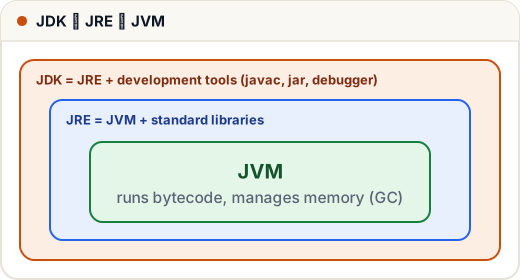
1. JDK vs JRE vs JVM? JVM runs bytecode; JRE = JVM + libraries (to run); JDK = JRE + tools like javac (to develop).
2. Why is Java platform-independent? javac produces bytecode, and every OS has a JVM that runs the same bytecode.
3. Why is main public static void? public — the JVM calls it from outside; static — no object exists yet; void — it returns nothing to the JVM.
4. Primitive vs wrapper? int stores a value; Integer is an object (needed in collections, can be null). Autoboxing converts between them.
5. Stack vs heap? Stack: method calls and local variables (one per thread). Heap: all objects (shared); cleaned by the garbage collector.
OOP
6. The four pillars? Encapsulation, Abstraction, Inheritance, Polymorphism.
7. Overloading vs overriding? Overloading: same name, different parameters, same class, compile time. Overriding: same signature in a subclass, runtime.
8. Abstract class vs interface? Abstract class: state + code, constructors, extend one. Interface: contract, default/static methods, constants, implement many.
9. Can we override a static method? No. A static method with the same signature in a subclass hides the parent's; it is not runtime polymorphism.
10. Can a constructor be private? Yes — used in the Singleton pattern and utility classes.
11. What is super / this? this = current object (or this(...) constructor chaining); super = parent's members or constructor.
Strings
12. Why are Strings immutable? Security, string-pool sharing, thread safety and safe hash keys.
13. == vs equals()? == compares references; equals() compares content.
public class Main {
    public static void main(String[] args) {
        String a = "skills", b = "skills", c = new String("skills");
        System.out.println((a == b) + " " + (a == c) + " " + a.equals(c));
    }
}
true false true
14. String vs StringBuilder vs StringBuffer? String immutable; StringBuilder mutable and fast; StringBuffer mutable and synchronized (slower).
Collections
15. ArrayList vs LinkedList? ArrayList: O(1) get, best default. LinkedList: O(1) insert/remove at known nodes, O(n) get.
16. How does HashMap work? hashCode → bucket index; collisions chained (tree after 8); equals finds the key; resizes at load factor 0.75; O(1) average.
17. Why override hashCode with equals? Equal objects must have equal hash codes, or hash collections can't find them.
18. HashMap vs ConcurrentHashMap? HashMap is not thread-safe; ConcurrentHashMap is safe and fast for concurrent use.
19. Comparable vs Comparator? Comparable: one natural order (compareTo) inside the class. Comparator: any number of external orders.
Exceptions
20. Checked vs unchecked? Checked (IOException) must be caught or declared; unchecked (RuntimeException) need not be.
21. final vs finally vs finalize? final — constant/no override/no extend; finally — always-run block; finalize — deprecated GC hook.
22. Can finally be skipped? Only if the JVM exits (System.exit) or crashes.
Java 8 and threads
23. What is a functional interface? An interface with exactly one abstract method; can be implemented with a lambda.
24. map vs flatMap? map transforms each element to one element; flatMap transforms each to a stream and flattens them.
import java.util.*;
import java.util.stream.*;

public class Main {
    public static void main(String[] args) {
        List<List<Integer>> nested = List.of(List.of(1, 2), List.of(3), List.of(4, 5));
        System.out.println(nested.stream().map(List::size).toList());
        System.out.println(nested.stream().flatMap(List::stream).toList());
    }
}
[2, 1, 2]
[1, 2, 3, 4, 5]
25. start() vs run()? start() creates a new thread; run() executes in the current thread.
How to answer well
- Give the one-line answer first.
- Add an example (a tiny code snippet or real use).
- Mention a trade-off or common mistake — that shows real understanding.
Common mistakes
- Memorising definitions without being able to give an example.
- Saying "Java is pass-by-reference" (it is always pass-by-value).
- Confusing
final,finallyandfinalize.
Quick recap
- Revise: JVM/JRE/JDK, OOP pillars, overloading vs overriding, String pool, HashMap internals, exceptions, Java 8.
- Answer short → example → trade-off.
- Practise coding problems in Java on the Skills101 judge.