Java Programming · Lesson 5 of 15 · Updated ·
Strings in Java — Immutability, String Pool, equals() and StringBuilder
String is the most used class in Java. Two facts explain most String questions in interviews: strings are immutable, and literals are shared in a string pool.
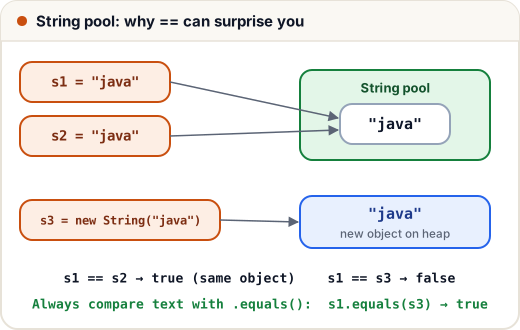
1. == vs equals() and the string pool
public class Main {
    public static void main(String[] args) {
        String s1 = "java";
        String s2 = "java";
        String s3 = new String("java");
        System.out.println(s1 == s2);
        System.out.println(s1 == s3);
        System.out.println(s1.equals(s3));
        System.out.println("JAVA".equalsIgnoreCase(s1));
    }
}
true
false
true
true
==checks if two variables point to the same object..equals()checks if the text is the same. Always use.equals()for strings.
2. Strings are immutable
A String can never change. Methods like toUpperCase() return a new String.
public class Main {
    public static void main(String[] args) {
        String s = "hello";
        s.toUpperCase();          // result thrown away
        System.out.println(s);
        s = s.toUpperCase();      // keep the new string
        System.out.println(s);
    }
}
hello
HELLO
Why immutable? Safety (strings are used for passwords, file paths, class names), the string pool can share them, and they are thread-safe.
3. Most-used methods
public class Main {
    public static void main(String[] args) {
        String t = "  Skills101 Java Course  ".trim();
        System.out.println(t.length());
        System.out.println(t.charAt(0) + " " + t.indexOf("Java") + " " + t.contains("Course"));
        System.out.println(t.substring(10, 14));
        System.out.println(t.replace("Java", "Python"));
        System.out.println(t.toLowerCase().startsWith("skills"));
        String[] parts = "a,b,c".split(",");
        System.out.println(parts.length + " " + String.join("-", parts));
        System.out.println("apple".compareTo("banana") < 0);
    }
}
21
S 10 true
Java
Skills101 Python Course
true
3 a-b-c
true
substring(start, end)— end is excluded (like Python slicing).compareToreturns negative / 0 / positive for alphabetical order.
4. StringBuilder: build strings fast
Because Strings are immutable, s = s + x in a loop creates a new object every time. Use StringBuilder instead.
public class Main {
    public static void main(String[] args) {
        StringBuilder sb = new StringBuilder();
        for (int i = 1; i <= 5; i++) {
            sb.append(i).append(",");
        }
        sb.setLength(sb.length() - 1);     // remove last comma
        System.out.println(sb);
        System.out.println(new StringBuilder("racecar").reverse());
        sb.insert(0, "[").append("]");
        System.out.println(sb.toString());
    }
}
1,2,3,4,5
racecar
[1,2,3,4,5]
| String | StringBuilder | StringBuffer | |
|---|---|---|---|
| Changeable? | no | yes | yes |
| Thread-safe? | yes (immutable) | no | yes (synchronized) |
| Speed | slow to modify | fastest | slower |
5. Interview programs
Palindrome
public class Main {
    static boolean isPalindrome(String s) {
        s = s.toLowerCase().replaceAll("[^a-z0-9]", "");
        int l = 0, r = s.length() - 1;
        while (l < r) {
            if (s.charAt(l++) != s.charAt(r--)) return false;
        }
        return true;
    }
    public static void main(String[] args) {
        System.out.println(isPalindrome("Madam") + " " + isPalindrome("A man, a plan, a canal: Panama") + " " + isPalindrome("Java"));
    }
}
true true false
Count character frequency
public class Main {
    public static void main(String[] args) {
        String s = "programming";
        int[] freq = new int[26];
        for (char c : s.toCharArray()) freq[c - 'a']++;
        for (int i = 0; i < 26; i++) {
            if (freq[i] > 1) System.out.print((char) ('a' + i) + "=" + freq[i] + " ");
        }
        System.out.println();
    }
}
g=2 m=2 r=2
Common mistakes
- Comparing strings with
==. - Calling a method and ignoring the returned new string.
- Building strings with
+inside big loops.
Quick recap
==compares references;.equals()compares text.- Literals share the string pool;
new Stringmakes a new object. - Strings are immutable; use StringBuilder to build them.
substring(start, end)excludes end.