AdvancedLogical Reasoning · Lesson 23 of 24 · Updated ·
Strong and Weak Arguments — How to Judge a Reason Quickly
In this question type you get a statement that is usually a yes-or-no question about a public issue, such as "Should mobile phones be banned in colleges?". Two arguments follow, often one starting with Yes and one with No. You must decide which arguments are strong.
An argument is a reason given to support an answer. A strong argument is important and directly related to the question. A weak argument is minor, off the topic, or based on guesswork.
1. The answer options
Most tests use these five options (the wording may change a little):
| Option | Meaning |
|---|---|
| (a) | Only argument I is strong |
| (b) | Only argument II is strong |
| (c) | Either I or II is strong |
| (d) | Neither I nor II is strong |
| (e) | Both I and II are strong |
Option (c), "either I or II", is tricky. It is used when the two arguments are about the same point from opposite sides, and both are strong, so you would pick one depending on your choice. Many tests use (e) "both" for this case instead. Read the options of your test carefully.
2. The five checks for a strong argument
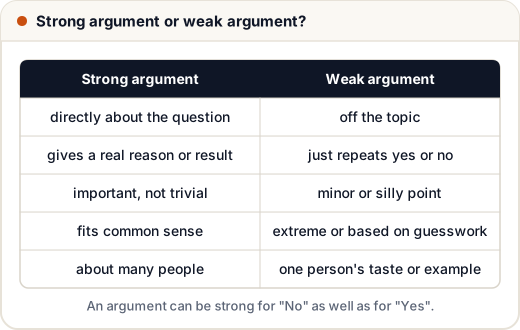
- On the topic. The argument must talk about the exact question asked, not a nearby issue.
- Gives a reason. "Yes, because it is good" only repeats the answer. A strong argument says why — what result or harm follows.
- Important. The reason should matter. Saving lives, education, health, safety, large sums of money and fairness are important. Convenience of a few people usually is not.
- Fits common sense. It should be true in general. Extreme claims ("this will end all crime") and pure guesses are weak.
- About many people. Arguments based on one person's taste ("I like it") or one example are weak.
Shortcut: ask "Would a sensible committee deciding this issue take this reason seriously?" If yes, it is strong.
3. Solved examples
Example 1
Should all colleges make 75% attendance compulsory? I. Yes. Regular attendance helps students follow lectures and learn better. II. No. Many students find morning lectures boring.
- I is on topic, gives a real reason (learning), and is important → strong.
- II is about some students' feelings, not about whether attendance helps → weak.
- Answer: Only I is strong.
Example 2
Should the government ban the sale of single-use plastic bags? I. Yes. These bags block drains and harm animals and the soil. II. No. Many small shopkeepers will need time and help to switch to other bags.
- I gives a real, important harm → strong.
- II gives a real, practical problem that affects many people → strong.
- Answer: Both I and II are strong. Notice that an argument for No can be strong too.
Example 3
Should India have only one official language? I. Yes. It will remove all differences between people. II. No. Other countries have more than one official language.
- I is extreme ("remove all differences") → weak.
- II only copies other countries; it does not say why it is better for India → weak.
- Answer: Neither I nor II is strong.
Example 4
Should online shopping websites be closed on Sundays? I. No. Many people shop online on Sundays because they work on other days. II. Yes. Sunday is a holiday, so everything should be closed.
- I gives a real reason affecting many buyers → strong.
- II states a rule that is not true in general (hospitals, buses and shops work on Sundays) and gives no benefit of closing → weak.
- Answer: Only I is strong.
4. Typical weak arguments to spot quickly
| Type | Example |
|---|---|
| Just repeats the answer | "Yes, it should be done because it is the right step." |
| Only about one person | "No, my uncle does not like it." |
| Copies others without reason | "Yes, America does it." |
| Extreme or impossible | "Yes, it will remove poverty completely." |
| Minor issue | "No, people will have to change their habits." |
| Off the topic | Talks about a related but different question. |
5. A step-by-step method
- Read the question and be clear about what exactly is being decided.
- Check each argument separately against the five checks. Do not compare them with each other first.
- Mark each one strong or weak.
- Map the result to the options. If both are strong and the test has an "either" option, check whether they argue about the same point from opposite sides.
Common mistakes
- Thinking a "No" argument is weak just because you personally support "Yes".
- Marking an argument strong because it is true, even though it is not about the question.
- Choosing "both" when one of the arguments is only about convenience or habit.
- Being fooled by big words. "It is our duty" with no real reason is still weak.
Quick recap
- A strong argument is on topic, gives a real reason, is important, fits common sense and concerns many people.
- Arguments for Yes and for No can both be strong.
- Extreme claims, personal taste, copying other countries and repeating the answer are weak.
- Judge each argument on its own, then pick the option.