AdvancedLogical Reasoning · Lesson 22 of 24 · Updated ·
Cause and Effect — Which Event Led to Which?
A cause is an event that makes another event happen. The event that happens because of it is the effect. In a cause-and-effect question you get two statements, A and B, and you must pick how they are related.
This is part of critical reasoning, along with the assumptions and conclusions you met earlier. Like those, it uses common sense about everyday life, not specialist facts.
1. The five standard answers
Most tests use the same five options (the wording can change a little):
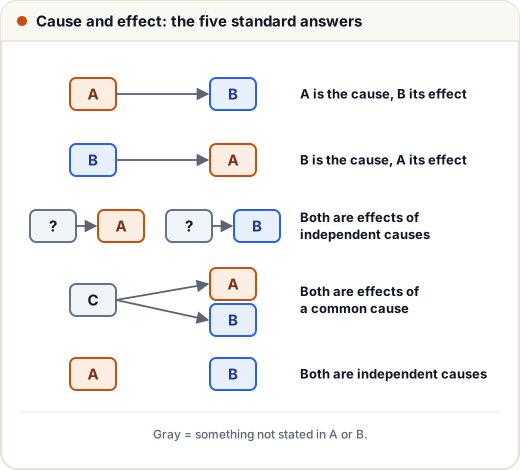
- A is the cause and B is its effect.
- B is the cause and A is its effect.
- Both A and B are effects of independent causes — two separate events, each with its own (unstated) reason.
- Both A and B are effects of some common cause — one unstated event led to both.
- Both A and B are independent causes — each could lead to something, but they are not linked to each other.
Option 5 is rare. Options 1, 2, 3 and 4 make up most answers.
2. Three tests for "A caused B"
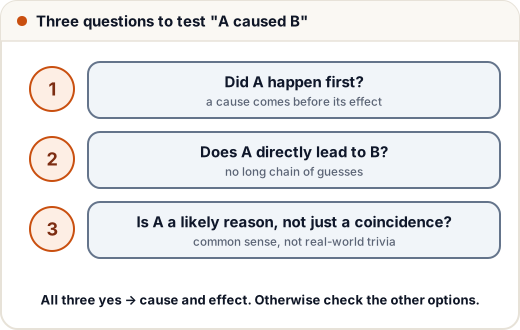
- Time order. A cause happens before its effect. A statement in the past tense, or one that describes a condition ("heavy rain for three days"), is often the cause.
- Direct link. You should be able to say "A, therefore B" in one step. If you need a long chain of guesses, it is not direct.
- Likely, not just possible. Would most sensible people agree A explains B?
The "therefore" test: read the two statements as "A, therefore B" and then "B, therefore A". The one that sounds natural shows the direction.
3. Solved examples
Example 1
A. The state received very heavy rain for a week. B. Several low-lying roads in the city were flooded.
"Heavy rain, therefore roads flooded" — natural, one step, rain came first. A is the cause, B is its effect.
Example 2
A. The company's online orders dropped sharply this month. B. The company's website was down for nine days this month.
"Website down, therefore orders dropped" is natural. "Orders dropped, therefore website down" is not. B is the cause, A is its effect.
Example 3 — common cause
A. Many schools in the district declared a holiday. B. Most shops in the district stayed closed.
Neither causes the other: schools closing doesn't shut shops, and shops closing doesn't shut schools. But one event — for example a cyclone warning or a bandh — could explain both. Both are effects of a common cause.
Signal: two "reaction" events in the same place at the same time, neither explaining the other → look for a common cause.
Example 4 — independent causes
A. The price of tomatoes rose sharply in Delhi. B. Train ticket bookings to Goa increased.
No link and no single event that explains both: tomato prices depend on crops and supply, Goa bookings on holidays. Both are effects of independent causes.
Example 5 — careful with time
A. The college has started free evening coding classes. B. Many final-year students failed the placement aptitude test last year.
B happened earlier ("last year"). Starting the classes looks like a response to B. B is the cause, A is its effect.
4. Immediate cause and principal cause
Some questions ask you to separate the immediate cause (the trigger, just before the effect) from the principal cause (the main, deeper reason).
Effect: A building collapsed.
- Immediate cause: a strong earthquake that morning.
- Principal cause: the building was built with poor materials and never inspected.
The earthquake triggered it, but poor construction is the main reason it fell when nearby buildings did not.
5. A quick decision path
- Does one statement explain the other directly? → option 1 or 2 (use the "therefore" test for direction).
- If not: are they two reactions to something that happened at the same place and time? → common cause.
- If not: are they simply two unrelated events? → independent causes.
Common mistakes
- Choosing the direction from the order the statements are printed. B can be the cause.
- Marking "common cause" for two events that are only both "bad news" but in different places and contexts.
- Using a long chain ("rain → farmers lose crops → less income → fewer phones sold") as a direct cause.
- Ignoring time words such as "last year", "after", "since".
Quick recap
- Five options: A → B, B → A, independent causes, common cause, independent causes of something else.
- A real cause comes first, leads directly, and is a likely reason.
- Use "A, therefore B" and "B, therefore A" to decide direction.
- Two reactions in one place and time, not explaining each other → common cause.