AdvancedLogical Reasoning · Lesson 18 of 24 · Updated ·
Advanced Seating — Two Rows Facing Each Other and Mixed-Facing Circles
The earlier seating lesson covered one row and a round table where everyone faces the centre. Harder puzzles add one more twist: two rows facing each other, or a round table where some people face outside. The method is the same — draw, place sure clues, branch on doubtful ones — but you must get left and right right for every single person.
1. Left and right: one table for every case
| Where the person is | Their right is | Their left is |
|---|---|---|
| Row facing north (away from you on paper) | your right | your left |
| Row facing south (towards you on paper) | your left | your right |
| Round table, facing the centre | anticlockwise | clockwise |
| Round table, facing outside | clockwise | anticlockwise |
Pen trick: put your pen on the person and point it the way they face. Turn the pen a quarter turn to the right — that is their right. It works for every case in the table.
2. Two parallel rows facing each other
Eight people sit in two rows of four. A, B, C, D sit in Row 1 facing south. P, Q, R, S sit in Row 2 facing north. So each person in Row 1 faces exactly one person in Row 2.
Clues:
- B sits at one end of Row 1.
- Q faces B.
- R sits second to the right of Q.
- S sits at one end of Row 2.
- A sits to the immediate right of C.
- The person who faces R sits to the immediate right of D.
Number the seats 1 to 4 from left to right as you look at the paper. Row 1 is drawn on top (facing down, south); Row 2 at the bottom (facing up, north).
Step 1 — clues 1 and 2. B is at seat 1 or seat 4 of Row 1, and Q is in the same seat in Row 2.
Step 2 — clue 3 decides the end. Row 2 faces north, so Q's right is your right. If Q were at seat 4, "second to the right" would be seat 6, which does not exist. So Q = seat 1, B = seat 1, and R = seat 3.
Step 3 — clue 4. Seat 1 of Row 2 is taken, so S = seat 4. The last person, P = seat 2.
Step 4 — clue 6. The person facing R is in Row 1, seat 3. Row 1 faces south, so a person's right is your left. "Immediate right of D" means one seat to your left of D. So D is at seat 4 and the person facing R (seat 3) is to D's right. D = seat 4.
Step 5 — clue 5. A and C take seats 2 and 3. A is to C's immediate right, which in Row 1 means one seat to your left. So C = seat 3, A = seat 2.
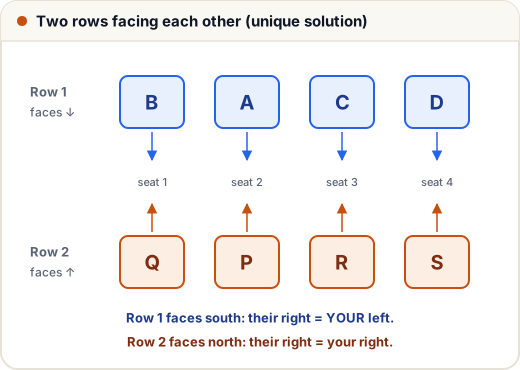
Final arrangement: Row 1: B A C D (facing south); Row 2: Q P R S (facing north). Every clue checks out, and no other arrangement fits all six clues (we confirmed this by testing all 576 possible orders).
Questions you can now answer:
- Who faces A? → P.
- Who is to the immediate left of C? C faces south, so left = your right → D.
- Who is second to the left of R? R faces north, so left = your left → Q.
3. A round table with mixed facing
Six friends K, L, M, N, O, P sit around a round table. Some face the centre and some face outside.
Clues:
- K faces the centre. L sits opposite K.
- M sits to the immediate left of K.
- M faces outside. N sits to the immediate right of M.
- L faces the centre. O sits to the immediate left of L.
- P sits to the immediate left of O.
- N faces the same direction as M, and P faces the same direction as N.
Number the seats 1 to 6 clockwise.
Step 1. K = seat 1 (facing centre). Opposite in a 6-seat table is 3 seats away → L = seat 4.
Step 2. K faces the centre, so K's left is clockwise → M = seat 2.
Step 3. M faces outside, so M's right is clockwise → N = seat 3.
Step 4. L faces the centre, so L's left is clockwise → O = seat 5. Only seat 6 is left → P = seat 6.
Step 5 — clue 5 tells us which way O faces. P (seat 6) must be O's immediate left. If O faced the centre, O's left would be clockwise = seat 6 ✓. If O faced outside, O's left would be anticlockwise = seat 4, which is L ✗. So O faces the centre.
Step 6. N faces outside (same as M), and P faces outside (same as N).
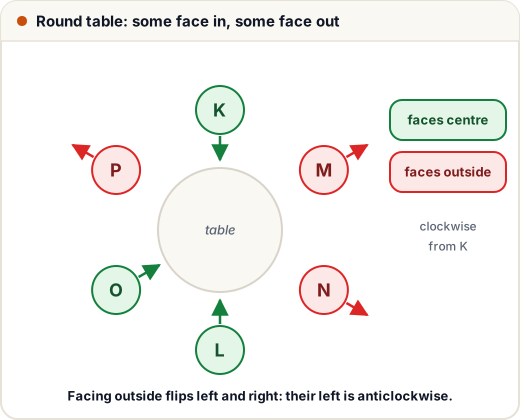
Final: clockwise K (in), M (out), N (out), L (in), O (in), P (out). We checked all 7,680 possible seatings and facings: only this one satisfies every clue.
Questions:
- Who sits to the immediate right of P? P faces outside, so right = clockwise → seat 1 → K.
- Who is second to the right of K? K faces the centre, so right = anticlockwise: seat 6, then seat 5 → O.
- How many people face outside? M, N, P → 3.
4. Habits that save time
- Draw the seats before reading clue 1. Mark each person's facing with a small arrow as soon as you know it.
- In parallel rows, write "R1 ↓" and "R2 ↑" next to the rows so you never forget which way each row faces.
- A clue like "X is second to the right of Y" can rule out an end seat — always check whether the seat exists.
- Facing clues often come last. Use them to decide between two cases, as clue 5 did above.
Common mistakes
- Using your own left and right for a row that faces south.
- Assuming everyone at a round table faces the centre.
- Forgetting that "opposite" in a parallel-row puzzle means the person you face, not the far end of your own row.
- Deciding a person's facing too early, before a clue actually fixes it.
Quick recap
- Facing south or facing outside → left and right flip.
- Parallel rows: each person faces the person in the same seat of the other row.
- Use "second to the right/left" clues to rule out end seats.
- Facing clues: test both directions and keep the one that fits.