AdvancedLogical Reasoning · Lesson 17 of 17 · Updated ·
Advanced Coding-Decoding — Mixed Shifts, Matrix Codes and Conditional Codes
The first coding-decoding lesson covered simple shifts, opposite letters, reversing and sentence codes. Placement tests also use mixed rules, where two simple ideas are combined. The method stays the same: write the positions, compare, and test your rule on every letter.
| Letter | A | B | C | D | E | F | G | H | I | J | K | L | M |
|---|---|---|---|---|---|---|---|---|---|---|---|---|---|
| Position | 1 | 2 | 3 | 4 | 5 | 6 | 7 | 8 | 9 | 10 | 11 | 12 | 13 |
| Letter | N | O | P | Q | R | S | T | U | V | W | X | Y | Z |
| Position | 14 | 15 | 16 | 17 | 18 | 19 | 20 | 21 | 22 | 23 | 24 | 25 | 26 |
1. Different shifts for odd and even places
Example 1
If SMART is coded as TLBQU, how is PLANT coded?
| Letter | S | M | A | R | T |
|---|---|---|---|---|---|
| Code | T | L | B | Q | U |
| Change | +1 | −1 | +1 | −1 | +1 |
Letters in odd places (1st, 3rd, 5th) move +1; letters in even places move −1.
PLANT → P+1 = Q, L−1 = K, A+1 = B, N−1 = M, T+1 = U → QKBMU.
If the changes look random (+1, −1, +1…), look at positions in the word, not positions in the alphabet.
2. Reverse, then shift
Example 2
If CODE is coded as GFQE, how is LOOP coded?
Compare directly: C→G is +4, O→F is −9. No pattern. Now reverse CODE → EDOC and compare again:
E→G (+2), D→F (+2), O→Q (+2), C→E (+2). The rule is reverse, then +2.
LOOP → reversed POOL → +2 → RQQN.
When a direct comparison gives no pattern, try the reversed word. Many "hard" codes are just two easy steps.
3. Letter → number codes
Example 3
If CAB is written as 624, how is FED written?
C = 3 → 6, A = 1 → 2, B = 2 → 4. Each letter becomes twice its position.
F = 6 → 12, E = 5 → 10, D = 4 → 8 → 12108.
Other number rules to try, in this order: the position itself, position × 2, the opposite position (27 − n), the sum of positions, and the square of positions.
4. Matrix (grid) codes
Some questions place letters in a grid and code each letter by its row number and column number.
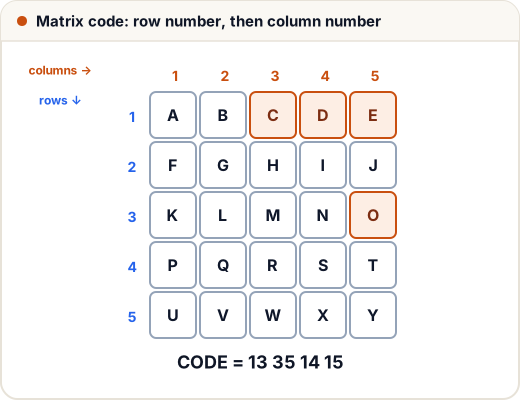
The letters A to Y fill the grid row by row (Z is left out to fit 25 boxes). A letter's code is row first, then column.
Example 4
Code CODE using the grid. C = 13, O = 35, D = 14, E = 15 → 13 35 14 15.
Example 5 — decode
Which word is 45 15 11 33? Row 4 column 5 = T, 15 = E, 11 = A, 33 = M → TEAM.
In exam versions, each letter can often be written by more than one code (two grids, or the same letter in two cells). Then check each option one letter at a time and reject an option as soon as one code does not match.
5. Conditional (symbol) codes
Here each letter has a fixed code, but conditions can change the first and last codes. These are common in AMCAT-style and bank-style tests.
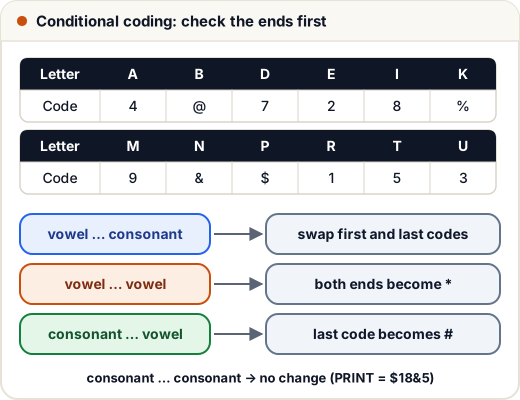
Conditions:
- If the first letter is a vowel and the last is a consonant, their codes are swapped.
- If the first and last letters are both vowels, both are coded as
*. - If the first letter is a consonant and the last is a vowel, the last is coded as #.
Check the conditions before writing the code, in order.
Example 6 — MATRE
First M (consonant), last E (vowel) → condition 3. Codes: M 9, A 4, T 5, R 1, then E becomes # → 9451#.
Example 7 — EKPDR
First E (vowel), last R (consonant) → condition 1. Plain codes: 2 % $ 7 1. Swap first and last → 1%$72.
Example 8 — UNKTE
First U and last E are both vowels → condition 2. Codes: U → *, N &, K %, T 5, E → * → *&%5*.
Example 9 — PRINT
First P and last T are both consonants → no condition applies → $18&5.
6. Three-sentence codes
With three coded sentences, use every pair of sentences.
"cloud data is secure" → "la ri po ne" "secure your data now" → "ne ka ri tu" "now is the time" → "tu po zo mi"
- Sentences 1 and 2 share data, secure and the codes ri, ne.
- Sentences 1 and 3 share is and the code po → is = po.
- Sentence 1 has four codes: ri, ne (data, secure), po (is) → cloud = la.
- Sentences 2 and 3 share now and tu → now = tu, so your = ka.
- the and time are zo and mi, but nothing tells us which is which → cannot be determined.
Common mistakes
- Testing a rule on the first two letters only. Check every letter.
- Forgetting to try the reversed word.
- Applying a condition without checking whether the first and last letters are vowels or consonants.
- In matrix codes, reading column first. The usual order is row, then column.
Quick recap
- Changes like +1, −1, +1 → think odd/even places in the word.
- No pattern? Reverse the word and compare again.
- Number codes: position, × 2, 27 − n, sum, square.
- Matrix codes: row then column.
- Conditional codes: check the conditions in order before you code.