AdvancedLogical Reasoning · Lesson 16 of 17 · Updated ·
Logical Venn Diagrams — Match Classes to Circles and Count Regions
A logical Venn diagram question gives three groups (called classes), such as India, Delhi, Asia, and asks which picture of circles shows how they are related. A second kind gives a diagram with numbers in it and asks you to count people in certain parts.
The syllogism lesson used circles to test conclusions. Here the circles describe real-world groups, so — unlike syllogisms — you do use common knowledge.
1. Two classes: only three possibilities
| Relation | Picture | Example |
|---|---|---|
| One is part of the other | small circle inside the big one | Roses, Flowers |
| They share some members | two overlapping circles | Doctors, Women |
| They have nothing in common | two separate circles | Cats, Chairs |
To decide, ask two questions:
- Is every X also a Y? If yes, X goes inside Y.
- Can something be both X and Y? If yes (and neither is inside the other), they overlap. If no, they are separate.
2. Three classes: six common patterns
Work pair by pair: there are only three pairs in three classes. Decide each pair with the two questions, then pick the picture that matches all three.
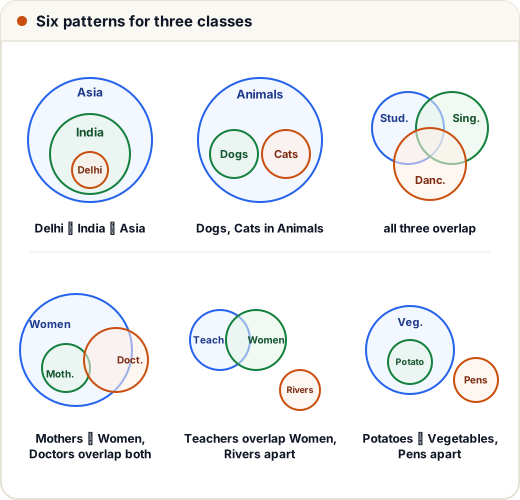
Example 1 — Women, Mothers, Doctors
- Women and Mothers: every mother is a woman → Mothers inside Women.
- Women and Doctors: some women are doctors, some doctors are men → overlap.
- Mothers and Doctors: some mothers are doctors → overlap.
So Mothers sits inside Women, and the Doctors circle cuts across both, while also going outside Women (male doctors). That is the fourth pattern in the picture.
Example 2 — Hindi, English, Languages
- Hindi is a language, English is a language → both inside Languages.
- Is anything both Hindi and English? No — they are different languages → separate.
Pattern: two separate circles inside one big circle (like Dogs, Cats, Animals).
Example 3 — Engineers, Graduates, Indians
- Engineers and Graduates: most engineers are graduates, but a diploma engineer may not be one; many graduates are not engineers → overlap.
- Engineers and Indians: overlap. Graduates and Indians: overlap.
All three overlap. When every pair overlaps, choose the three-overlapping-circles picture.
Check the edges. Before you put X inside Y, try to think of one X that is not a Y. If you find one, it is an overlap, not "inside".
Example 4 — Nitrogen, Oxygen, Air
Nitrogen and oxygen are both parts of air and are different gases → two separate circles inside Air. (Questions like this treat "is part of" the same way as "is a kind of".)
3. Reading numbers from a diagram
The second type puts a number in every region. Each number counts only the people in that one region.
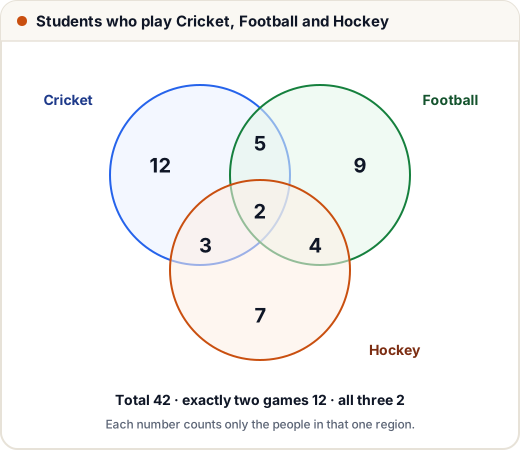
| Question | Regions to add | Answer |
|---|---|---|
| How many play cricket? | 12 + 5 + 3 + 2 | 22 |
| How many play only cricket? | 12 | 12 |
| How many play exactly two games? | 5 + 4 + 3 | 12 |
| How many play at least two games? | 5 + 4 + 3 + 2 | 14 |
| How many play exactly one game? | 12 + 9 + 7 | 28 |
| How many play cricket but not football? | 12 + 3 | 15 |
| How many play cricket and football? | 5 + 2 | 7 |
| How many students in total? | all seven regions | 42 |
The words matter:
- "Only X" — the part of X that touches no other circle.
- "Exactly two" — the three two-circle regions, not the centre.
- "At least two" — exactly two plus the centre.
- "X and Y" — the X–Y overlap including the centre (people who play all three also play X and Y).
Example 5 — check a total
"How many play football or hockey (or both)?"
Add every region that is inside either circle: 9 + 7 + 5 + 4 + 3 + 2 = 30. A quick check: total 42 minus "only cricket" 12 = 30 ✓.
Common mistakes
- Using "inside" when only some members belong. "Engineers inside Graduates" is wrong if even one engineer is not a graduate.
- Forgetting that two different things of the same kind (Hindi and English) are separate, not overlapping.
- Counting the centre in "exactly two".
- Leaving out the centre when the question says "X and Y".
Quick recap
- Decide every pair: inside, overlap or separate. Then pick the picture that fits all three pairs.
- Logical Venn questions use real-world knowledge, unlike syllogisms.
- Only X = X's own region; exactly two = the three two-circle parts; at least two = those plus the centre.
- Check totals by subtracting from the whole.