AdvancedLogical Reasoning · Lesson 15 of 17 · Updated ·
Inequalities — Direct, Coded and Either-Or Conclusions
An inequality question gives statements such as A > B ≥ C = D and asks which conclusions definitely follow. It is quick once you know three rules, and it appears in AMCAT-style and bank-style reasoning sections. (Not every company test includes it; it is still worth the 20 minutes it takes to learn.)
1. The signs
| Sign | Read as | Example meaning |
|---|---|---|
| A > B | A is greater than B | A = 7, B = 5 |
| A ≥ B | A is greater than or equal to B | A = 5, B = 5 is allowed |
| A = B | A equals B | |
| A < B | A is less than B | same as B > A |
| A ≤ B | A is less than or equal to B | same as B ≥ A |
A conclusion "follows" only if it is true for every set of values that fits the statements. If even one allowed set of values breaks it, it does not follow.
2. Rule 1 — combine along the chain
To compare two letters, walk from one to the other along the chain and look at the signs you pass.
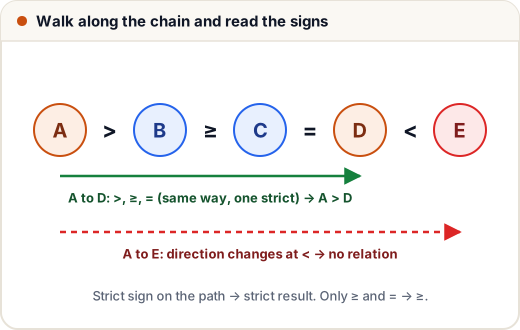
- If all the signs point the same way (only >, ≥ and =, or only <, ≤ and =), a relation exists.
- If there is at least one strict sign (> or <) on the path, the result is strict.
- If the path has only ≥ and =, the result is ≥. Only = signs → =.
Example 1
Statement: A > B ≥ C = D < E Conclusions: I. A > D II. E > C III. A > E
- I. A to D passes >, ≥, = — same direction, one strict sign → A > D. Follows.
- II. E to C: read the chain from the right. E > D = C → E > C. Follows.
- III. A to E passes >, ≥, = and then <. The direction changes, so there is no fixed relation. (A = 9, E = 10 and A = 9, E = 2 both fit.) Does not follow.
3. Rule 2 — opposite signs mean no relation
When the signs on the path point against each other, like B > C < D, C is smaller than both B and D, but B and D can be in any order. No conclusion between B and D follows.
Quick test: stand on the letter in the middle. If both neighbours are bigger (or both smaller), the two outer letters cannot be compared.
4. Combining two or more statements
Join statements at the common letter, then use Rule 1.
Example 2
Statements: M ≥ N, N > K, K = L Conclusions: I. M > L II. L < N
Join at N and K: M ≥ N > K = L.
- I. M to L passes ≥, >, = → one strict sign → M > L. Follows.
- II. N to L passes >, = → N > L, which is the same as L < N. Follows.
Both follow.
5. Rule 3 — "either I or II follows"
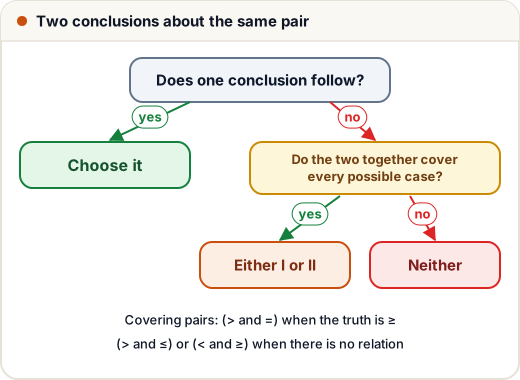
Sometimes neither conclusion follows alone, but one of the two must be true. Then the answer is "either I or II follows". This happens when:
- Both conclusions are about the same two letters,
- Neither follows alone, and
- Together they cover every possibility.
| The real relation is | Conclusion pair | Answer |
|---|---|---|
| P ≥ Q | I. P > Q, II. P = Q | Either I or II |
| P ≤ Q | I. P < Q, II. P = Q | Either I or II |
| no relation | I. P > Q, II. P ≤ Q | Either I or II |
| no relation | I. P < Q, II. P ≥ Q | Either I or II |
Example 3
Statement: P ≥ Q. Conclusions: I. P > Q II. P = Q
P could be bigger than Q, or equal to it. Neither is certain, but one of them must be true. Either I or II follows.
Example 4
Statements: J ≤ K < L, M > K. Conclusions: I. L > M II. L ≤ M
Join at K: J ≤ K < L and K < M. L and M are both bigger than K, so they cannot be compared (Rule 2). But "L > M" and "L ≤ M" together cover every case. Either I or II follows.
6. Coded inequalities
Some questions replace the signs with symbols. First decode, then solve as usual.
Let A @ B mean A ≥ B, A # B mean A > B, A $ B mean A = B, A % B mean A < B, A & B mean A ≤ B.
Example 5
Statements: R # S, S @ T, T $ U. Conclusions: I. R # U II. U % S
Decode: R > S, S ≥ T, T = U → R > S ≥ T = U.
- I. R # U means R > U. Path: >, ≥, = → strict → follows.
- II. U % S means U < S. Path from S to U: ≥, = → S ≥ U only. U could equal S, so U < S is not certain. Does not follow.
Answer: only I follows.
Write the decoded chain on paper. Decoding in your head is where most mistakes happen.
Common mistakes
- Treating ≥ as > (P ≥ Q does not give P > Q).
- Comparing letters across a change of direction (A > B < C does not give A > C).
- Marking "either-or" when the two conclusions are about different pairs of letters.
- Mixing up the symbol code. Decode every statement before you start.
Quick recap
- Walk along the chain: same direction → a relation; any change of direction → no relation.
- One strict sign on the path → strict result; only ≥ and = → ≥.
- Join multiple statements at the common letter.
- Either-or: same pair, neither follows alone, together they cover every case.