AdvancedLogical Reasoning · Lesson 19 of 24 · Updated ·
Floor and Box Puzzles — Buildings, Stacks and Two Attributes
In a floor puzzle, people live on different floors of a building. In a box puzzle, boxes are kept one above another in a stack. Both are a vertical line of positions, so the tools are the same: place sure clues, count gaps carefully, and split into cases when a clue allows two positions.
The first puzzles lesson used a simple tick-and-cross grid. These puzzles are bigger (6–8 items, sometimes with a second attribute such as a colour), so we use a case table instead.
1. Words you must read exactly
| Clue says | It means |
|---|---|
| X lives immediately above Y | X's floor = Y's floor + 1 |
| X lives above Y | X is higher, by any number of floors |
| Two people live between X and Y | the floor numbers differ by 3 |
| X lives on an even-numbered floor | 2, 4, 6… |
| Floor 1 is the bottom; the top floor is the highest number | (always check this in the question — some puzzles number from the top) |
Gap rule: "n people between X and Y" means the floor numbers differ by n + 1. Two people between → difference 3.
2. A seven-floor building with colours
Seven people A, B, C, D, E, F, G live on floors 1 (bottom) to 7 (top), one per floor. Each likes a different colour: red, blue, green, pink, white, black, yellow.
Clues:
- C lives on floor 4.
- Only two people live between C and E.
- E lives below C.
- B lives on an even-numbered floor below C.
- G lives immediately below C.
- A lives immediately above F, and D lives above A.
- The person who likes blue lives immediately above B.
- The person on the top floor likes black.
- E likes pink.
- The person who likes red lives immediately above the person who likes white.
- C does not like white, and B likes yellow.
Solving the floors
- Clue 1: C = 4.
- Clue 2: two people between → difference 3 → E = 1 or E = 7. Two cases.
- Clue 3: E is below C → E = 1. (The case E = 7 is gone.)
- Clue 4: B is on an even floor below 4 → floor 2 → B = 2.
- Clue 5: G = 3.
- Clue 6: floors 5, 6, 7 are left for A, D, F. A is immediately above F, and D is above A → F = 5, A = 6, D = 7.
Solving the colours
- Clue 7: blue is immediately above B (floor 2) → floor 3 → G likes blue.
- Clue 8: D (floor 7) likes black.
- Clue 9: E likes pink.
- Clue 10: red is immediately above white. The colours left are red, white, green, yellow, for A (6), F (5), C (4) and B (2). The possible pairs one floor apart are A–F (6–5) and F–C (5–4).
- Clue 11: C is not white, so the pair F–C fails → A likes red, F likes white. B likes yellow, so C likes green.
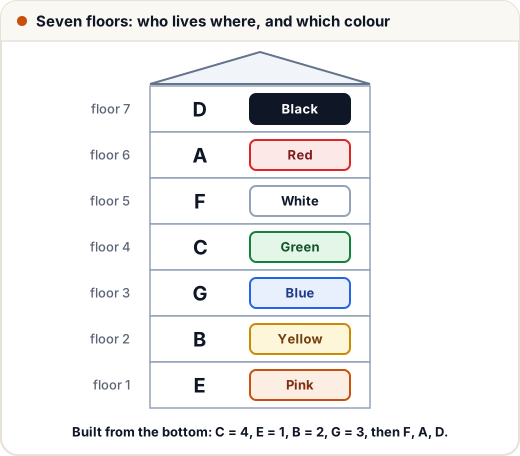
We checked this by testing every one of the 5,040 × 5,040 possible combinations of floors and colours: exactly one fits all eleven clues.
Typical questions:
- How many people live between B and A? Floors 3, 4, 5 → 3.
- Who likes green? → C.
- Who lives immediately below the person who likes white? White is F (5); floor 4 → C.
3. Box stacking — when you need two cases
Six boxes P, Q, R, S, T, U are kept one above another. Position 1 is the bottom and position 6 is the top.
Clues:
- Exactly two boxes are kept between P and S.
- Q is kept immediately above S.
- T is kept somewhere above Q.
- R is not at the bottom, and U is kept immediately above R.
- U is not at the top.
Step 1 — make the cases. Clue 1 allows many positions, so combine it with clue 2 and clue 3: S needs Q directly above it and T somewhere above Q, so S cannot be high in the stack. Try the lowest options:
- Case 1: P = 1, S = 4 → Q = 5 → T = 6. Left: positions 2 and 3 for R and U. R is not at the bottom and U is just above R → R = 2, U = 3.
- Case 2: S = 1, P = 4 → Q = 2 → T must be above 2. Left: 3, 5, 6 for R, T, U. U is just above R, so R and U take 5 and 6 → R = 5, U = 6, T = 3.
Other positions for P and S (for example P = 2, S = 5) leave no room for Q and T, so only these two cases survive clues 1–4.
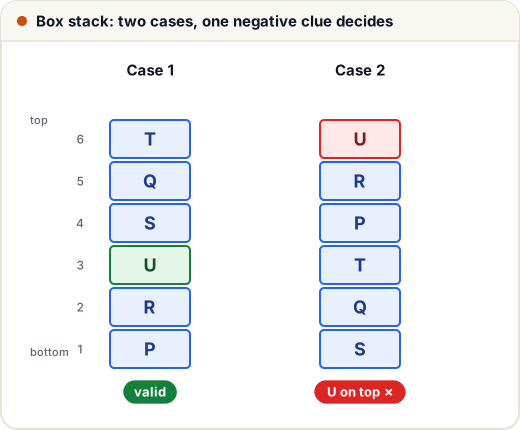
Step 2 — use the negative clue. Clue 5 says U is not at the top. Case 2 has U at the top → Case 2 is rejected.
Answer (bottom to top): P, R, U, S, Q, T.
Typical questions:
- How many boxes are between R and T? Positions 3, 4, 5 → 3.
- Which box is immediately below S? → U.
- Which box is at the bottom? → P.
4. How to write the case table
Write one column per case, with positions as rows (top position at the top of the page — it matches the building). Fill every case in parallel. As soon as a clue breaks a case, cross out the whole column. When only one column is left, you are done.
| Position | Case 1 | Case 2 |
|---|---|---|
| 6 (top) | T | U ✗ |
| 5 | Q | R |
| 4 | S | P |
| 3 | U | T |
| 2 | R | Q |
| 1 (bottom) | P | S |
Common mistakes
- Reading "two between" as a difference of 2. It is a difference of 3.
- Mixing up "above" and "immediately above".
- Writing floor 1 at the top of the page. Draw it like a real building — top floor at the top.
- Dropping a case too early. Keep both columns until a clue clearly breaks one.
Quick recap
- A floor or box puzzle is a vertical line: immediately above = +1, n between = difference n + 1.
- Place definite clues first, then clues linked to placed people.
- When a clue allows two places, make cases and fill them side by side.
- Negative clues ("not at the top", "does not like white") usually decide between cases.